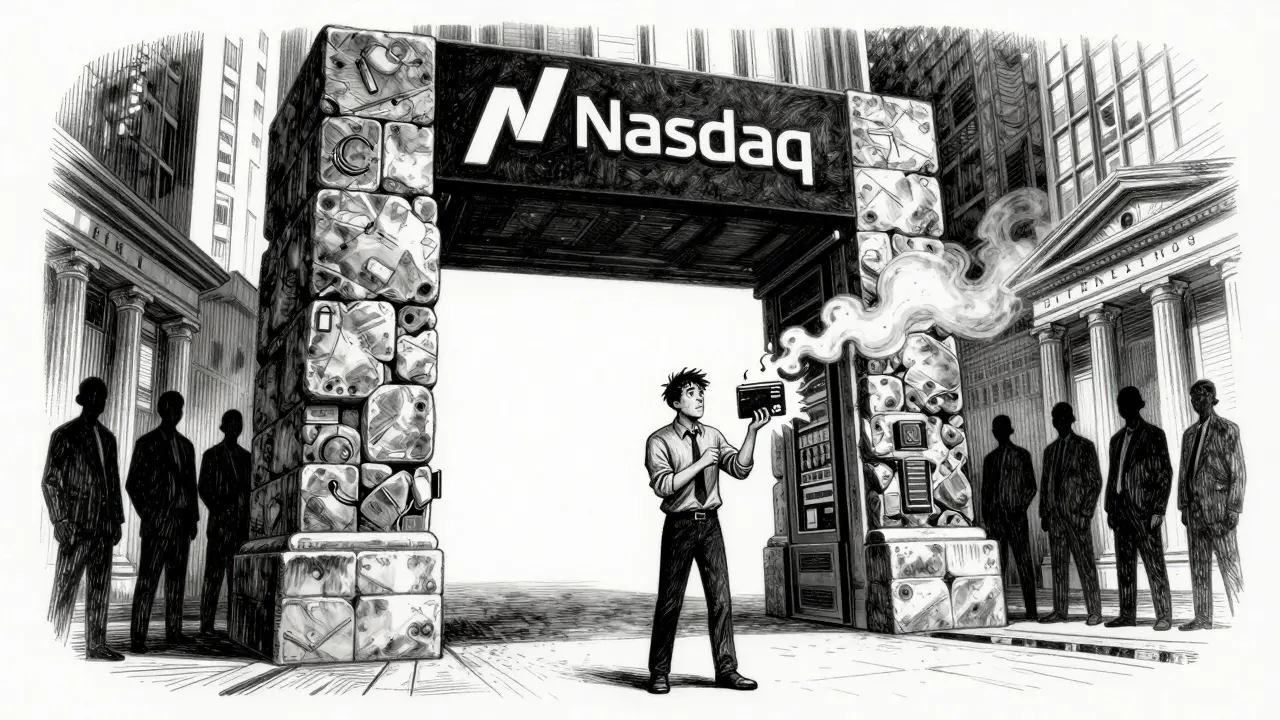
There is a major misunderstanding floating around the internet right now. Many people search for a "Nasdaq crypto exchange" expecting to find a platform where they can log in, deposit Bitcoin, and trade it directly against Ethereum. Here is the hard truth: Nasdaq does not operate a standalone cryptocurrency exchange like Coinbase, Binance, or Kraken. You cannot go to Nasdaq.com and buy spot Bitcoin.
So why are we talking about Nasdaq in crypto circles? Because Nasdaq has taken a different, highly strategic path. Instead of competing with retail traders on speed and fees, Nasdaq is bridging the gap between traditional finance (TradFi) and digital assets through regulated index products, data services, and upcoming tokenized securities. If you are an institutional investor or a conservative trader looking for regulated exposure, Nasdaq’s ecosystem might be exactly what you need. If you are a day trader looking for leverage on Solana, you will be disappointed.
The Reality Check: No Spot Trading
Let’s clear up the confusion immediately. When you hear "Nasdaq Crypto," you are likely hearing about one of two things: their proprietary indices or their proposed rules for tokenized securities. As of July 2026, Nasdaq remains a global technology company providing trading infrastructure for traditional stocks and bonds. They do not hold your private keys. They do not offer a wallet interface for native cryptocurrencies.
This distinction matters because it defines who this product is for. A platform like Coinbase processed $1.2 trillion in trading volume in Q4 2025. That is massive, direct user activity. Nasdaq’s role is upstream. They provide the metrics, the regulatory frameworks, and the financial products that allow banks and wealth managers to touch crypto without breaking compliance rules. Think of Nasdaq not as a store where you buy apples, but as the organization that sets the standards for how apples are graded and traded on the wholesale market.
The Core Product: Nasdaq Crypto Index (NCI)
If you want exposure to crypto via Nasdaq, you are likely looking at the Nasdaq Crypto Index, also known as NCI. This index was co-developed with Hashdex, a fintech firm specializing in crypto investment products. The NCI is not a place to trade; it is a benchmark.
The index uses a market-cap weighted methodology that is recalculated quarterly. It has strict eligibility criteria. To be included, a digital asset must be listed on regulated exchanges like SIX Swiss Exchange or Xetra. This filters out the chaotic, unregulated corners of the crypto market. As of December 2025, the composition of the NCI looked like this:
- Bitcoin (BTC): 74.47%
- Ethereum (ETH): 14.30%
- XRP: 6.27%
- Solana (SOL): 3.39%
- Cardano (ADA): 0.81%
- Chainlink (LINK): 0.42%
- Stellar (XLM): 0.33%
You can access this index primarily through the Hashdex Nasdaq Crypto Index ETF. By December 11, 2025, this ETF held $660 million in assets under management. For a traditional investor, this is huge. It means you can buy shares of this ETF through your existing brokerage account-like Fidelity or Schwab-without ever creating a crypto wallet or dealing with seed phrases.
| Feature | Nasdaq Ecosystem (NCI/ETF) | Crypto-Native Exchanges (Coinbase/Binance) |
|---|---|---|
| Trading Type | Indirect (via ETF/Index) | Direct Spot & Derivatives |
| Regulatory Framework | SEC/Traditional Securities Laws | Mixed/Varies by Jurisdiction |
| Asset Coverage | Top 7-10 Large Caps Only | Hundreds to Thousands of Tokens |
| Cost Structure | Expense Ratio (~0.95%) | Trading Fees (0.1% - 0.5%) |
| Target Audience | Institutions, Wealth Managers | Retail Traders, Degens |
| Custody | Third-party Custodians (e.g., BNY Mellon) | Exchange-Controlled Wallets |
The Future Play: Tokenized Securities
The real game-changer for Nasdaq isn’t just the index; it’s what they proposed to the Securities and Exchange Commission (SEC) on September 8, 2025. Nasdaq filed a rule change to enable the trading and settlement of tokenized securities on its traditional exchange platform.
What does this mean for you? Currently, when you buy a stock, it takes T+1 days to settle. With Nasdaq’s proposal, they aim to use distributed ledger technology (DLT) to settle these trades instantly while maintaining the T+1 cycle for regulatory compliance. The Depository Trust Company (DTC) is developing a system to convert positions into token form, delivering them to participants' blockchain wallets registered with DTC.
This is significant because it brings the efficiency of blockchain into the heavily regulated world of stocks and bonds. SEC Commissioner Hester Peirce signaled support for this direction in July 2025, noting that while markets should innovate, they must remain subject to federal securities laws. Nasdaq argues that tokenization can enhance liquidity and transparency without diluting core protections. If approved and implemented in Q2 2026 as projected, this could make Nasdaq the primary venue for institutional-grade digital asset trading in the US.

Pros and Cons: Who Should Use Nasdaq's Crypto Offerings?
Not every investor needs the Nasdaq approach. Let’s break down the advantages and disadvantages based on real-world usage data from late 2025.
The Pros:
- Regulatory Safety: You are operating within established securities laws. There is no fear of the exchange running away with your funds, a risk prevalent in unregulated crypto platforms.
- Simplicity: No need to manage private keys. Your broker handles custody. This reduces counterparty risk significantly for non-technical users.
- Institutional Grade Data: Nasdaq’s data products are rated highly for accuracy. Their Crypto Regulation Guide, updated in November 2025, addresses 37 distinct compliance scenarios, making it easier for advisors to recommend these products.
The Cons:
- High Costs: The Hashdex Nasdaq Crypto Index ETF carries an expense ratio of 0.95%. Compare this to spot Bitcoin ETFs charging around 0.25%, or direct exchange fees which can be fractions of a percent. Over time, this fee drag eats into returns.
- Limited Selection: You are stuck with the top 7-10 coins. If you believe in smaller altcoins or new launches, Nasdaq’s index won’t help you. It dilutes performance if Bitcoin outpaces the rest of the market.
- No Direct Control: You cannot move your assets off-platform. You own shares of an ETF, not the underlying Bitcoin. In a true crisis, this distinction can matter.
User Feedback and Market Sentiment
How do actual users feel about this setup? On professional forums like Seeking Alpha, institutional investors praised the ability to access crypto through traditional accounts. One advisor noted in December 2025 that using the Hashdex ETF reduced "counterparty risk concerns" compared to recommending clients open accounts on unknown offshore exchanges.
However, retail sentiment on Reddit’s r/etf community was more critical. Users pointed out that the 0.95% fee feels steep when Bitcoin is performing well. One user, "InstitutionalTrader88," commented that the multi-asset approach "dilutes Bitcoin's performance." This is a valid point. If you are bullish solely on Bitcoin, a diversified index holds you back. But if you want broad market exposure with less volatility, the index makes sense.
Trustpilot reviews for Nasdaq’s data products sit at a 4.1/5 rating, with users citing "excellent data quality" but noting a "steep learning curve" for newcomers. This reinforces the idea that Nasdaq’s crypto tools are built for professionals, not beginners.

Market Context: Where Does Nasdaq Fit in 2026?
The total crypto market cap crossed $4 trillion in 2025. Stablecoin supply exceeded $300 billion. The market is maturing. According to TRM Labs, institutional volume grew to represent 38% of total crypto volume in Q4 2025. Nasdaq is positioning itself squarely in this institutional segment.
Competitors like Coinbase dominate the retail space with 29% of U.S. trading volume. Kraken and Binance follow. But Nasdaq isn’t trying to beat them at their own game. They are building the rails for the next phase: regulated, tokenized securities. J.P. Morgan rated Nasdaq’s approach as having "high viability" in their December 2025 report, citing strong regulatory alignment.
However, risks remain. Legislation like the Boozman-Booker draft, which could grant the CFTC exclusive jurisdiction over spot digital commodities, might reshape the landscape. If that passes in 2026, it could limit the SEC’s power over certain crypto assets, potentially affecting Nasdaq’s strategy. For now, Nasdaq remains a "crypto-adjacent" player, as Messari described it, rather than a core participant in the wild west of decentralized finance.
Final Verdict
Is there a Nasdaq crypto exchange? No. Is there a valuable way to invest in crypto through Nasdaq? Yes, if you value regulation over convenience and cost-efficiency. The Nasdaq Crypto Index and its associated ETFs provide a safe, compliant bridge for traditional investors. For the average retail trader wanting to experiment with DeFi or trade obscure tokens, stick to Coinbase or Kraken. For the wealth manager needing to allocate client funds to digital assets without sleeping poorly at night, Nasdaq’s ecosystem is currently the gold standard.
Can I buy Bitcoin directly on the Nasdaq website?
No. Nasdaq does not operate a retail cryptocurrency exchange. You cannot create an account on Nasdaq to buy spot Bitcoin or Ethereum. You can only gain exposure to crypto through financial products like the Hashdex Nasdaq Crypto Index ETF, which you would purchase through a traditional brokerage account.
What is the difference between Nasdaq Crypto Index and a regular crypto exchange?
A regular crypto exchange allows you to trade hundreds of tokens directly, often with high risk and varying levels of regulation. The Nasdaq Crypto Index (NCI) is a benchmark that tracks only the top 7-10 largest cryptocurrencies that meet strict listing requirements on regulated exchanges. It is designed for stability and institutional compliance, not for speculative trading.
How much does it cost to invest in Nasdaq's crypto products?
The primary product, the Hashdex Nasdaq Crypto Index ETF, has an expense ratio of 0.95% annually. This is higher than many spot Bitcoin ETFs (around 0.25%) but includes the cost of managing a diversified basket of assets and ensuring regulatory compliance. There are no trading fees for buying the ETF shares, but your broker may charge standard commission fees.
What are tokenized securities on Nasdaq?
Tokenized securities are traditional financial assets, like stocks or bonds, that have been converted into digital tokens on a blockchain. Nasdaq proposed a rule change in September 2025 to allow these tokens to be traded and settled on its exchange. This aims to combine the speed of blockchain with the security of traditional regulations. Implementation is expected in mid-2026.
Is Nasdaq safer than Coinbase or Binance?
For traditional investors, yes. Nasdaq operates under strict U.S. securities laws and works with regulated custodians. This reduces the risk of fraud or insolvency compared to some offshore crypto exchanges. However, "safer" comes with trade-offs: you pay higher fees, have fewer asset choices, and do not have direct control over your private keys.