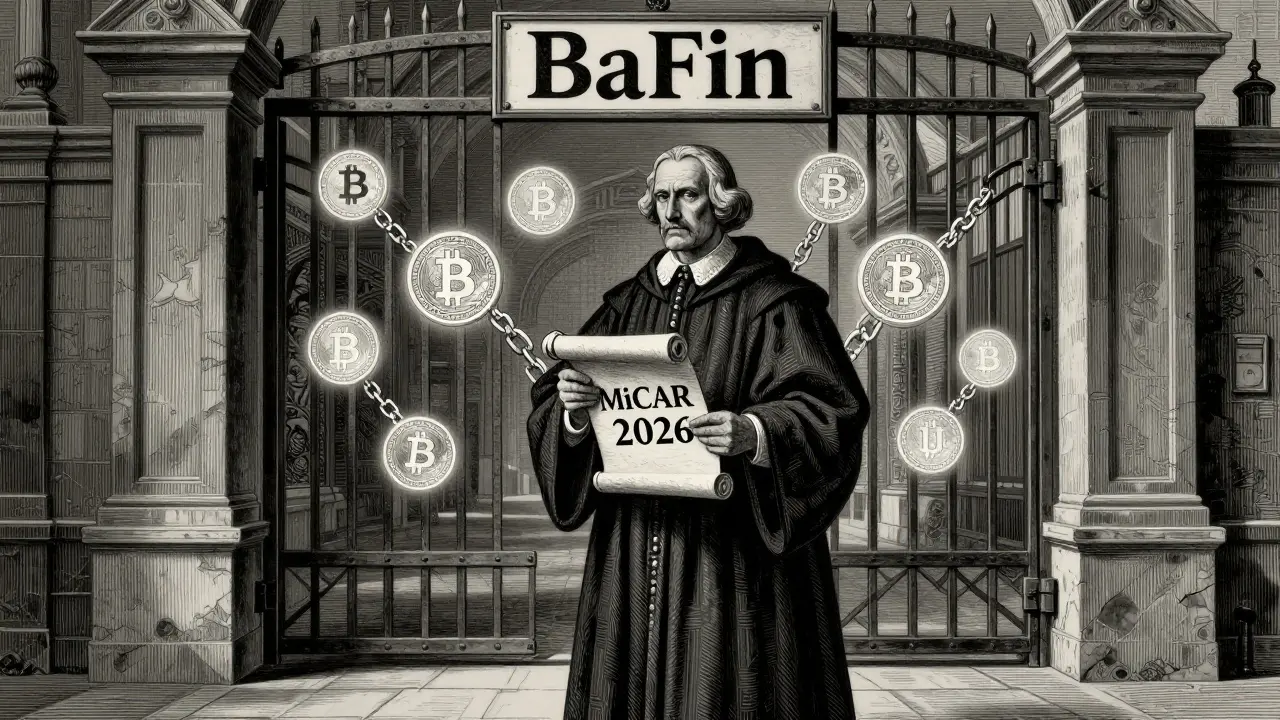
If you're running a crypto business in Germany or targeting German customers, you can't ignore BaFin. It’s not just another regulator-it’s the gatekeeper. Since 2013, when Germany officially recognized Bitcoin as a unit of account, the country has built one of the clearest, most rigorous crypto frameworks in Europe. And today, with MiCAR fully in force, BaFin’s rules are tighter than ever. Forget the wild west of crypto. In Germany, compliance isn’t optional-it’s the price of doing business.
What BaFin Actually Controls
BaFin doesn’t just watch crypto. It controls it. Under the German Banking Act (KWG), any crypto asset-whether it’s Bitcoin, a stablecoin like USDe, or a security token-is treated as a financial instrument. That means if your business does anything with those assets beyond simple buying or selling for personal use, you need BaFin’s permission.
Here’s what triggers a licensing requirement:
- Custody of crypto assets (holding keys for clients)
- Operating a crypto exchange platform
- Trading crypto as a business (even if you’re just buying and selling for profit)
- Running a mining pool that accepts external participants
- Providing staking services to customers
Simple transactions? Fine. If you run a bakery and take Bitcoin for bread, no license needed. But if you use a payment processor that converts that Bitcoin to euros and doesn’t have a BaFin license? You’re at risk. BaFin can come after you, even if you didn’t directly break the rules. The regulator looks at the whole chain.
MiCAR Is the New Rulebook
Before 2024, Germany had its own patchwork of crypto laws. Now, everything rolls under the EU’s Markets in Crypto-Assets Regulation (MiCAR). It’s not just a guideline-it’s binding law. And BaFin is the one making sure it’s followed.
MiCAR forces companies to:
- Submit detailed white papers before launching new tokens
- Prove they have enough capital to cover operational risks
- Have robust IT systems that can’t be hacked
- Report all transactions above €1,000 to BaFin
Even if your company is based in Estonia or Singapore, if you’re marketing to German customers-posting ads on German forums, offering German language support, or accepting euros-you’re under BaFin’s thumb. The regulator doesn’t care where you’re registered. It cares where your customers live.
Compliance Isn’t Optional-It’s a Checklist
Getting licensed isn’t a formality. It’s a marathon. Here’s what BaFin demands before it even looks at your application:
- KYC/AML: You must verify every customer’s identity using government-issued ID and proof of address. No exceptions. Even if someone sends you €50 in ETH, you still need to know who they are.
- The Travel Rule: For every crypto transfer over €1,000, you must send BaFin the name, address, and ID of both sender and receiver. This applies to all transfers-whether it’s between wallets you control or to external users.
- IT Security: Your systems must be audited by a certified third party. No cloud provider can be used without encryption, multi-factor authentication, and cold storage for 95% of assets.
- White Papers: If you’re issuing a new token, you need a 50+ page document explaining the tech, team, risks, and roadmap. BaFin will reject vague or marketing-heavy versions.
- Financial Proof: You must show you have at least €125,000 in capital, plus enough to cover 6 months of operating costs.
One company applied in October 2024. By January 2025, they had their license. Why? They didn’t just fill out forms-they hired a German compliance lawyer, pre-audited their systems, and submitted every document in the exact format BaFin expects.
What Happens If You Skip the Rules?
On June 25, 2025, BaFin shut down Ethena GmbH’s operations in Germany. The company was offering USDe, a stablecoin tied to U.S. dollar reserves. BaFin found the issuer hadn’t submitted a MiCAR-compliant white paper, hadn’t secured custody licenses, and was advertising to German users through local Telegram groups. Within weeks, BaFin froze all transactions and appointed a representative to handle token redemptions.
That wasn’t a warning. That was a message.
Smaller businesses get hit too. In late 2024, BaFin fined a Berlin-based NFT marketplace €180,000 for not verifying buyers’ identities. The owners thought NFTs were “just art.” BaFin said no-any trading platform handling crypto is a financial service.
And tax? Don’t forget that. In March 2025, Germany’s Finance Ministry updated its rules. Now, staking rewards are taxed as income, not capital gains. DeFi transactions must be tracked individually. If you can’t prove your tax calculations with bank-grade records, you’re on the hook for back taxes plus penalties.
Who Can Skip the License?
Not many. But there are two clear exceptions:
- Individuals buying crypto for personal use: No license needed. You can hold, trade, or spend crypto as long as you’re not running a business.
- Merchants accepting crypto as payment: If you sell a product and take Bitcoin as payment-without converting it or holding it for more than 24 hours-you’re fine. But if you hold it, exchange it, or use a third-party processor that does? You’re in the gray zone.
Here’s a real example: A Hamburg café accepts Dogecoin for coffee. They use a payment gateway that instantly converts it to euros and deposits it into their bank account. The gateway has a BaFin license. The café is safe. But if the gateway doesn’t? The café is now liable. BaFin doesn’t care if you didn’t know-the law says you’re responsible for who you partner with.

How Fast Can You Get Licensed?
Five years ago, BaFin took 18-24 months to approve a crypto license. That changed after the Wirecard scandal. Now, they’re faster-sometimes much faster.
Companies applying under MiCAR in 2025 are getting decisions in 3-6 months. Why? BaFin now requires:
- Applications in German (no English submissions)
- Executive summaries under 5 pages
- Proof of local German representation (a registered office or agent)
- Pre-submission meetings with BaFin staff
One startup in Cologne submitted its application on November 1, 2024. By February 15, 2025, they were approved. Their secret? They didn’t wait for perfection. They submitted early, got feedback, fixed issues in 10 days, and resubmitted. BaFin rewarded that speed and clarity.
What’s Next?
Germany isn’t slowing down. By the end of 2026, BaFin plans to launch a real-time monitoring system for all licensed crypto firms. Every transaction will be flagged if it matches known money laundering patterns. AI will scan wallet addresses, cross-check them with global sanctions lists, and alert regulators automatically.
Also, BaFin is pushing for stricter rules on DeFi protocols. If a decentralized exchange has more than 1,000 German users, it could be classified as a financial service provider-even if it’s coded in code and run on a blockchain.
If you’re thinking of launching a crypto product in Europe, Germany isn’t the easiest place. But it’s the safest. Clear rules mean less legal risk. Licensed operators get access to banks, payment processors, and institutional investors. Unlicensed ones? They get shut down.
Final Advice
Don’t guess. Don’t assume. If you’re touching crypto in Germany, assume BaFin is watching. Talk to a German compliance lawyer. Get your IT systems audited. Submit your documents in the right format. Don’t wait until you’re flagged.
Germany’s crypto market is growing fast. But only the compliant ones are staying.
Do I need a BaFin license if I only trade crypto for myself?
No. Personal trading-buying, holding, or selling crypto for your own account-doesn’t require a license. But if you start advising others, running a newsletter, or managing funds for friends, that’s considered a financial service and triggers licensing requirements.
Can I use a payment processor that doesn’t have a BaFin license?
No. If you accept crypto as payment and your processor converts it to euros, that processor must be BaFin-licensed. If they aren’t, and BaFin finds out, you can be held liable for facilitating unregulated financial activity-even if you didn’t know. Always verify your payment partner’s license status on BaFin’s public register.
What’s the difference between a crypto asset and a virtual currency under German law?
The term "virtual currency" was officially replaced with "crypto asset" in March 2025. Now, all digital assets-including stablecoins, utility tokens, and security tokens-are grouped under "crypto asset." This change reflects MiCAR’s broader scope and removes legal ambiguity. Tax rules and licensing now apply uniformly to all types.
Is mining crypto legal in Germany?
Yes, personal mining is legal. But if you run a mining pool that accepts external participants or operates as a business, you need a BaFin license. Mining pools that pool resources from multiple users are considered financial intermediaries under the German Banking Act.
How do I check if a crypto company is BaFin-licensed?
Go to BaFin’s official register at bafin.de/registration. Search by company name or license number. Only companies listed there are legally allowed to offer crypto services in Germany. If a company says they’re "in the process" of getting licensed, that’s not enough-until they’re listed, they’re operating illegally.
What happens if I move my crypto business out of Germany?
If you stop serving German customers and close your German office, BaFin’s jurisdiction ends. But if you still target Germans-through German websites, ads, or customer support-you’re still under their authority. BaFin’s reach is based on customer location, not company headquarters.
Bro. BaFin doesn't play. I saw a guy get fined $200k for using a non-licensed crypto payment gateway to sell NFTs. He thought he was just 'helping artists.' Turns out, BaFin doesn't care if you're nice. They care if you're legal. This isn't crypto wild west anymore-it's crypto courtroom.
And don't even get me started on the 'I'm just a small biz' excuse. BaFin eats small biz for breakfast. They don't care if you're one guy with a laptop. If you touch crypto and serve Germans? You're in the system now. No mercy.
so like… if i take btc for my handmade candles and my processor cashes it out to euros in like 10 sec… im cool? or do i still need a license? i dont even know what a whitepaper is lmao
Actually, Gary, you’re in the clear-if you’re using a licensed gateway that instantly converts and deposits euros into your bank account, and you never hold the crypto yourself, then yes, you’re fine. But here’s the catch: you have to verify that the gateway is actually licensed. BaFin’s public register is the only source you can trust. Many processors claim to be compliant, but if they’re not listed on bafin.de/registration, you’re still liable. And don’t assume ‘instant conversion’ means safe-some gateways hold funds for 48 hours under the hood, which triggers custody rules. You need to ask them for their license number and cross-check it yourself. It’s not hard, but it’s one of those things people skip until they get a letter from a regulator that looks like it was printed on a prison form.
Also, if you ever expand to selling to German customers via Etsy or Shopify and use German language options? That’s targeting. That’s jurisdiction. That’s BaFin’s radar lighting up. You don’t need a license to sell candles, but you do need one to touch crypto on the backend. It’s a trap, honestly.
Germany is the only country that actually enforces rules. Everyone else is a cartoon. The U.S. lets crypto companies laugh in court. The UK pretends to regulate. But BaFin? They show up with lawyers, auditors, and a subpoena list longer than your grocery list. If you’re running a crypto business and you’re not German, you’re either naive or arrogant. Pick one.
Interesting read. I’ve worked with several EU fintechs on compliance, and BaFin’s approach is indeed among the most rigorous-but also the most predictable. Unlike some regulators who change rules weekly, BaFin gives clear expectations. The challenge isn’t the complexity-it’s the documentation burden. Many startups underestimate how much time goes into formatting submissions in German, securing local representation, and pre-meetings. But once you get past that, the license is actually a competitive advantage. Banks and investors trust it. The real winners are the ones who treat compliance as product development, not a hurdle.
ba fin? more like ba bin. why does a german agency get to tell me what to do if i live in texas? its not like i even have german customers. why are we even talking about this
bro this is wild i just started selling crypto merch in india and now i hear this like i thought i was safe but now i think i need to check if my payment processor is licensed or not like damn this is so much stress but hey at least germany is serious about safety right
also anyone know if i can use usdt for my tshirt shop without getting in trouble idk i just want to make money and not end up in a courtroom with a suit and tie
Hey Raju, I feel you-this stuff is overwhelming, especially if you’re just trying to run a small shop. But here’s the good news: if you’re only selling to people in India and not targeting Germans at all-no German website, no German support, no euro payments-you’re totally fine. BaFin only cares about who your customers are, not where you live. So if you’re using USDT and converting to INR for your t-shirts? No problem. Just make sure you’re not accidentally advertising on German forums or using German keywords on Etsy. And if you ever do expand to Europe? Start talking to a compliance person early. Don’t wait until you get a notice. You got this. Small businesses like yours are the heart of crypto, and you don’t need to be a lawyer to do it right-just careful.