| Feature | Bitcoin (BTC) | Traditional (Visa/Bank) |
|---|---|---|
| Control | Decentralized (Peer-to-Peer) | Centralized (Bank/Issuer) |
| Settlement Time | Minutes to Hours | Instant (Authorization) |
| Value Stability | High Volatility | Relatively Stable |
| Transparency | Public Blockchain Ledger | Private Internal Ledgers |
The Engine Behind the Money: How it Works
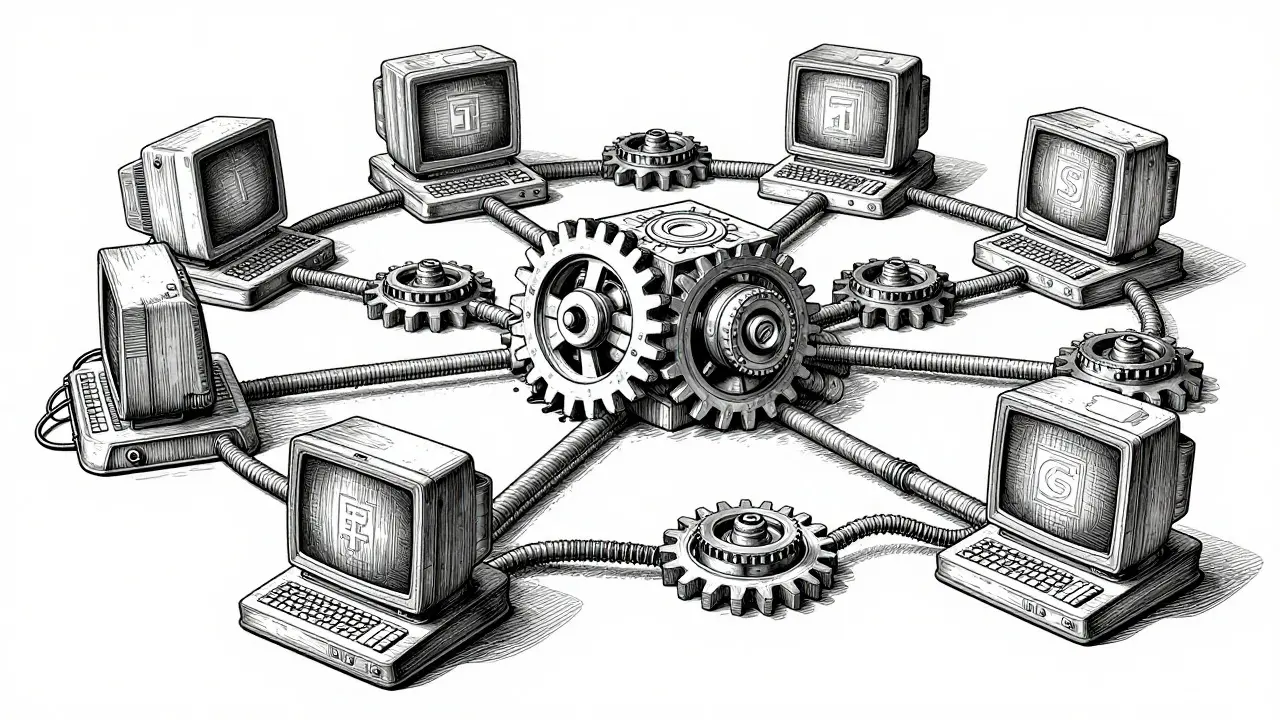
To understand why Bitcoin behaves the way it does, we have to look at Blockchain technology. Think of it as a massive, digital receipt book that everyone has a copy of. Instead of a bank keeping a private record of who owns what, this decentralized ledger is maintained by a global network of computers. Every time you send Bitcoin, the network verifies the transaction using cryptography and adds it to a block. Once that block is locked in, it's practically impossible to change.
This system removes the middleman. You don't need a bank to "approve" your transfer; you just need the network to agree that you actually have the funds. However, this decentralization comes with a trade-off in speed. While a credit card swipe feels instant, a Bitcoin transaction needs confirmations from the network, which can take anywhere from ten minutes to several hours depending on how busy the network is and how much you're willing to pay in fees.
From Darknets to Wall Street
Bitcoin's reputation has shifted dramatically over the last decade. In its early days, it was the currency of choice for the underground economy, with a huge portion of its volume flowing through darknet markets. It provided the anonymity and borderless nature that illegal trades required. But as the world woke up to the potential of programmable money, the narrative changed. Online retailers began accepting it, and suddenly, it wasn't just about anonymity-it was about access.
The turning point came when institutional money entered the room. We saw companies like Tesla making massive Bitcoin purchases, signaling that this wasn't just a toy for hackers. By January 2024, the Securities and Exchange Commission (SEC) approved spot Bitcoin exchange-traded products (ETPs), effectively bridging the gap between the wild world of crypto and the regulated halls of traditional finance. This shift turned Bitcoin into "digital gold," where people buy it to hold for the long term rather than spending it on a sandwich.
The Volatility Problem: Why You Can't Buy Milk with BTC
If you're a merchant, Bitcoin is a nightmare for accounting. How do you price a product when the currency's value swings 5% in a day? For example, if Bitcoin hits a record high-like the $109,000 peak seen in early 2025-merchants are hesitant to sell their holdings because they believe the price will keep climbing. Conversely, when the market dips, users are reluctant to spend their coins, hoping for a bounce back.
This volatility is the primary reason Bitcoin struggles as a daily currency. For a currency to be effective, it needs to be a stable unit of account. When the price of one Bitcoin can move by thousands of dollars in a week, it ceases to be a reliable tool for pricing goods and becomes a speculative asset. Most people now treat Bitcoin as a global investment strategy, using it to hedge against inflation in traditional fiat currencies rather than as a way to pay their monthly electric bill.
The Learning Curve and Practical Hurdles
For the average person, the barrier to entry is still quite high. Using Bitcoin isn't as simple as downloading an app; it requires an understanding of Digital Wallets and the terrifying responsibility of managing private keys. If you lose your key, your money is gone forever-there is no "Forgot Password" button in a decentralized system.
The process usually goes like this: you visit a cryptocurrency exchange, swap your dollars for Bitcoin, and then move those coins to a secure wallet. For tech-savvy users, this is a breeze. For everyone else, it's a minefield of potential errors. While mainstream financial institutions are trying to simplify this by offering managed custody, the core tension remains: do you want the security and ease of a bank, or the total control and risk of self-custody?
The Future: Tokenization and Central Bank Rivals
While Bitcoin paved the way, it's no longer the only player. We're seeing a massive move toward the tokenization of assets. Financial giants like Mastercard are building infrastructure, such as their Multi-Token Network, to make digital asset transactions more scalable and interoperable. They aren't necessarily trying to replace Bitcoin, but they are using its underlying logic to make traditional money move faster.
Then there are the CBDCs (Central Bank Digital Currencies). The European Central Bank and China have both moved forward with digital versions of their national currencies. Unlike Bitcoin, these are centralized and regulated. They offer the speed and digital nature of crypto but without the volatility or the decentralization. This creates a bifurcated future: you'll likely use a CBDC for your daily payments and hold Bitcoin as a long-term store of value.
Practical Tips for Using Bitcoin Today
- Prioritize Security: Never share your private keys. Use a hardware wallet for any amount of Bitcoin you aren't planning to spend immediately.
- Watch the Fees: Blockchain fees fluctuate based on network congestion. Check a fee estimator before sending a transaction to avoid overpaying.
- Use Stablecoins for Payments: If you want the speed of blockchain without the price swings, look into stablecoins that peg their value to the US Dollar.
- Verify Addresses: Always double-check the receiving address. Bitcoin transactions are irreversible; one wrong character and your funds are lost in the void.
Is Bitcoin legal tender?
In the vast majority of countries, Bitcoin is not legal tender, meaning businesses aren't required to accept it. However, some nations have adopted it as legal tender to attract investment or bypass traditional banking systems, though this remains rare and controversial.
How long does a Bitcoin payment take?
A transaction is broadcast instantly, but it requires "confirmations" from miners. Typically, 3 to 6 confirmations are required for security, which usually takes about 30 to 60 minutes. In times of high network congestion, this can take longer unless you pay a higher fee.
Can I use Bitcoin for everyday shopping?
Technically yes, if the merchant accepts it. Some major retailers and online stores do, but it's not yet a mainstream experience. Most people find it easier to use a crypto-linked debit card that converts Bitcoin to fiat currency at the point of sale.
What is the difference between Bitcoin and a CBDC?
Bitcoin is decentralized, meaning no government or company controls it. A CBDC (Central Bank Digital Currency) is issued and managed by a government. While both use digital ledgers, CBDCs provide state-backed stability and surveillance, whereas Bitcoin provides anonymity and independence from central banks.
Is Bitcoin a safe investment for beginners?
It depends on your risk tolerance. Bitcoin has seen explosive growth, but it's incredibly volatile. Beginners are often advised to use regulated ETPs or ETFs to get exposure without having to manage the technical risks of private keys and digital wallets.
The whole thing about the 'forgot password' button is the real kicker here. Most ppl don't realize that self-custody is basically like holding a gold bar in your backyard; if you lose the map to where you buried it, that's just it, gone forever. Its a huge mental shift from the bank model where someone is always there to verify your identity. I think we'll see more 'hybrid' solutions where people keep a small amount for spending and the rest in cold storage, but the ux needs to get way better before it hits the masses. Also, the Lightning Network is kind of the missing piece for that coffee shop scenario because it handles the micro-transactions off-chain and then settles later, which solves the 10-minute wait problem. Its honestly a fascinatng evolution of how we perceive value in a digital age, moving from centralized trust to mathamatical proof.
Digital gold is the only way it works!!!
Omg the drama of losing a private key is literally my worst nightmare!! Imagine just poof, your life savings vanish because you misplaced a piece of paper or a USB stick... absolute madness! I can't even keep track of my Netflix password half the time, so the idea of being my own bank is honestly terrifying but also kind of thrilling in a chaotic way. People act like it's easy, but the stress is just too much for me to handle lol.
I completely agree with the point about stablecoins being the bridge, as it seems much more practical for someone who wants the efficiency of a blockchain without the constant stress of watching the market crash every few hours while they're just trying to buy groceries for their family. It's really interesting how the technology evolved from this rebellious idea into something that the biggest financial institutions in the world are now trying to integrate into their own systems to stay relevant in the modern era, and I think that transition will eventually lead to a much more inclusive financial system if it's handled with care and proper regulation for everyone's safety.
The shift toward CBDCs is definitely going to change things for the average user.