
Imagine trying to build a skyscraper where the same crew is responsible for pouring the concrete, installing the plumbing, wiring the electricity, and painting the walls all at once. It sounds chaotic, right? That is exactly how traditional blockchains work. They are "monolithic," meaning one single network handles everything from processing transactions to securing the data. The problem is that as more people use the network, it slows down, and the cost to run a node skyrockets. This is the heart of the blockchain trilemma: the struggle to balance security, scalability, and decentralization.
Enter Celestia is a modular blockchain network that decouples the consensus and data availability layers from the execution layer. Unlike the all-in-one approach of Bitcoin or Ethereum, Celestia doesn't care about executing smart contracts or managing complex application logic. It does one thing and does it exceptionally well: it ensures that the data required to verify a block is available for everyone to see. By stripping away the execution burden, Celestia creates a foundation where other blockchains, specifically rollups, can live and breathe without the overhead of a massive monolithic chain.
Why the World is Moving Away from Monolithic Chains
For years, we've looked at Layer 1s as the only way to scale. But monolithic chains have a ceiling. When every node in the network has to process every single transaction, the network can only be as fast as its slowest node. If you want more speed, you usually have to sacrifice decentralization by requiring more powerful (and expensive) hardware, which pushes out the average user.
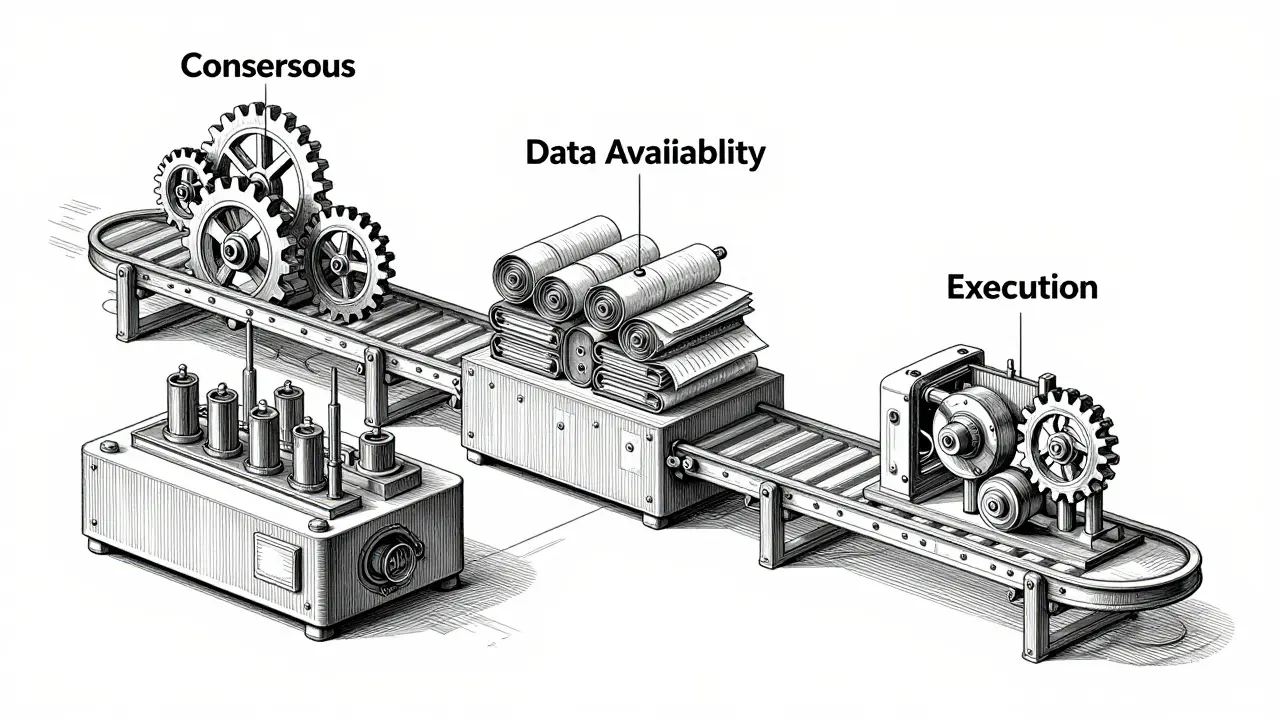
The modular blockchain approach flips this script. Instead of one chain doing four jobs (execution, settlement, consensus, and data availability), the work is split. Think of it like a specialized assembly line. One layer handles the agreement on the order of transactions (consensus), another ensures the data is there (data availability), and a separate layer actually runs the code (execution). This allows each part to scale independently. If you need more execution power, you just launch another rollup on top of the data layer without slowing down the rest of the network.
Breaking Down the Technical Magic: DAS and NMT
You might wonder how a node can verify that data exists without actually downloading the whole thing. That would seem impossible, but Celestia uses a trick called Data Availability Sampling (or DAS), a method allowing lightweight nodes to verify data availability by requesting small, random chunks of a block.
Here is how it actually works in a real scenario: Celestia uses erasure coding to expand block data. If you have a 1MB block, the system expands it to 2MB. Because of this redundancy, you only need about 50% of the data to reconstruct the entire block. A light node doesn't download the whole 2MB; it just asks for a few random samples. If the first sample is there, you have a 50% confidence level. If you check seven random samples and they are all present, your confidence jumps to over 99%. This means a smartphone could theoretically help secure the network without needing a terabyte of storage.
To keep this organized, Celestia employs the Namespace Merkle Tree (or NMT), a data structure that organizes block data into namespaces, allowing users to download only the data relevant to their specific application. Each dApp gets its own namespace. If you are using a gaming rollup, your node doesn't need to waste bandwidth downloading data for a DeFi lending protocol on the same network. It only tracks the "leaf nodes" associated with its own identifier, making the system incredibly lean.
| Feature | Monolithic (e.g., Traditional L1) | Modular (e.g., Celestia) |
|---|---|---|
| Responsibilities | Execution, Settlement, Consensus, DA | Consensus and Data Availability only |
| Node Hardware Requirements | High (must process all data) | Low (can use DAS to sample data) |
| Customizability | Limited to chain-wide rules | High (Rollups define their own execution) |
| Scalability Bottleneck | Single-layer throughput limits | Distributed across multiple execution layers |
The Role of Rollups in the Modular Ecosystem
If Celestia is the foundation, Rollups are the houses built upon it. A rollup is essentially a separate blockchain that "rolls up" a batch of transactions and posts them to a data availability layer like Celestia. Since the rollup doesn't have to worry about the heavy lifting of consensus and data availability-Celestia handles that-the rollup can focus entirely on execution speed and user experience.
This setup gives developers a massive amount of freedom. They can choose their preferred programming language. Whether you are using Solidity for EVM compatibility, Rust, or Golang via the Cosmos SDK, you can launch your chain on Celestia. You aren't locked into a specific virtual machine or a rigid set of rules imposed by a monolithic Layer 1. You get the security of a decentralized network but the flexibility of a private server.

Performance Gains and Future Outlook
The modular approach isn't just a theoretical win; it's showing real performance gains. For instance, the Ginger upgrade introduced in late 2024 focused on cutting block times from 12 seconds down to 6 seconds. In the world of data availability, a 50% reduction in block time significantly reduces the latency for rollups that rely on the network to confirm their data is available. When a rollup can settle its data faster, the end-user experiences quicker transaction finality.
Looking ahead, the demand for scalable infrastructure is only growing. As more developers move away from expensive mainnets and toward Layer 2 solutions, the need for a dedicated, cost-effective data layer becomes critical. Celestia's ability to scale without increasing the hardware burden on nodes makes it a primary candidate for the backbone of the next generation of Web3 applications.
Practical Tips for Developers and Users
If you are a developer looking to dive into this, you need to shift your mental model. Stop thinking about "deploying a contract to a chain" and start thinking about "deploying a chain to a data layer." You will need to understand how to handle fraud or validity proofs to ensure your rollup remains secure while leveraging DAS for lightweight verification.
- Assess your needs: If your app requires massive throughput and custom logic, a modular rollup is better than a standard smart contract.
- Pick your stack: Decide if you want EVM compatibility (Solidity) or high-performance systems programming (Rust/Cosmos SDK).
- Optimize for data: Use the Namespace Merkle Tree logic to ensure your nodes only track what is necessary, keeping your infrastructure costs low.
What exactly is "Data Availability"?
Data availability means that all the data required to verify the state of a blockchain is accessible to anyone who wants to see it. If a block is produced but the data is hidden or lost, no one can verify if the transactions in that block were valid, which would allow the network to be cheated. Celestia ensures this data is always there without requiring every node to store every bit of it.
How is Celestia different from Ethereum?
Ethereum is traditionally monolithic (though it is moving toward a rollup-centric roadmap). It handles execution (smart contracts), consensus, and data availability all in one. Celestia removes the execution part entirely, acting as a specialized service that only provides consensus and data availability for other chains to use.
Can any programming language be used on Celestia?
Yes, because Celestia doesn't execute the code itself. The execution happens on the rollup layer. Since the rollup is a separate entity, developers can use Solidity, Rust, Golang, or even a custom virtual machine, as long as the resulting data can be posted to Celestia's data availability layer.
What is the "Blockchain Trilemma"?
The trilemma is the idea that a blockchain cannot achieve decentralization, security, and scalability all at once. Usually, to get more scale, you sacrifice decentralization (by having fewer, more powerful nodes). Modular blockchains like Celestia attempt to solve this by splitting these requirements across different layers.
Does the Ginger upgrade affect regular users?
While regular users don't interact with Celestia's core layer directly, they feel the effects through the rollups they use. By reducing block times from 12 to 6 seconds, the Ginger upgrade makes the rollups built on Celestia feel faster and more responsive.

Modular architecture is definitely the way forward because the bottlenecks on monolithic chains have become a joke lately. Splitting the layers allows for specific optimizations that just aren't possible when you're trying to do everything in one place.
Too much jargon here
Actually, the technical implementation of DAS is quite elegant! 🌟 It is truly a masterful way to handle the data availability problem without compromising the decentralization of the network. I find the use of erasure coding particularly fascinating as it provides a robust safety net for the entire ecosystem! 🚀
This whole shift feels like we're finally waking up to the reality that one size never fits all in the digital realm. It is a poetic evolution of the internet's core philosophy where we move from these rigid, suffocating monoliths toward a fluid, breathing ecosystem of specialized layers. Imagine the liberation for devs when they aren't chained to a specific VM but can instead weave their own logic into the fabric of the web. We are witnessing the birth of a digital renaissance where the infrastructure finally bows to the imagination of the creator. It's not just about throughput or latency, it's about the philosophical liberation of data. When we decouple consensus from execution, we're essentially saying that the truth of a transaction is independent of how that transaction is processed. That is a profound leap in how we perceive trust and verification in a decentralized world. The implications for global inclusivity are staggering because lowering the hardware barrier means a kid with a cheap phone in a developing nation can actually participate in securing the network. We are moving toward a future where the barrier to entry is curiosity, not capital. This is the kind of systemic change that actually moves the needle on decentralization. I love how this forces us to rethink the very nature of a 'blockchain' not as a single product, but as a suite of interoperable services. It's a wild ride and we're just getting started with the modular era.
Typical tech hype 🙄 the industry just loves renaming things to feel innovative when they're just shuffling the same old problems around. 💅
The sheer audacity of presenting this as a revolution when it's merely a fragmented patchwork of existing concepts is almost impressive. It's a tedious exercise in over-engineering for the sake of venture capital optics. Truly a pedestrian analysis of what is essentially a desperate attempt to fix the architectural failures of the previous decade.
I think the modular approach will eventually win over the skeptics as more rollups demonstrate their stability and speed
The distinction between the data availability layer and the execution layer is most certainly the most critical component of this architecture. It provides a commendable level of efficiency and ensures that the network remains sustainable in the long term.
totally a vibe shift for the devs
cutting the bloat makes the whole thing feel way more breezy