
Send money internationally today, and you are likely staring at a screen that promises three to five business days for your funds to arrive. You also know the hidden cost: fees that eat up 6% or more of your transfer, plus foreign exchange spreads that quietly shrink your balance further. For decades, this has been the price of doing business across borders. But in 2026, that model is crumbling under the weight of inefficiency.
A new infrastructure is taking its place. It does not rely on the slow, opaque web of correspondent banks that have dominated global finance since the mid-20th century. Instead, it uses stablecoins, which are digital assets pegged to fiat currencies like the US dollar or euro, operating on blockchain networks to enable near-instant settlement. This shift isn't just about faster speeds; it is about reclaiming control over your capital. With transaction costs dropping to under 1% and settlement times shrinking from days to minutes, cross-border crypto payments have moved from a niche experiment to a mainstream financial utility.
The High Cost of Traditional Banking
To understand why the shift is happening, you first need to look at what traditional banking gets wrong. The system relies on a chain of intermediary banks, each taking a cut and adding processing time. According to the World Bank’s 2024 Remittance Prices Worldwide report, the average fee for sending $200 internationally was 6.4%. That number includes both explicit fees and the hidden markup on exchange rates.
Consider a small business in Europe paying a supplier in Mexico. A traditional wire transfer might take four days. During that time, the money sits in limbo, earning nothing, while the sender waits for confirmation. If the recipient needs those funds urgently, they often turn to informal channels or high-cost remittance services that charge even higher premiums for speed. The opacity is the real killer. You rarely know exactly where your money stops or how much it will be worth when it arrives until it actually does.
This friction creates a massive economic drag. Global cross-border payments total roughly $150 trillion annually. Even a small percentage saved in fees and improved liquidity represents billions of dollars trapped in the system. This is the gap that crypto alternatives are filling.
How the "Stablecoin Sandwich" Works
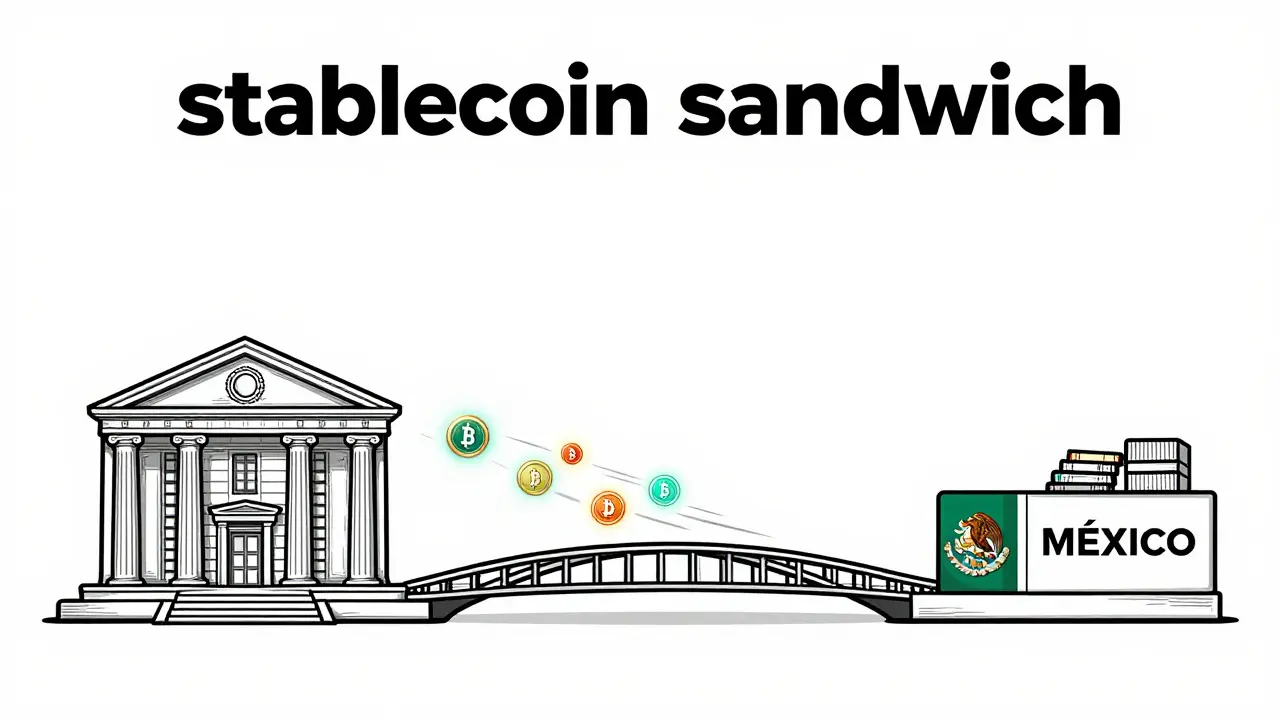
The core mechanism behind modern cross-border crypto payments is often called the "stablecoin sandwich." It sounds complex, but the logic is straightforward. Instead of moving actual dollars through a network of bank accounts, you convert your local currency into a digital equivalent, move that digital asset across a blockchain, and then convert it back into the destination currency.
- On-Ramp: You send Euros from your European bank account to a regulated liquidity provider. They instantly buy USDC, which is a fully reserved digital dollar issued by Circle, designed for stability and regulatory compliance.
- Transfer: That USDC moves across a blockchain network-like Ethereum, Polygon, or Solana-to a partner in the destination country. This step takes seconds or minutes, regardless of distance.
- Off-Ramp: The partner sells the USDC for Mexican Pesos (MXN) and deposits them directly into your supplier’s local bank account.
The result? Settlement in 5 to 10 minutes, compared to the traditional 2 to 5 days. FXCIntel’s April 2025 State of Stablecoins report documents that these transactions now average 0.5% to 1.2% in total cost, a fraction of the 4% to 8% typical in traditional corridors.
David Mason, Head of Global Payments at a leading fintech firm, described this process as the "golden egg" of cross-border payments. He noted that if someone gives him euros, he can automatically buy USDT in real-time with a European liquidity provider, sell that USDT in Mexico, and send pesos out-all within minutes. This automation removes the human bottlenecks and manual reconciliations that plague legacy systems.
Key Players and Infrastructure in 2026
You do not need to be a crypto expert to use these systems anymore. The infrastructure has matured significantly. Major players now provide API-based solutions that integrate seamlessly with existing accounting and payment software.
Layer1, developed by BVNK, is a prime example. As of Q1 2025, their platform handles multi-currency conversion with 99.98% uptime. They connect to over 150 currency pairs, offering an average settlement time of 7.3 minutes. Similarly, Ripple, known for its enterprise-focused payment protocol using XRP as a bridge currency to facilitate fast, low-cost transfers between institutions, leads in corporate adoption, holding 38% market share among enterprise users according to Greenwich Associates' May 2025 report.
| Metric | Traditional Banking (SWIFT) | Stablecoin-Based Payments |
|---|---|---|
| Settlement Time | 2-5 Business Days | 5-10 Minutes |
| Average Fee | 4% - 8% | 0.5% - 1.2% |
| FX Spread Transparency | Opaque (Hidden Markups) | Transparent (Market Rate) |
| Global Coverage | 195 Countries | 127 Countries (Growing) |
| Success Rate (Same-Day) | 63.2% | 98.7% |
Note the coverage gap. Traditional banking still wins on universal acceptance, available in nearly every country on earth. Stablecoin networks cover 127 countries, but liquidity is concentrated. About 70% of stablecoin volume flows through just 15 major corridors. This means while the tech works brilliantly for USD to MXN or EUR to INR, it can struggle in less common routes like USD to Nigerian Naira, where success rates drop to 68.4% due to limited off-ramp infrastructure.
Regulatory Clarity: The Game Changer
For years, regulation was the biggest barrier. Governments were wary of unbacked cryptocurrencies threatening monetary sovereignty. In 2026, that fear has largely been replaced by structured oversight.
The U.S. GENIUS Act, enacted in December 2024, established clear reserve, disclosure, and compliance requirements for stablecoin issuers. Meanwhile, the EU’s MiCA regulation came fully into effect in June 2024, creating a unified framework for digital assets across Europe. These laws did not kill innovation; they legitimized it. Banks and large enterprises felt safe adopting these tools because the rules of engagement were finally written down.
Germany’s BaFin approved EURAU, a euro stablecoin from the AllUnity JV, in January 2025. Stefan Dorfling, CEO of DWS (part of the joint venture), called stablecoins a "gigantic market," signaling strong institutional confidence. Even the U.S. Federal Reserve is warming up, announcing Phase 3 of Project Hamilton in February 2025, which plans to integrate select stablecoins into the FedNow real-time payment system by late 2025.
However, fragmentation remains a challenge. As of June 2025, 37 countries had distinct stablecoin frameworks. While better than chaos, this patchwork requires businesses to navigate different compliance standards depending on where they operate. Christine Lagarde, former ECB President, warned in January 2025 that rapid expansion could fragment monetary policy transmission if not properly managed-a valid concern that regulators are actively monitoring.
Real-World Adoption and User Experience
Who is actually using this? Not just crypto enthusiasts. Enterprise adoption is accelerating. Remittance companies lead with a 47% adoption rate, followed by fintechs (38%) and payment service providers (33%). Large enterprises primarily use these systems for treasury management (62% of use cases) and supplier payments (28%).
User experiences reflect the benefits but also highlight the growing pains. On Reddit’s r/Fintech forum, a March 2025 thread featured 287 comments. 78% reported positive experiences, citing same-day receipts and FX savings of over 2%. One user, u/MexicoExporter, noted receiving MXN payments in hours instead of four days. Another, u/EuropeanTrader, highlighted saving 2.3% on EUR to INR transfers.
But 22% reported issues. Common complaints included failed off-ramps during periods of high market volatility and confusion with tax authorities regarding reporting requirements. Trustpilot reviews for major providers like BVNK show high ratings (4.5/5), but negative reviews often cite inconsistent availability in emerging markets. This "last-mile liquidity" problem is the current bottleneck. If there isn’t a reliable partner in the destination country to convert the crypto back to cash, the speed advantage disappears.

Getting Started: What Businesses Need to Know
If you are considering switching your cross-border payments to crypto rails, the barrier to entry is lower than you think. You do not need to build your own blockchain. You need partners.
Integration typically takes 2 to 3 weeks for businesses already using API-based payment systems, versus 6 to 8 weeks for those migrating from legacy platforms. The process involves:
- Selecting a Provider: Choose a regulated infrastructure provider like Layer1, Ripple, or Coinbase Commerce. Look for strong documentation and uptime guarantees.
- Liquidity Management: Ensure you have access to sufficient liquidity pools. Small businesses may need minimum capital reserves of $250,000 per BVNK’s 2025 requirements to maintain smooth operations across multiple corridors.
- Compliance Setup: Work with legal counsel to ensure your KYC (Know Your Customer) and AML (Anti-Money Laundering) procedures align with both local regulations and the provider’s requirements.
The learning curve is manageable. Most teams require 2 to 3 dedicated technical staff members to handle the integration and ongoing monitoring. Community support is robust, with over 14,200 active participants in the Stablecoin Payment Developers Forum as of May 2025.
Risks and Limitations to Watch
No financial system is risk-free. While stablecoins offer transparency, they introduce new types of risk.
Counterparty Risk: You are trusting the issuer of the stablecoin to hold the reserves. While audits have improved, the March 2024 crypto market crash showed that extreme volatility can increase settlement times by 300% and cause temporary failures. A Brazilian fintech lost $1.2 million in March 2025 when an off-ramp liquidity provider became insolvent during a volatile period.
Regulatory Uncertainty: Laws change. A corridor that is open today might face restrictions tomorrow. Diversifying your payment rails-keeping some volume in traditional banking-is a prudent strategy for now.
Technical Vulnerabilities: Blockchain networks can experience congestion. During peak usage, settlement times on Ethereum can spike from 15 seconds to 30 minutes. Choosing providers that utilize Layer 2 solutions or alternative chains like Solana can mitigate this.
Despite these risks, the trajectory is clear. McKinsey forecasts that stablecoins could handle 20% to 25% of all cross-border payments by 2027. JPMorgan’s 2025 report expresses strong confidence in stablecoins becoming a permanent fixture in the ecosystem. The question is no longer whether this technology will replace traditional banking for cross-border payments, but how quickly businesses will adapt to stay competitive.
Is it legal to use stablecoins for cross-border payments?
Yes, in most major jurisdictions, provided you use regulated entities. The U.S. GENIUS Act and the EU’s MiCA regulation have created clear legal frameworks for stablecoin issuers and payment providers. However, you must ensure your specific provider is licensed in both the origin and destination countries. Always consult local legal counsel to confirm compliance with anti-money laundering (AML) and know-your-customer (KYC) laws.
Which stablecoin is best for international transfers: USDT or USDC?
It depends on your priorities. USDT (Tether) offers the deepest liquidity and widest acceptance, especially in emerging markets and retail corridors. USDC (Circle) is generally preferred by enterprises and institutions due to its rigorous regulatory compliance, transparent reserves, and stronger alignment with Western financial regulations. For B2B payments, USDC is often the safer choice.
How long does a stablecoin transfer actually take?
The blockchain transfer itself takes seconds to minutes. On Solana, finality is around 2.5 seconds; on Ethereum Layer 2s, it is about 15 seconds. However, the total end-to-end time-including converting fiat to crypto and then back to fiat-typically averages 5 to 10 minutes. This is significantly faster than the 2 to 5 days required for traditional SWIFT transfers.
What happens if the stablecoin loses its peg?
If a stablecoin de-pegs (loses its 1:1 value with the underlying currency), you could lose money during the transfer window. This is rare for major coins like USDC and USDT, but it has happened historically with lesser-known assets. To mitigate this, use reputable providers that monitor market conditions and can pause transfers or switch assets if volatility spikes. Diversifying across multiple stablecoins or keeping a portion of funds in traditional banking can also reduce exposure.
Can I receive crypto payments directly into my personal bank account?
Not directly. Banks do not accept cryptocurrency deposits. You need an intermediary service-a "off-ramp" provider-that converts the crypto to fiat currency and then deposits it into your bank account via standard methods like SEPA, FedWire, or local bank transfers. Services like PayPal, BVNK, and various fintech apps handle this conversion seamlessly for the user.

Wow! This is such a massive shift in how we think about money! I have been waiting for this kind of transparency for years! The fees were always so hidden and frustrating! Now we can actually see where our money goes! It feels like we are finally taking control back from the banks! The speed is incredible too! Five minutes instead of five days is a game changer! I am so excited to see more businesses adopt this! We need to keep pushing for wider adoption everywhere!
I've been using stablecoins for my freelance work lately, and it's honestly just smoother than wires. Not super hyped about it, but I appreciate not losing 6% on every transfer to India. Just nice to have options that don't feel like they're designed to bleed you dry.
The article ignores the reality of emerging markets. Western regulators write rules for themselves. Indian users face strict capital controls. Stablecoins do not solve sovereignty issues. You cannot bypass national monetary policy with digital tokens. The infrastructure is flawed for non-Western economies. Do not pretend otherwise.
Why are you guys ignoring the risk? I lost money last year. It was terrifying. My partner went insolvent. I felt betrayed by the system. Who protects us now? Tell me who protects us.
You cling to fear while progress marches on. Your trauma is your own burden. The market corrects itself. Weak hands exit. Strong hands build. Stop whining about volatility. It is the price of innovation. Grow up.
Let's focus on the solution here. Integration is easier than people think. We should support each other as we learn these new tools. Community forums are great resources. Let's share our success stories and help others navigate the setup process. Together we can make this transition smoother for everyone involved.