Living in Santa Fe, I watch the global crypto market shift daily. But if you are in Dhaka, Chittagong, or anywhere else in Bangladesh, the rules are entirely different. As of June 2026, anti-money laundering crypto enforcement in Bangladesh remains one of the strictest in Asia. You cannot legally buy, sell, or mine Bitcoin here. The government treats virtual assets as a threat to financial stability and a gateway for illicit funds.
This isn't just a theoretical warning. It is an active enforcement regime. If you hold crypto in Bangladesh, you are operating in a gray zone that can quickly turn black. The central bank has issued repeated bans, police have arrested miners, and international pressure is mounting. Understanding these restrictions is not optional-it is essential for your safety.
The Regulatory Landscape: Implicit Ban vs. Explicit Law
Bangladesh does not have a specific "Cryptocurrency Act." Instead, it relies on a patchwork of older laws to crush digital asset activity. This creates a confusing but dangerous environment for users.
The primary enforcer is the Bangladesh Bank, the country's central banking authority. Since 2014, they have issued multiple circulars warning against cryptocurrency usage. They do not recognize Bitcoin, Ethereum, or any other token as legal tender. In fact, they explicitly state that no entity can issue, offer, or deal in virtual currencies.
Here is how the legal framework connects:
- Foreign Exchange Regulations Act of 1947: Using crypto to move money out of the country violates this act. The government wants all foreign exchange transactions routed through licensed banks.
- Money Laundering Prevention Act of 2012: Authorities view anonymous crypto transactions as potential money laundering. If you use crypto to hide the source of funds, you face criminal charges under this law.
- Information and Communication Technology (ICT) Act: This provides the digital framework for prohibiting unauthorized digital currency platforms and services.
The result? There is no clear law saying "owning Bitcoin is illegal." However, every action associated with it-trading, exchanging, mining, or using it for payments-is prohibited under existing financial regulations. This ambiguity works against you. If caught, authorities interpret your actions as violations of anti-money laundering or foreign exchange laws.
Enforcement Actions: Arrests and Real-World Consequences
You might think, "I just keep my coins in a cold wallet. No one will know." Think again. Enforcement in Bangladesh is aggressive, particularly regarding mining and large-scale trading operations.
In 2024, police in Dhaka arrested several individuals for running clandestine crypto mining farms. These weren't hobbyists with one graphics card. These were organized operations consuming significant electricity and attempting to bypass grid monitoring. Authorities deemed these activities violations of anti-money laundering laws because the revenue generated was difficult to trace and tax.
The message from the Criminal Investigation Department (CID) is clear: while mere possession might not always lead to immediate jail time, engaging in trade, exchange, or mining triggers severe legal proceedings. Potential penalties include:
- Fines equivalent to the value of the illicit transaction.
- Imprisonment for violating foreign exchange controls.
- Confiscation of hardware and digital assets.
Compare this to neighbors like Canada or Sweden, where mining is a booming industry supported by renewable energy incentives. In Bangladesh, mining is explicitly illegal. The government views the high energy consumption and untraceable profits as a direct threat to national security and economic planning.
The Money Laundering Connection and FIU Oversight
Why is the government so hardline? The core concern is money laundering and terrorist financing. Cryptocurrencies offer anonymity that traditional banking lacks. Features like decentralized exchanges and anonymous wallets (such as TRC20 addresses) make it hard for authorities to track fund flows.
The Financial Intelligence Unit (FIU) of Bangladesh monitors suspicious transactions. They work closely with the Bangladesh Bank to identify patterns that suggest illicit activity. If you send large amounts of Taka to a peer-to-peer (P2P) trader who then converts it to USDT, the FIU may flag this as a structuring attempt to evade reporting requirements.
Historical context matters here. Bangladesh has suffered from various Ponzi schemes and investment scams. One notable example was the MTFE scam, which attracted thousands of investors before vanishing with their funds. While not strictly a crypto scam initially, it highlighted the public's vulnerability to unregulated financial instruments. Authorities fear crypto will become the next vehicle for such mass fraud.

Tax Implications and Revenue Collection
If you are earning income from crypto abroad or holding assets, what about taxes? There is no specific "crypto tax" law in Bangladesh. However, the National Board of Revenue (NBR) applies the general Income Tax Ordinance of 1984 to all transactions.
This means:
- If you earn profit from trading, it is considered taxable income.
- If you receive crypto as payment for goods or services, it is treated as revenue.
- You must declare these earnings in your annual tax return.
The catch? To declare the income, you admit to participating in an illegal activity. Most citizens avoid declaring crypto income altogether, which increases their risk profile with the NBR. If audited, failing to report unexplained wealth can lead to severe penalties. The lack of a clear regulatory path forces users into a corner: either break the law by trading or break the law by hiding income.
International Pressure: FATF Compliance Gaps
Bangladesh faces growing scrutiny from the Financial Action Task Force (FATF). This global body sets standards for combating money laundering and terrorist financing. Recommendation 15 specifically addresses virtual assets, requiring countries to regulate crypto service providers.
Currently, Bangladesh’s implicit ban does not fully satisfy FATF standards. The FATF wants transparency and regulation, not just prohibition. By banning crypto without providing a legal framework for oversight, Bangladesh leaves gaps where illicit actors can operate underground without any monitoring.
This non-compliance poses risks for the country’s banking sector. International banks may hesitate to process transactions with Bangladeshi institutions if they perceive weak AML controls. As global adoption of fintech grows, Bangladesh’s outdated approach isolates it from regional innovation.
Regional Contrast: Bangladesh vs. Pakistan
To understand how isolated Bangladesh’s stance is, look at its neighbor, Pakistan. In May 2025, Pakistan established the Pakistan Digital Assets Authority (PDAA). They created a National Crypto Committee and allocated 2,000 megawatts of power for Bitcoin mining. Pakistan even formed a Bitcoin Strategic Reserve.
| Feature | Bangladesh | Pakistan |
|---|---|---|
| Legal Status | Implicitly Banned | Regulated & Legal |
| Mining | Illegal | Supported (2,000 MW allocated) |
| Regulatory Body | Bangladesh Bank / FIU | Pakistan Digital Assets Authority (PDAA) |
| FATF Alignment | Gaps in Recommendation 15 | Actively Aligning |
| Market Access | Underground/P2P only | Licensed Exchanges |
This divergence highlights a strategic error by Bangladesh. While Pakistan captures tax revenue and technological expertise, Bangladesh pushes its youth into informal, unmonitored markets. Estimated informal crypto markets in Pakistan reached $25 billion by 2023. Bangladesh likely has similar volumes, but with zero tax contribution and higher crime risks.
The Blockchain Paradox: Government Adoption vs. Private Ban
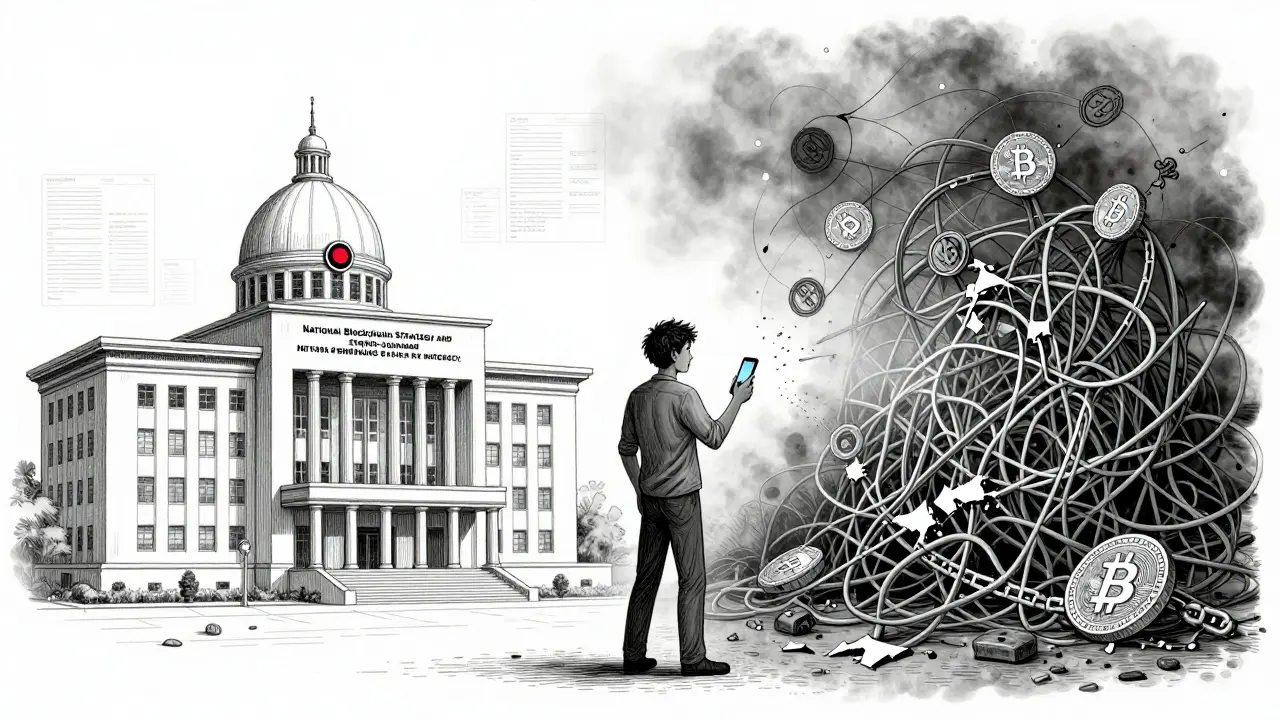
There is a glaring contradiction in Bangladesh’s policy. In 2020, the Bangladesh Computer Council released the National Blockchain Strategy. The government recognizes blockchain’s value for land records, identity systems, and e-governance.
So, why ban the private use of the same technology? The government wants the efficiency of blockchain for state control but rejects its decentralization for citizens. This dual standard creates confusion. Developers interested in building dApps or smart contracts find themselves in a legal void. Is developing a DeFi protocol illegal if it doesn’t involve currency exchange? The answer is unclear, discouraging local tech innovation.
Navigating the Gray Zone: Risks for Users
Despite the bans, crypto usage persists. People use P2P platforms, Telegram groups, and anonymous wallets to trade. Here is what you need to know if you are in this space:
- No Consumer Protection: If you get scammed on a P2P platform, the police may arrest you for trading crypto rather than helping you recover funds.
- Bank Account Freezes: Banks monitor accounts for suspicious crypto-related deposits. Frequent transfers to known P2P merchants can lead to account closure.
- Hardware Confiscation: If raided, mining rigs or devices storing private keys can be seized as evidence of illegal activity.
The decentralized nature of crypto offers some privacy, but it also removes recourse. Unlike traditional banking, there is no customer support to reverse a fraudulent transaction. In Bangladesh, this risk is amplified by the lack of legal standing.
Future Outlook: Will the Ban Lift?
As of mid-2026, there is no sign of imminent legalization. The Ministry of Finance holds the key to future legislation, but current trends favor continued restriction. The government prioritizes protecting the traditional banking system over fostering digital innovation.
However, international pressure may force change. FATF compliance deadlines loom. If Bangladesh fails to align with global standards, it could face stricter scrutiny on international remittances-a vital part of the economy. This might eventually push regulators toward a controlled legalization model, similar to India’s recent approach, rather than total prohibition.
Until then, the status quo remains: high risk, low protection, and strict enforcement. For investors and developers, Bangladesh is currently a hostile environment for crypto. For users, it is a dangerous game of cat and mouse with authorities.
Is owning cryptocurrency illegal in Bangladesh?
Owning cryptocurrency itself is not explicitly defined as a criminal offense in a specific law. However, the Bangladesh Bank prohibits all buying, selling, trading, and mining of virtual assets. Engaging in any transaction involving crypto violates foreign exchange and anti-money laundering regulations, making practical ownership risky and potentially punishable.
Can I mine Bitcoin in Bangladesh?
No, cryptocurrency mining is explicitly illegal in Bangladesh. Authorities treat mining operations as violations of anti-money laundering laws due to the difficulty in tracing revenues and the high energy consumption involved. Police have arrested individuals for running mining farms, confiscating equipment and imposing fines.
What happens if I use P2P crypto trading?
Using Peer-to-Peer (P2P) platforms to trade crypto is highly risky. Banks monitor accounts for suspicious transactions linked to known P2P merchants. Your bank account may be frozen or closed. Additionally, if you are involved in a scam, you have no legal recourse, and authorities may prosecute you for violating foreign exchange regulations.
How does Bangladesh comply with FATF standards?
Bangladesh currently struggles to fully comply with FATF Recommendation 15, which requires regulating virtual asset service providers. The implicit ban creates gaps in oversight, allowing illicit activities to flourish underground. This non-compliance poses risks for the country's international banking relationships and may force future regulatory changes.
Is blockchain technology banned in Bangladesh?
No, blockchain technology is not banned. The Bangladesh Computer Council released a National Blockchain Strategy in 2020, recognizing its utility for government sectors like land records and identity management. However, the private use of blockchain for cryptocurrency and decentralized finance remains prohibited.
Do I need to pay taxes on crypto gains in Bangladesh?
Yes, technically. The National Board of Revenue applies the Income Tax Ordinance of 1984 to all income, including profits from cryptocurrency trading. However, since trading crypto is illegal, declaring such income admits to breaking the law. Most users do not declare these gains, increasing their audit risk.