India’s crypto tax system isn’t just strict - it’s one of the harshest in the world. If you’re trading, staking, or even just holding cryptocurrency here, you’re under intense scrutiny. The government doesn’t treat crypto like stocks or real estate. It treats it like a lottery win: no deductions, no loss offsets, and no mercy. And while there’s no public list of people fined or jailed for crypto tax evasion, that doesn’t mean enforcement isn’t happening. It’s just quieter - and more systematic.
How Crypto Is Taxed in India (The 30% Rule)
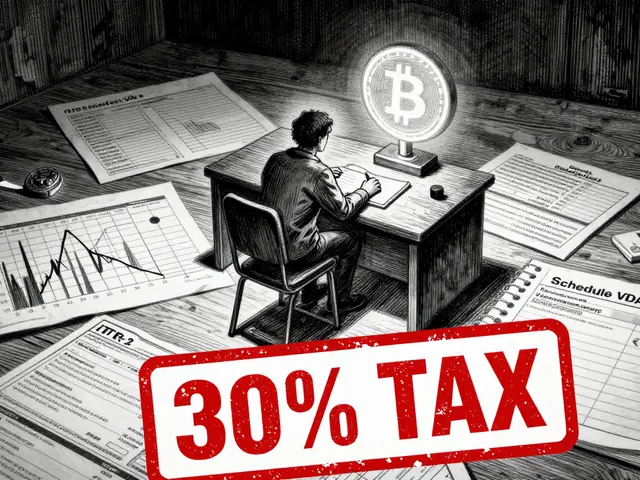
Since April 2022, every rupee you make from crypto - whether it’s Bitcoin, Ethereum, or a meme coin - gets hit with a flat 30% tax. That’s not a capital gains rate. That’s not an income tax slab. It’s a flat rate, no exceptions. You can’t use losses from one coin to offset gains from another. If you bought Bitcoin for ₹5 lakh and sold it for ₹8 lakh, you owe ₹90,000 in taxes. If you lost ₹3 lakh on Solana, that loss? Irrelevant. It disappears.
This rule comes from Section 115BBH of the Income Tax Act. It’s the same section that taxes lottery winnings and game show prizes. The government’s message is clear: crypto isn’t investment - it’s speculation. And speculation gets taxed hard.
The 1% TDS That’s Catching Everyone
It’s not just about what you earn. It’s about every single trade you make. Since July 1, 2022, every crypto transaction in India triggers a 1% Tax Deducted at Source (TDS). That means if you sell ₹1 lakh worth of Dogecoin, ₹1,000 gets pulled out before you even see the money. The buyer - whether it’s a friend, an exchange, or a decentralized wallet - has to deduct it. If they don’t, they’re liable.
This TDS rule is designed to force transparency. Every time you trade, the exchange or platform reports it to the tax department. No hiding. No anonymity. Even if you’re using a peer-to-peer app like Paxful or LocalBitcoins, the Indian tax authorities can track the IP, device, and bank account linked to the transaction. And if you’re not reporting it? You’re already on their radar.
GST on Crypto Services - The Hidden Tax
Starting July 7, 2025, 18% GST was slapped on every service provided by crypto platforms. That includes:
- Trading fees
- Withdrawal or deposit charges
- Staking rewards management
- Custody fees
- KYC verification
- Wallet maintenance
This isn’t just about big exchanges. Even if you’re using a foreign platform like Binance or Kraken and paying fees in USD, the Indian government says you’re still liable. Why? Because you’re a resident, and you’re consuming a service from an offshore provider. Under Section 2(102) of the CGST Act, these platforms are classified as Online Information and Database Access or Retrieval (OIDAR) services. That means they must register for GST in India, even if they’re based in Singapore or the Cayman Islands.
So now, when you pay ₹500 to trade on Binance, ₹90 of that goes to GST. You don’t see it on your receipt - but it’s there. And if you don’t report that as part of your income? You’re underreporting.

How to Report Crypto - ITR-2 and Schedule VDA
If you made crypto gains in FY 2024-25 (April 2024 to March 2025), you must file your return using either ITR-2 or ITR-3. You can’t use the simpler ITR-1. Why? Because both forms now include a dedicated section called Schedule VDA - Virtual Digital Assets.
Here’s what you need to report:
- Details of every crypto sale - date, coin, cost price, sale price
- Any staking or mining income - taxed at fair market value on the day you received it
- Airdrops - treated as income when you receive them
- Gifts of crypto - if over ₹50,000, taxed as income
- Transactions with foreign exchanges - even if you didn’t convert to INR
The tax department cross-checks this with data from exchanges, TDS records, and GST filings. If your bank statements show ₹12 lakh going to Binance, but you only reported ₹3 lakh in gains? That’s a red flag.
What Happens If You Don’t Pay?
There’s no public list of crypto tax evaders fined in India. But that doesn’t mean penalties don’t exist. The government uses existing tax laws to enforce compliance.
If you underreport crypto income:
- You can be hit with a penalty of 50% to 200% of the unpaid tax under Section 270A
- You may face prosecution under Section 276C for willful evasion - which can mean jail time
- Your bank accounts can be frozen under the Income Tax Department’s attachment powers
- Future visa applications or foreign travel could be blocked if you’re flagged as a tax defaulter
Even if you didn’t file a return at all, the tax department can issue a notice under Section 148. They’ll demand your crypto transaction history. If you can’t produce it? They’ll estimate your income - and tax you at the highest rate.

Why Enforcement Is So Hard - And Why It’s Changing
Here’s the catch: the system works great on paper. But in practice? It’s leaking.
Decentralized exchanges like Uniswap or PancakeSwap don’t collect TDS. Peer-to-peer trades happen over WhatsApp. Mining rigs run in basements. Airdrops land in wallets without any paper trail. The government’s tools were built for banks, not blockchains.
That’s why in August 2025, the Central Board of Direct Taxes (CBDT) started asking tough questions:
- Is the 1% TDS on every trade too much? (It’s driving traders offshore.)
- Does the 30% tax kill market liquidity? (Yes - trading volumes dropped 60% in 2023.)
- Do offshore exchanges have an unfair advantage? (Yes - they don’t report to India.)
- Should India draft a full crypto law instead of just taxing it?
These aren’t theoretical questions. They’re signs that the current system is failing. Exchanges like WazirX and CoinSwitch are moving operations overseas. Retail traders are using VPNs and foreign wallets. The tax base is shrinking.
The Real Penalty: Losing Trust
The biggest penalty isn’t a fine. It’s the loss of trust.
India has 15 million crypto users. Most aren’t criminals. They’re students, freelancers, small business owners. They bought Bitcoin because they saw potential - not because they wanted to dodge taxes. But now, they’re caught in a system that treats them like gamblers.
The government didn’t ban crypto. But it made it so expensive to own, trade, or report that the only people left are those who can afford to pay 30% - or those who are willing to risk jail.
And that’s the real cost: innovation fleeing, talent leaving, and a generation of tech-savvy Indians being pushed out of their own market.
What’s Next?
Don’t expect a crackdown. Expect a reset.
The CBDT review isn’t over. The Ministry of Finance is weighing whether to:
- Allow loss offsetting (like stocks)
- Lower the 30% rate to 20%
- Remove the 1% TDS on small trades under ₹1 lakh
- Introduce a formal crypto regulatory framework - not just a tax code
If you’re holding crypto in India, you’re not just watching. You’re waiting. And your next move - whether to report, sell, or hold - might depend on what happens in the next 12 months.
Is crypto legal in India?
Yes, crypto is legal to own and trade in India. The Supreme Court lifted a banking ban in 2020, and the government hasn’t banned it since. But it’s not legal tender. You can’t use Bitcoin to buy groceries. You can only use it as an asset - and you must pay tax on any gains.
Do I have to report crypto if I didn’t sell?
You don’t need to report holdings, but you must report income. If you earned staking rewards, received an airdrop, or got crypto as payment for work, that’s taxable income. Even if you didn’t sell, you still owe tax on the fair market value when you received it.
Can I avoid crypto tax by using a foreign exchange?
No. Indian tax law applies to residents regardless of where the transaction happens. If you’re an Indian citizen or resident, the tax department can still track your foreign exchange activity through bank transfers, TDS records, and GST filings. Using Binance or Kraken doesn’t make you invisible.
What if I lost money on crypto? Can I claim a loss?
No. Under Section 115BBH, you cannot offset crypto losses against any other income - not even against other crypto gains. A ₹1 lakh loss on Solana doesn’t reduce your ₹3 lakh profit from Bitcoin. You pay tax on the profit. The loss vanishes.
Can the tax department freeze my bank account for crypto tax?
Yes. Under Section 281 of the Income Tax Act, the department can freeze bank accounts if they believe you’re evading tax. This has happened to businesses and individuals who failed to file returns or underreported income. Crypto users are not exempt.
Do I need to pay GST if I’m just buying crypto?
No. GST applies only to services provided by crypto platforms - like trading fees, withdrawal charges, or staking management. If you’re simply buying Bitcoin from someone else (peer-to-peer), you don’t pay GST. But if you use an exchange, the platform already added 18% GST to its fees - even if you didn’t see it.