
Imagine waking up to a massive green candle on your Bitcoin chart, cashing out six figures, and realizing you owe the government exactly zero dollars in tax. For decades, this was the stuff of offshore rumors. Today, it is the daily reality for thousands of traders and investors who have made the United Arab Emirates their home base. The UAE has aggressively positioned itself as the global capital for digital assets, offering a rare combination of zero personal income tax, zero capital gains tax, and a regulatory framework that actually makes sense.
But here is the catch: "Tax-free" does not mean "rule-free." As we move through 2026, the landscape is shifting. While your profits remain yours, the era of total anonymity is ending with the implementation of international reporting standards. If you are considering moving your crypto operations to Dubai or Abu Dhabi, you need to understand exactly what is free, what is regulated, and how the new Crypto-Asset Reporting Framework (CARF) will change your compliance routine starting in 2027.
The Core Advantage: Zero Personal Tax on Crypto
Let’s get the biggest selling point out of the way first. In the UAE, individual residents pay zero percent personal income tax. This applies universally across all seven emirates, including Dubai and Abu Dhabi. More importantly for us, there is no specific capital gains tax on cryptocurrency transactions.
When you buy Ethereum, stake Solana, mine Bitcoin, or trade NFTs, any profit you make belongs entirely to you. Whether you are a swing trader making small daily profits or a long-term holder who just sold a significant portion of your portfolio, the tax authority does not take a cut. This stands in stark contrast to jurisdictions like the United States, where short-term gains can be taxed at ordinary income rates, or Europe, where rules vary wildly by country and often include complex holding period requirements.
| Jurisdiction | Personal Income Tax | Crypto Capital Gains Tax | Regulatory Clarity |
|---|---|---|---|
| United Arab Emirates | 0% | 0% (for individuals) | High (VARA, DFSA, FSRA) |
| United States | Up to 37% | 15-37% (depending on income) | Medium (SEC/CFTC overlap) |
| Singapore | Progressive (up to 24%) | 0% (generally) | High (MAS) |
| Switzerland | Varies by canton | Varies (often 0-35%) | High (FINMA) |
This tax structure creates what industry experts call a "tax-free Bitcoin lifestyle." It allows wealth to compound without the friction of annual tax bills eating into your principal. For high-net-worth individuals, this is not just a convenience; it is a strategic advantage that can significantly alter long-term net worth projections.
Corporate Considerations: It’s Not All Free for Businesses
If you are operating as an individual trader, the story above is complete. However, if you run a crypto business-a fund, an exchange, a consulting firm, or even a freelance trading service-the rules change slightly. The UAE introduced a federal Corporate Tax in 2023, which now fully applies to crypto-related businesses.
Here is how it works:
- Small Business Relief: If your taxable profits are AED 375,000 or less per year, your corporate tax rate is 0%.
- Standard Rate: Profits exceeding AED 375,000 are taxed at a flat rate of 9%.
- VAT Implications: Value Added Tax (VAT) in the UAE is 5%. Generally, pure financial services like buying and selling cryptocurrencies are exempt from VAT. However, if you use crypto to provide other goods or services, or if you charge fees for custody or advisory services, VAT may apply.
For most retail investors who trade from home, this corporate tax does not apply unless you formally register a business entity and generate revenue beyond simple investment gains. It is crucial to distinguish between "investment income" (which remains untaxed for individuals) and "business income" (which triggers corporate obligations).
Regulatory Clarity: VARA, DFSA, and FSRA
Tax benefits are meaningless if the regulatory environment is hostile or ambiguous. One of the UAE’s strongest competitive advantages is its clear, proactive regulatory framework. Unlike countries where regulators are still figuring out whether Bitcoin is a security, commodity, or currency, the UAE has established dedicated authorities.
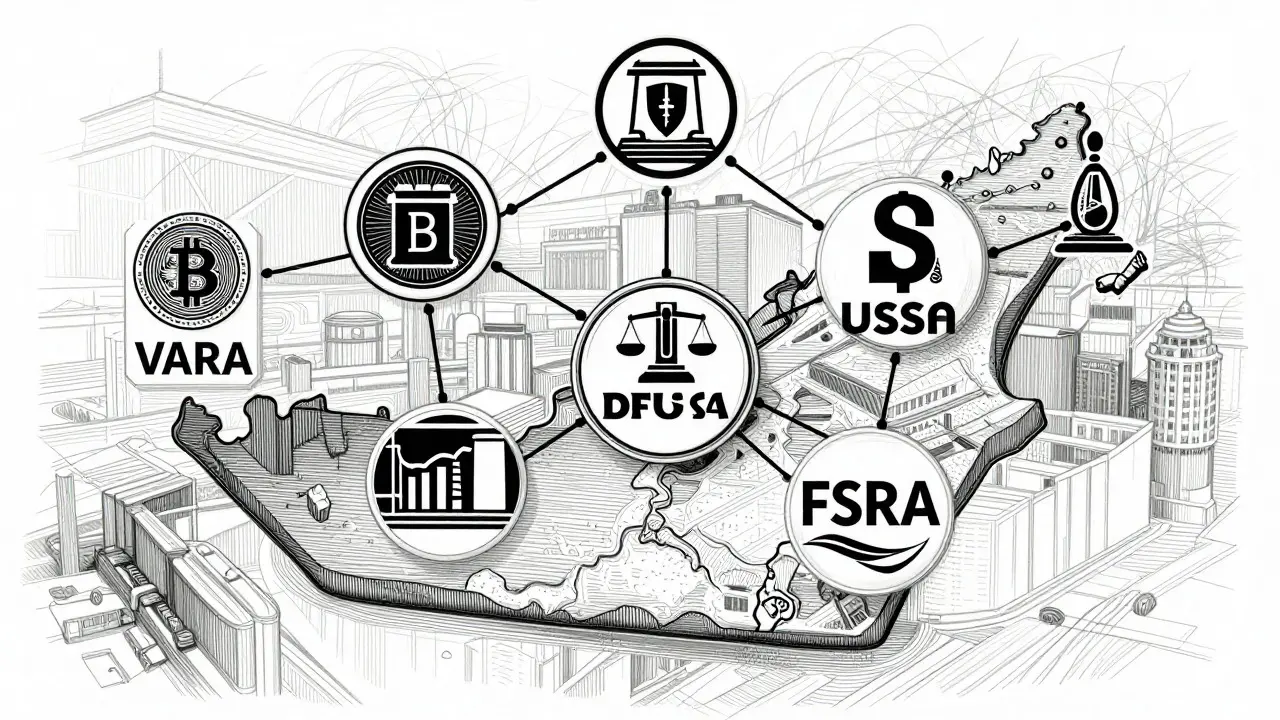
In Dubai, the Virtual Asset Regulatory Authority (VARA) oversees all virtual asset activities outside the financial free zones. VARA provides detailed licensing categories, from basic wallet providers to complex decentralized finance (DeFi) protocols. Their guidelines are public, transparent, and designed to foster innovation while protecting consumers.
In the Dubai International Financial Centre (DIFC), the Dubai Financial Services Authority (DFSA) regulates crypto firms. Similarly, in Abu Dhabi Global Market (ADGM), the Financial Services Regulatory Authority (FSRA) handles oversight. This multi-authority approach might sound complicated, but it actually offers flexibility. You can choose the jurisdiction that best fits your business model, knowing that each regulator is sophisticated and well-resourced.
For investors, this clarity means safety. You know which exchanges are licensed, which custodians are compliant, and where to go if something goes wrong. This reduces counterparty risk significantly compared to unregulated offshore havens.
The Big Shift: CARF and the End of Anonymity
Here is where things get interesting. The UAE has signed the Multilateral Competent Authority Agreement (MCAA) to implement the Crypto-Asset Reporting Framework (CARF). Announced by the Ministry of Finance in late 2025, CARF aligns the UAE with global standards set by the OECD. The goal? Automatic exchange of information on crypto assets between tax authorities worldwide.
Does this mean you will start paying taxes in the UAE? No. Your local tax rate remains zero. But it does mean that if you are a tax resident of another country (like the US, UK, or Germany) but live in the UAE, your home country will eventually see your crypto holdings.
The timeline is structured and predictable:
- 2026: Final regulations are published following public consultation.
- January 1, 2027: CARF implementation begins. Crypto service providers (exchanges, brokers, custodians) must start collecting detailed data.
- 2028: The first automatic exchange of crypto tax data occurs between participating countries.
Under CARF, entities providing crypto services will report:
- Account balances and transaction histories.
- Buying, selling, and exchanging activities.
- Customer identification and residency status.
For the average trader, this means you don’t need to file extra forms yourself. Your exchange will do the reporting. However, it reinforces the importance of maintaining accurate records. If your home country taxes crypto gains, they will now have the data to enforce it. The UAE isn’t hiding your money anymore; it’s just keeping it tax-free locally.

Why the UAE Ranks Among the Top Five Global Destinations
The Henley Crypto Adoption Index gives the UAE a perfect score of 10 for tax-friendliness. But numbers alone don’t tell the whole story. The UAE ranks alongside Singapore, Hong Kong, the USA, and Switzerland because it combines favorable taxation with genuine infrastructure.
Consider these factors:
- Adoption Rates: Over 26% of UAE residents own cryptocurrency. Dubai scores a remarkable 98.5 out of 100 on global crypto enthusiasm rankings. You are not an outlier here; you are part of a vibrant community.
- Wealth Migration: The global count of crypto millionaires jumped 40% in 2025, reaching over 241,000 individuals. The UAE has captured a significant share of this demographic, creating a network effect of expertise, liquidity, and opportunity.
- Visa Programs: The UAE offers specific visas for crypto professionals, including the Golden Visa for high-net-worth investors and specialized permits for blockchain developers and traders. This makes relocation straightforward.
- Infrastructure: From world-class banking to cutting-edge tech hubs, the physical and digital infrastructure supports serious wealth management. Major stablecoin issuers and DeFi protocols have shifted operations to the region to leverage this ecosystem.
User feedback consistently highlights the peace of mind that comes with this setup. Unlike traditional tax havens that offer secrecy but little substance, the UAE offers transparency, stability, and a high quality of life. Social media discussions buzz with excitement about the country’s policies, reflecting a broader trend of digital nomads and crypto entrepreneurs choosing Dubai as their base.
Practical Steps for Crypto Investors Moving to the UAE
If you are ready to capitalize on these advantages, here is a practical checklist to ensure a smooth transition:
- Determine Residency Status: Obtain a residence visa. Tax residency requires meeting specific physical presence criteria (typically 182 days per year). Keep proof of your stay-flights, hotel bookings, utility bills.
- Choose the Right Emirate: Dubai is the hub for most retail traders due to VARA’s comprehensive framework. Abu Dhabi (ADGM) may be better for institutional funds. Research which free zone aligns with your activity.
- Select Regulated Exchanges: Use platforms licensed by VARA, DFSA, or FSRA. This ensures your assets are protected under local law and simplifies future compliance with CARF.
- Maintain Detailed Records: Even though you pay no tax, keep meticulous logs of every transaction: purchase price, sale date, fees, and cost basis. This is critical for personal financial management and potential audits from foreign tax authorities.
- Consult a Local Expert: Regulations evolve. Hire a local accountant or legal advisor familiar with crypto assets to review your structure annually, especially as CARF rolls out in 2027.
The UAE’s position as a bridge between East and West, combined with its tax advantages and regulatory sophistication, suggests sustained growth in crypto adoption. By understanding both the benefits and the upcoming reporting requirements, you can build wealth confidently, knowing your strategy is built on solid ground.
Do I pay any tax on crypto profits in the UAE?
No. Individual residents in the UAE pay zero personal income tax and zero capital gains tax on cryptocurrency profits. This applies to trading, staking, mining, and selling digital assets across all seven emirates.
What is CARF and how does it affect me?
The Crypto-Asset Reporting Framework (CARF) is an international standard for sharing crypto tax data. Starting in 2027, UAE-based exchanges will report your account details to tax authorities. This does not increase your UAE tax bill (which remains zero), but it may affect your tax obligations in your country of origin if you are not a UAE tax resident.
Is the UAE safe for crypto investments?
Yes. The UAE has one of the clearest regulatory frameworks globally, overseen by authorities like VARA in Dubai and DFSA in DIFC. These regulators license and monitor crypto businesses, reducing fraud risk and ensuring consumer protection.
Do I need a business license to trade crypto in the UAE?
Not necessarily. Retail investors trading their own funds do not need a business license. However, if you run a crypto business (like an exchange, fund, or advisory service), you must obtain a license from VARA, DFSA, or FSRA depending on your location and activity.
How much does corporate tax cost for crypto businesses?
Crypto businesses in the UAE pay 0% corporate tax on profits up to AED 375,000. Profits above this threshold are taxed at 9%. Small-scale operations often fall below this limit, effectively remaining tax-free.