
Imagine walking into a branch in Cairo to wire money abroad, only to have your transfer flagged because the destination looks like a crypto exchange. For years, this scenario was a gray area in Egypt. Today, it is a strict compliance reality. If you are banking in Egypt, understanding how Egyptian banks monitor cryptocurrency transactions is no longer optional-it is essential for keeping your account active.
The situation has shifted dramatically since the early 2020s. What started as vague warnings has hardened into concrete legal obligations. The core issue isn't just about whether you can buy Bitcoin; it's about how banks detect these purchases when they happen outside their direct control. This guide breaks down the current regulatory landscape, the specific monitoring techniques banks use, and what you need to know to avoid unnecessary freezes on your funds.
Key Takeaways
- Legal Status: Cryptocurrency trading is unlicensed and restricted under Banking Law No. 194 of 2020, though individual possession remains in a legal gray area rather than being explicitly criminalized for personal use.
- Bank Obligations: Egyptian banks must actively monitor and report suspicious international transfers that resemble crypto purchases, driven by anti-money laundering (AML) mandates.
- Recent Warnings: The Financial Regulatory Authority (FRA) issued renewed warnings in May 2025, specifically targeting aggressive online advertising for crypto investments.
- Detection Methods: Banks use algorithmic monitoring to flag transfers to known exchanges like Binance or Bitget, often requiring users to provide detailed explanations for such payments.
- Regional Contrast: While Gulf nations explore regulated frameworks, Egypt maintains a conservative, prohibitive stance focused on financial stability and capital flight prevention.
The Legal Backbone: Banking Law No. 194 of 2020
To understand why your bank asks so many questions, you have to look at the law. In 2020, Egypt passed Banking Law No. 194. This legislation fundamentally changed the game. Before this, regulations were scattered and ambiguous. The new law gave the Central Bank of Egypt (CBE) explicit power to prohibit the issuance, trading, and promotion of cryptocurrencies without prior approval.
This wasn't just a suggestion. It created a legal obligation for financial institutions. Banks are now required to ensure they do not facilitate unlicensed crypto activities. This means if a bank allows a customer to easily move large sums to a crypto platform without scrutiny, the bank itself risks regulatory penalties. The law effectively criminalizes the *promotion* and *issuance* of crypto within the formal banking sector, pushing all retail activity into an informal or offshore space that banks must then police.
The CBE has maintained this hardline stance through various communications. For instance, a warning issued in March 2023 reiterated that cryptocurrencies lack official backing. They are not considered "real" money by the central bank, which influences how religious bodies like Dar Al-Ifta view them, further reinforcing social and regulatory pressure against adoption.
How Egyptian Banks Monitor Crypto Transactions
You might wonder, "If I buy crypto on an app, how does my local bank even know?" The answer lies in sophisticated transaction monitoring systems. Egyptian banks have invested heavily in compliance technology over the last few years. These systems don't just look at the amount; they analyze patterns.
Here is what triggers an alert in a typical Egyptian bank's system:
- Destination Analysis: Transfers sent to entities identified as cryptocurrency exchanges (e.g., Binance, Rain, Bitget) or payment processors associated with digital assets.
- Transaction Sequencing: Rapid movements of funds-such as receiving a salary and immediately wiring it out to an international fintech service-are flagged as potential conversion activities.
- Peer-to-Peer (P2P) Patterns: Multiple small transfers from different individuals to one account, followed by a single large withdrawal, often indicate P2P crypto trading.
- Keyword Triggers: Some systems scan memos or reference fields for terms like "BTC," "ETH," or "exchange."
When a flag is raised, the bank’s compliance team steps in. You might receive a call or an email asking for the purpose of the transfer. If you cannot provide a legitimate commercial reason, the transaction may be held or reversed. In stricter cases, accounts showing repeated unexplained crypto-related flows face closure.

The Role of the Financial Regulatory Authority (FRA)
While the Central Bank handles the banking mechanics, the Financial Regulatory Authority (FRA) oversees the broader market conduct. Their role became particularly visible in May 2025. The FRA issued a sharp warning against the surge in local online advertisements promoting cryptocurrency investments.
Why did this trigger such a strong response? Because marketing creates expectation. When Egyptians see ads promising high returns, they assume safety. The FRA clarified that there is no investor protection mechanism for crypto. If an exchange collapses or a scam occurs, the state will not bail you out. This distinction is critical for compliance. Banks are expected to align with the FRA’s risk assessments, meaning they treat crypto exposure as high-risk, similar to speculative derivatives.
Experts note that the FRA’s focus extends beyond simple investment risk. There is a significant concern regarding terrorist financing. Because crypto transactions can obscure the ultimate beneficiary, regulators worry that illicit funds could enter the traditional banking system via crypto conversions. This fear drives the rigorous due diligence banks apply to international wires.
Challenges for Banks and Customers
Navigating this landscape is difficult for everyone involved. For banks, the challenge is technological and operational. Implementing effective crypto-detection algorithms takes time-often 6 to 12 months for full deployment. Banks must train staff who previously dealt with standard fiat currencies to understand blockchain mechanics. Without domestic expertise, many rely on international compliance vendors to update their watchlists of crypto-related entities.
For customers, the friction is immediate. Many Egyptians still access global markets via platforms like Binance or Bitget. However, funding these accounts requires moving money out of Egypt. This is where the bottleneck happens. Users report increased scrutiny on international transfers. If you try to send $500 to a known exchange, expect a delay while the bank verifies the source of funds and the nature of the recipient.
| Country/Region | Regulatory Stance | Banking Access | Primary Concern |
|---|---|---|---|
| Egypt | Prohibitive / Unlicensed | Restricted; High Scrutiny | Capital Flight & AML |
| UAE (Dubai) | Regulated Frameworks | Open; Licensed Entities | Innovation & Market Growth |
| Saudi Arabia | Cautious / Ban on Exchanges | Limited Direct Access | Financial Stability |
| Bahrain | Progressive Licensing | Strong Support | Fintech Leadership |
This table highlights how isolated Egypt’s approach is compared to its neighbors. While Dubai welcomes crypto firms with licenses, Egypt pushes them away. This divergence forces Egyptian traders to become experts in cross-border payment logistics, often using intermediary services that add cost and complexity.
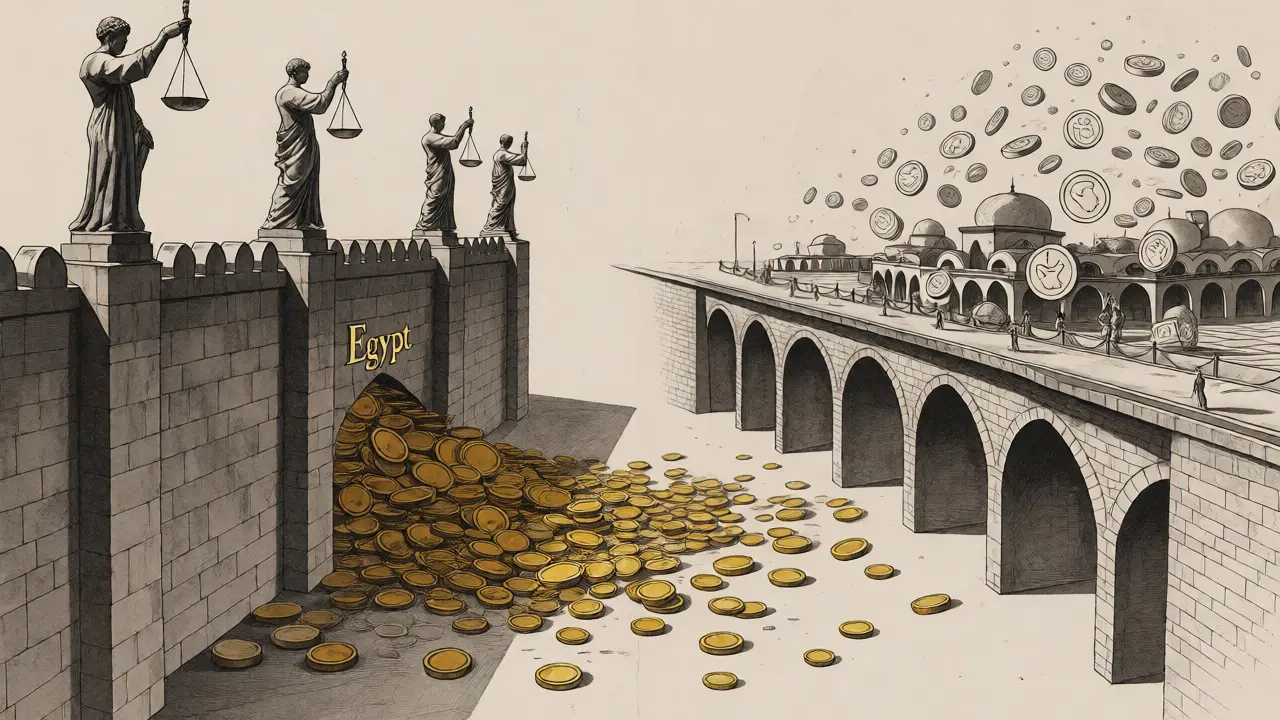
Practical Steps for Managing Crypto Exposure in Egyptian Banks
If you hold crypto and maintain an Egyptian bank account, you need a strategy. Ignoring the rules usually leads to headaches later. Here is a practical checklist to minimize friction:
- Maintain Clean Records: Keep screenshots of your transactions on international exchanges. If your bank queries a transfer, having proof of purchase helps clarify intent.
- Avoid Large Round Numbers: Transfer amounts that look like business invoices (e.g., $1,250 instead of $1,000) may appear less suspicious than round figures often used in manual crypto trades.
- Use Local P2P Carefully: If selling crypto locally for EGP, ensure the buyer uses a reputable method. Sudden inflows from unknown individuals can trigger AML flags.
- Communicate Proactively: If you plan a large international transfer, notify your bank relationship manager beforehand. Explain that it is for educational subscriptions, software services, or other verifiable non-crypto purposes if applicable.
- Monitor Account Activity: Regularly check for holds or inquiries. Addressing a query within 24-48 hours prevents escalation to account suspension.
Remember, the goal of the bank is not to stop you from owning Bitcoin. It is to prevent the banking system from being used as a conduit for unregulated, high-risk capital movement. By demonstrating transparency, you reduce the likelihood of automated systems marking you as a high-risk client.
The Future of Crypto Regulation in Egypt
Will Egypt change its mind soon? Probably not in the immediate future. The current trajectory suggests tightening enforcement rather than relaxation. The May 2025 FRA warning indicates that regulators are watching market sentiment closely. As long as economic challenges persist and currency management remains a priority, the Central Bank will likely prioritize controlling capital outflows over embracing decentralized finance.
However, the conversation hasn't ended. Discussions around a Central Bank Digital Currency (CBDC) continue. If Egypt launches a digital pound, it might offer a controlled alternative to private cryptocurrencies. Until then, the status quo holds: crypto exists in the shadows of the formal economy, monitored but not fully integrated.
Is buying cryptocurrency illegal in Egypt?
Buying cryptocurrency for personal use is not explicitly criminalized for individuals, but it is unlicensed. The Banking Law No. 194 of 2020 prohibits the issuance, trading, and promotion of crypto without CBE approval. This places individual ownership in a legal gray area, while making commercial promotion illegal.
Why do Egyptian banks freeze accounts related to crypto?
Banks freeze accounts when transaction patterns suggest unlicensed crypto trading that violates Anti-Money Laundering (AML) laws. Frequent transfers to known exchanges or rapid P2P settlements raise red flags. Banks act to comply with CBE directives to prevent money laundering and unauthorized capital flight.
Can I use Binance from an Egyptian bank account?
Yes, but with difficulty. You cannot directly link most Egyptian bank cards to Binance for instant deposits. Most users rely on P2P transfers or international wire transfers, which require careful explanation to the bank to avoid holds or reversals.
What did the FRA warn about in May 2025?
The FRA warned against the surge in local online advertisements promoting cryptocurrency investments. They emphasized that crypto lacks regulatory protection for investors and highlighted risks related to fraud, volatility, and terrorist financing.
Does Dar Al-Ifta consider Bitcoin haram?
Dar Al-Ifta has stated that Bitcoin is not considered "real" money because it lacks central bank issuance. While not always issuing a blanket fatwa banning all usage, their guidance reinforces the regulatory view that crypto lacks the legal tender status required for mainstream acceptance in Egypt.