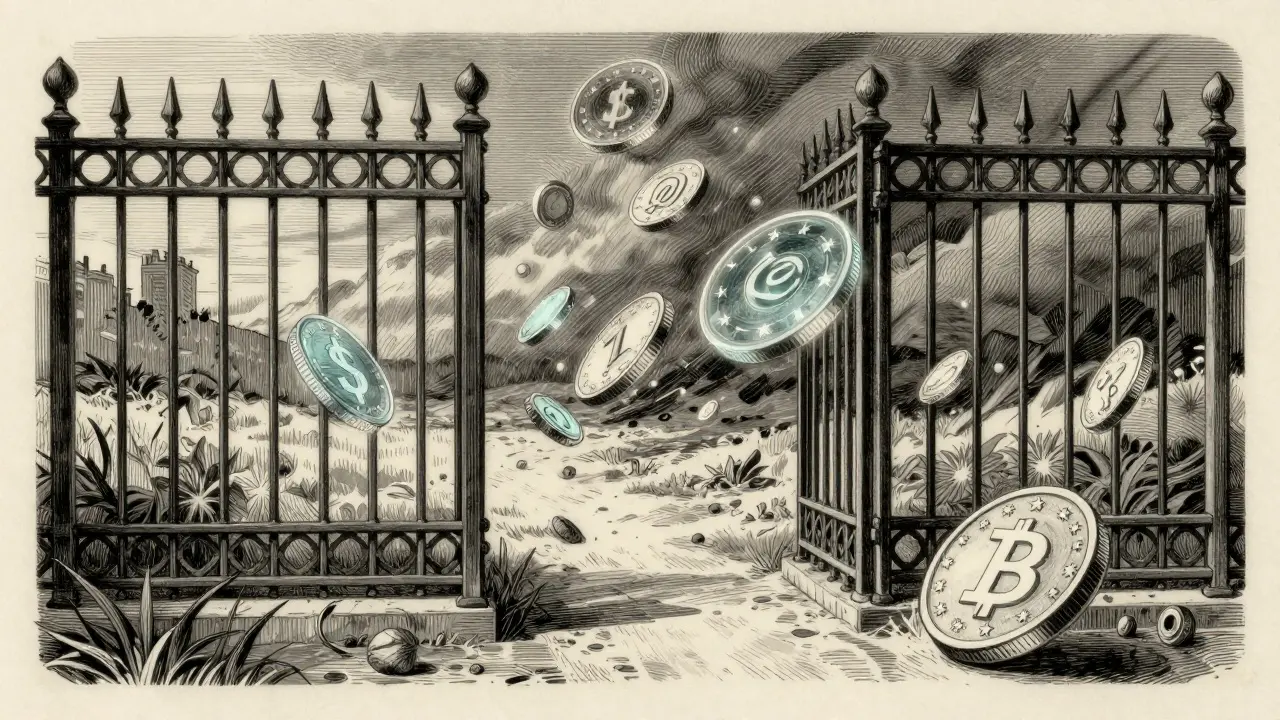
Imagine waking up to find your favorite trading pair has vanished from your exchange. For millions of European traders, this isn't a nightmare-it's the reality of the EU stablecoin restrictions now in full effect. The European Union has finally put a leash on the wild west of digital dollars and euros through a massive regulatory overhaul called MiCA. If you've been holding Tether (USDT) or other popular stablecoins, the rules of the game have changed fundamentally.
The Big Picture: What is MiCA?
The Markets in Crypto-Assets (MiCA) is a comprehensive regulatory framework designed to bring legal certainty and consumer protection to the crypto market across all 27 EU member states. Launched to prevent the kind of systemic collapses we saw in previous years, MiCA doesn't just "suggest" rules; it mandates them. If a stablecoin issuer doesn't play by these rules, they simply cannot be traded on regulated platforms within the EU.
Under MiCA, the EU has split stablecoins into two buckets. First, there are Asset-Referenced Tokens (ARTs), which are tokens backed by several different assets or currencies. Then, there are E-Money Tokens (EMTs), which are specifically designed to maintain a stable value by referencing a single official currency, like the Euro or the US Dollar.
Why USDT is in the Hot Seat
You've probably noticed that USDT is often the center of these conversations. Tether, the company behind USDT, has historically operated with a level of opacity that makes EU regulators nervous. MiCA requires a strict one-for-one reserve ratio. This means for every 1 USDT in circulation, there must be exactly 1 dollar (or equivalent liquid asset) held in a bankruptcy-protected structure.
Because USDT hasn't fully aligned with these rigid transparency and reserve standards, it is classified as non-compliant. This puts Crypto-Asset Service Providers (CASPs)-basically your exchanges like Binance or Kraken-in a tough spot. By the end of January 2025, these platforms were required to delist non-compliant stablecoins. If you're using an EU-regulated exchange today, you'll notice that USDT is either gone or restricted to basic custody and transfers, meaning you can hold it, but you can't trade it for other coins.
| Feature | MiCA-Compliant Stablecoins | Non-Compliant (e.g., USDT) |
|---|---|---|
| Reserve Ratio | Strict 1:1, bankruptcy-protected | Variable/Internal auditing |
| Redemption Rights | Guaranteed par value redemption | Issuer-dependent terms |
| EU Trading Status | Fully legal on regulated CASPs | Delisted or restricted |
| Supervision | Directly overseen by EU authorities | Operates outside EU jurisdiction |
The Redemption Right: A Game Changer for Users
One of the most practical wins for the average person under MiCA is the legal right to redemption. In the past, if a stablecoin issuer decided to stop honoring withdrawals or crashed, you were essentially out of luck. Now, MiCA grants holders a fundamental right to redeem their tokens at par value. If you have 100 compliant tokens, the issuer must give you 100 units of the referenced currency.
This is a direct response to the "fragility of the peg" that the Bank for International Settlements (BIS) warned about in 2025. When a stablecoin deviates from its 1.00 value, it's usually because users don't trust the reserves. By mandating these reserves, the EU is trying to make sure a "stable" coin actually stays stable.
EU vs. USA: The Regulatory War
While Europe is tightening the screws, the US has taken a slightly different path. On July 18, 2025, the US signed the GENIUS Act. Like MiCA, the GENIUS Act wants reserve transparency and bankruptcy protection, but it's generally more lenient on how companies implement these rules. The US treats these as "payment stablecoins," viewing them more as a tool for innovation and faster payments rather than just a financial risk to be managed.
This difference has created a bit of a tug-of-war. The US is actively trying to attract crypto business through "Project Crypto," a strategy focused on rapid onshoring. Meanwhile, European banks aren't just sitting around. A consortium of nine major banks, including ING and UniCredit, is currently building its own MiCA-compliant, euro-denominated stablecoin. They want to ensure Europe has its own financial infrastructure so it doesn't have to rely on US-based companies like Tether or Circle.
What This Means for Your Portfolio
If you are an investor based in Europe, you can't just ignore these changes. The transition period has already caused significant disruptions. Many traders who relied on USDT for liquidity have had to pivot to compliant alternatives or move their assets to non-EU platforms-though the latter comes with its own set of legal and security risks.
For those using decentralized finance (DeFi), the impact is more complex. While MiCA targets centralized exchanges (CASPs), the lack of compliant liquidity on those exchanges trickles down to DeFi protocols. If the primary "on-ramps" to the ecosystem are restricted, the volume of tokens flowing into DeFi apps naturally drops.
How to Navigate the New Rules
If you're feeling overwhelmed by the changes, here is a simple way to handle your assets moving forward:
- Check your exchange: Look at the "Terms of Service" or announcements from your platform to see which stablecoins they've flagged as non-compliant.
- Verify redemption rights: If you're moving into a new stablecoin, check if the issuer is licensed as an E-Money Institution in the EU.
- Diversify: Don't keep all your liquidity in a single non-compliant token. The risk of a sudden delisting is now a concrete operational reality, not just a theoretical fear.
- Monitor the 2026 launch: Keep an eye on the European bank consortium stablecoin. It's expected to launch in the second half of 2026 and will likely be the safest bet for Euro-based stability.
Can I still hold USDT in Europe?
Yes, you can hold USDT in a private wallet or via custody services at some exchanges. However, you will find it nearly impossible to trade USDT for other cryptocurrencies on any exchange that is officially licensed to operate within the EU under MiCA.
What happens if my exchange delists my stablecoins?
Regulated CASPs are required to provide you with options to convert your non-compliant tokens into compliant ones or allow you to withdraw them to an external wallet. They cannot simply seize your assets, but they can stop you from trading them.
Is the GENIUS Act the same as MiCA?
Not exactly. While both focus on 1:1 reserves and consumer protection, the US GENIUS Act is more flexible in its implementation and treats stablecoins more like electronic payment tools. MiCA is more stringent and focused on systemic financial stability and strict licensing.
What is an E-Money Token (EMT)?
An E-Money Token is a type of crypto-asset that refers to the value of a single official currency. Under MiCA, these are the gold standard for stablecoins because they provide a direct link to a fiat currency and guarantee redemption rights for the holder.
Are DeFi protocols affected by MiCA?
Indirectly, yes. While MiCA primarily regulates centralized intermediaries (CASPs), the restriction of non-compliant stablecoins on those exchanges reduces the liquidity available for DeFi protocols, making it harder for users to move funds in and out of decentralized apps.

Typical power grab by the EU bureaucracy. They claim it's for "consumer protection" but really it's just a way to strangle any asset that they can't fully track or manipulate. The obsession with a 1:1 reserve is a facade to force everyone into these bank-led stablecoins they're building behind the scenes. Wake up people. They want you in a closed loop where your "digital euros" can be frozen with a single keystroke from some faceless regulator in Brussels. The GENIUS Act is just the American version of the same leash, just with a friendlier name to trick the masses into thinking it's about "innovation." It's all about control, always has been and always will be. Once they kill off the independent stablecoins, the central bank digital currencies (CBDCs) will slide right in and we'll have zero privacy left in our financial lives.
The transition to MiCA is indeed a significant milestone for the European financial landscape. It is imperative for investors to recognize that the strict requirements for E-Money Tokens are designed to mitigate systemic risks that have previously plagued the cryptocurrency market. By ensuring that issuers maintain high-quality liquid assets and provide guaranteed redemption rights, the European Union is establishing a framework that prioritizes stability over speculative growth. One should carefully evaluate the licensing status of any entity providing custody services to ensure full compliance with these regulations.
It's really a learning curve for everyone! Moving your assets to a private wallet is a great way to stay safe while you figure out which compliant coins to trust. We can all help each other navigate this new era of digital finance together.
wild west indeed lol... just feels like a total whirlwind of rules and red tape. honestly just moving everything to a cold wallet and vibing until this settles down sounds like a plan
Stay chill everyone. Just a shift in the wind.
it's honestly so stressful trying to keep up with these changes i feel for everyone who woke up to restricted accounts
I guess we just have to go along with it if we want to use the big exchanges. It would be just great if there were more options right now, but I'm sure the bank consortium will be just wonderful once it actually launches.
This is actually a positive step toward long-term adoption. Having a clear legal framework might feel restrictive now, but it will likely attract institutional investors who were too scared of the legal gray areas. I believe this creates a safer environment for the average person to enter the space without worrying about a total collapse of their holdings. It's all about building a sustainable bridge between traditional finance and the blockchain. The fact that we now have a legal right to redemption is a huge win for the little guy. In the long run, transparency only helps the market grow stronger. We can look forward to a more mature ecosystem where "stability" isn't just a marketing term but a legal guarantee. It's an exciting time to watch the infrastructure evolve, even if the transition is a bit bumpy for some traders today.