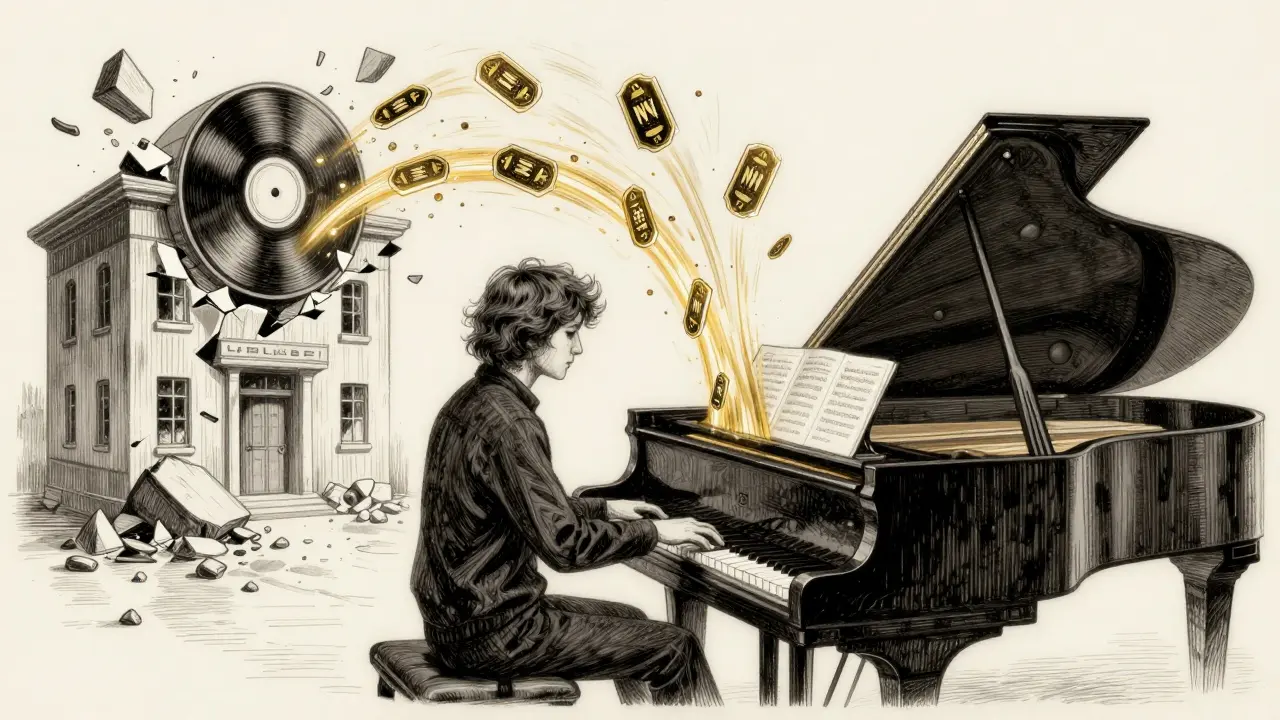
Back in 2021, when Kings of Leon dropped their album as an NFT and made $2 million in a week, it felt like a wild experiment. Today, in 2026, that experiment has turned into something real. NFTs in the music industry aren’t just digital collectibles anymore-they’re changing how artists get paid, how fans connect, and who actually owns the music. The hype has faded, but the utility? It’s growing fast.
How NFTs Are Fixing Music’s Broken Pay System
For decades, artists have been stuck in a system where streaming platforms take 85% of the revenue. Spotify pays about $0.003 per stream. That means an artist needs over 300,000 streams just to make $1,000. Meanwhile, record labels, distributors, and middlemen take cuts that can stretch for months before the artist sees a dime. NFTs cut out the middlemen. When an artist sells a song as an NFT-whether it’s a full album, a single, or even a fraction of the royalty rights-they set the terms directly. Platforms like Royal and Opulous let artists program smart contracts that automatically send 5-10% of every resale back to them. That’s right: every time someone flips the NFT, the artist gets paid again. No waiting. No bureaucracy. In 2025, independent artists using NFTs reported earning 70-90% of revenue from direct sales, compared to the 12-15% they’d make on Spotify. Electronic artist 3LAU made $11.7 million from his NFT album in 2021 and still gets quarterly payments from secondary sales. That kind of model doesn’t exist anywhere else in music.Three Types of Music NFTs That Actually Work
Not all NFTs are created equal. By 2025, three clear models emerged as the most valuable:- Royalty NFTs (Royal, Opulous): These let fans buy a share of future streaming income. Each NFT might represent 0.0001% of a song’s publishing rights. If the song hits 10 million streams, the holder gets a tiny payout-maybe $0.50. But if you own 100 of them? That’s $50. And since payments happen in 72 hours, not 12 months, it feels real.
- Experience NFTs (Yellowheart, Moment House): These aren’t just art. They’re tickets to exclusive shows, studio sessions, or even voice notes from the artist. A 2024 Billboard study found fans who bought experience NFTs were 73% more likely to stay engaged with the artist long-term. One fan in Austin bought an NFT for a private Zoom call with a synth-pop band. Two years later, they’re still buying merch and showing up to every live show.
- Collectible NFTs (Sound.xyz, Catalog): These are digital albums with artwork, animations, and sometimes hidden tracks. They sell for 0.5-2 ETH ($1,500-$6,000). But unlike traditional vinyl, these come with built-in royalties. Buy one, and you’re not just owning a piece of art-you’re owning a stake in its future.
These aren’t speculative gambles anymore. 78% of new music NFTs in 2025 offered real, usable benefits-not just JPEGs with a fancy name.
Who’s Using NFTs-and Who’s Not
The biggest shift? NFTs are no longer just for indie artists. In 2025, 68% of music NFT creators were independent, according to Soundcharts. But even major labels are jumping in. Universal Music Group launched its own platform, Eiffel, in late 2024. It now handles 15% of UMG’s NFT sales. That’s not a side project-it’s a strategic move. Genres matter too. Electronic and dance music lead the way, making up 42% of all music NFT sales. Why? Because their fans are already deep into digital culture, crypto wallets, and virtual concerts. Pop and hip-hop are catching up, but slower. Traditional rock acts? Still mostly on the sidelines. On the fan side, adoption is still low. Only 15% of music listeners own cryptocurrency, per Statista’s 2025 report. That’s the biggest bottleneck. You can’t buy an NFT if you don’t have a wallet. And setting one up? Still too complicated for most people.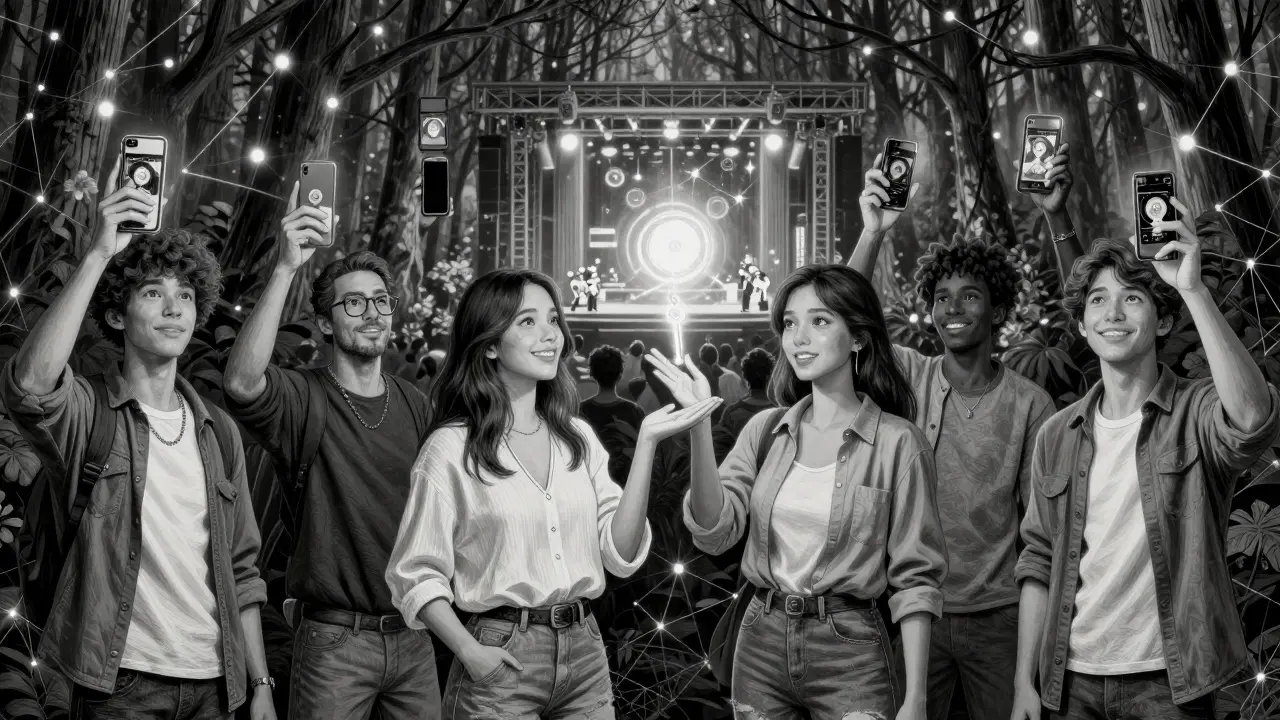
The Tech Behind the Scenes
Most music NFTs run on Ethereum-but not because it’s the best. It’s because it’s the most trusted. But gas fees were killing artists. A single mint could cost $1.20. That’s not feasible for a $10 album drop. Enter Polygon and Solana. By 2025, 38% of music NFTs moved to these blockchains. Polygon, in particular, slashed transaction costs to $0.01. Artists now mint albums for less than the price of a coffee. That’s why platforms like Sound.xyz switched entirely to Polygon in 2023. Their user base doubled in six months. Smart contracts are the real magic. ERC-721 and ERC-1155 standards let artists build rules into their NFTs: “Pay 7% to the producer,” “Give 3% to the engineer,” “Send 5% to charity.” No one has to chase payments. The code does it. And it’s not just about sales. Platforms like Audius (with 6.5 million monthly users) let artists upload music directly to a decentralized network. No label. No distributor. Just upload, mint, and sell. They handle 400,000 uploads a day.The Problems Still Standing
NFTs aren’t perfect. And they never will be. First, copyright. Only 41% of music NFTs in 2025 properly documented who owned what rights. A song might have five writers, a producer, a sample clearance, and a label stake. If the NFT doesn’t track all of them, someone gets left out. The Mechanical Licensing Collective found that 65% of royalty NFT payouts were incomplete or incorrect. Second, user experience. A 2024 Berklee study showed only 28% of artists felt confident using NFT platforms. Connecting a wallet, paying gas fees, understanding tokens-this isn’t intuitive. One artist from Nashville spent 28 hours learning how to mint before selling her first NFT. Platforms like Sound.xyz cut that to 12 hours, but it’s still too much. Third, regulation. The EU’s MiCA framework gave some clarity in 2024. But in the U.S., the IRS treats NFT sales as barter transactions. Artists have to report them as income-and figure out capital gains. The U.S. Copyright Office now requires platforms to verify ownership before minting. That’s good. But it’s also slow. One indie artist waited 11 weeks for approval on her NFT drop. And then there’s trust. In 2022, rapper Lil Pump sold NFTs promising backstage passes, merch, and studio time. None of it happened. He paid out $1.2 million in a class-action settlement. Fans remember that.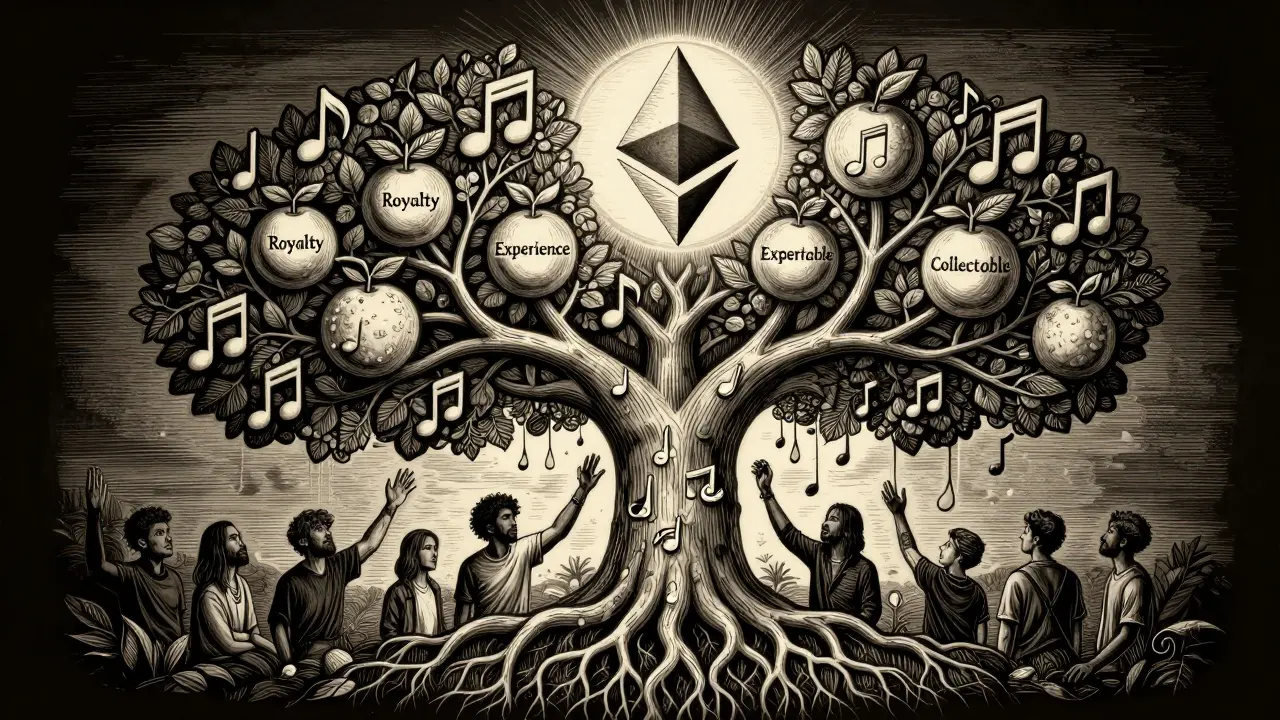
What’s Next? The Road to 2027
The future of music NFTs isn’t about buying JPEGs. It’s about integration. Spotify partnered with Polygon in early 2025 to let users unlock NFT perks based on their streaming history. Listen to an artist’s songs 50 times? Get a free NFT. That’s how you bring non-crypto fans in. Fortnite hosted 120 virtual concerts in 2024, selling $47 million in NFT tickets. Imagine a future where your favorite artist drops a new song-and you get an NFT that unlocks a live performance inside a game. Sony’s Dream Machine AI creates personalized album art based on your listening habits. Buy the NFT, and you get art that only you’ve ever seen. That’s not just a collectible. It’s emotional. The Music Blockchain Alliance is working on a universal royalty standard by mid-2026. If they succeed, every NFT, every platform, every artist will speak the same language. That’s the real goal.Should You Care?
If you’re an artist: NFTs are a lifeline. You can earn more, faster, and keep control. You don’t need a label. You just need a wallet and a story. If you’re a fan: You don’t have to buy an NFT to support music. But if you want to own a piece of your favorite artist’s future-get involved. Start small. Buy a $5 royalty share. See how it works. The music industry is broken. NFTs aren’t the fix. But they’re one of the first tools that actually put power back in the hands of creators. And that’s worth paying attention to.Are music NFTs still worth buying in 2026?
Yes-but only if you’re buying utility, not hype. The speculative bubble burst in 2023. Today, the best music NFTs offer real benefits: royalty shares, exclusive access, or digital collectibles with embedded rights. Avoid NFTs that promise “future value” without clear perks. Look for platforms like Royal, Sound.xyz, or Opulous that show transparent payment histories and clear terms.
Can I earn money from music NFTs as a fan?
Absolutely. Royalty NFTs let you earn small payments every time a song streams. For example, if you own 1,000 shares of a song that gets 1 million streams at $0.001 per share, you’d earn $1,000. Most fans earn less-often $5-$50 per year-but it’s passive income with no extra work. The key is buying into songs that already have traction, not just new drops.
Do I need cryptocurrency to buy music NFTs?
Yes, right now. You need a crypto wallet like MetaMask and some ETH, SOL, or MATIC to buy NFTs. But platforms are working on credit card options. Sound.xyz and Royal now let you use PayPal or Apple Pay to fund your wallet, but you still need to connect a wallet to claim the NFT. Expect simplified, wallet-free purchases by 2027.
How do I know if a music NFT is legitimate?
Check three things: 1) Does the artist verify the NFT on their official social media? 2) Is the smart contract published on a blockchain explorer like Etherscan? 3) Does the platform have a clear refund or dispute policy? Avoid NFTs that come with vague promises like “exclusive access” without dates or details. Stick to platforms with high Trustpilot ratings (4+ stars) and public transaction histories.
What happens if an artist deletes their NFT collection?
Nothing. Once an NFT is minted on the blockchain, it can’t be deleted. Even if the artist removes the artwork from their website, your NFT still exists on the blockchain. You still own the rights you were granted-royalties, access, etc. The only thing that disappears is the digital file, which is why smart NFTs include links to decentralized storage like IPFS, not just centralized servers.
Are music NFTs environmentally friendly?
Yes, if they’re on the right blockchain. Ethereum switched to a proof-of-stake system in 2022, cutting its energy use by 99.95%. Today, most music NFTs use Ethereum, Polygon, or Solana-all of which are far more efficient than Bitcoin or early blockchain models. A single transaction on Polygon uses less energy than sending an email. Environmental concerns are largely outdated for music NFTs in 2026.
Man, I just bought my first royalty NFT last week - $5 on a little indie lo-fi artist’s track. Got like 12 cents so far… but it felt weirdly meaningful? Like I’m not just scrolling past her music anymore. I’m in it. 🤝🎧
Let’s be real - this whole ‘utility’ narrative is just corporate rebranding for speculative gambling. The moment a label like UMG gets involved, you know it’s about control, not liberation. They’re not empowering artists - they’re packaging dissent as a subscription model. And don’t get me started on how ‘decentralized’ platforms still require KYC. 🤡
Oh wow, so now we’re pretending NFTs are ‘ethical’ because they’re on Polygon? That’s like saying a Tesla is eco-friendly because it doesn’t use gasoline… while the factory burns coal. The entire system is built on extractive capitalism - just with more blockchain buzzwords. And don’t even get me started on how 78% of these NFTs still have zero legal enforceability. Artists are being sold a fantasy while lawyers quietly rewrite the terms. 😭
It is worth noting that the underlying assumption - that blockchain redistributes power - is fundamentally flawed. Power does not decentralize; it migrates. The entities that control wallet infrastructure, gas fee liquidity, and verification protocols - often venture capital-backed firms - now hold de facto sovereignty over artistic livelihoods. The artist may mint, but the platform sets the rules. This is not liberation. It is algorithmic feudalism, draped in the aesthetics of Web3. The illusion of ownership is the most effective form of control.
Furthermore, the notion that ‘fans can earn passive income’ is a statistical mirage. The top 0.1% of NFT holders receive 94% of all royalty payouts. The remaining 99.9% are incentivized to believe in participation as virtue, while the system funnels wealth upward. This is not economic justice - it is gamified extraction with better UI.
And yet, one cannot ignore the psychological shift: fans now feel they have a stake. This is not trivial. It is the same mechanism that once made stock options feel like equity to Silicon Valley interns. The feeling of belonging is weaponized to obscure structural inequality.
When the EU mandates ownership verification, and the IRS treats NFTs as barter, we are not witnessing innovation - we are witnessing the state catching up to a deregulated market that was never meant to be regulated. The blockchain is not neutral. It is a tool. And tools reflect the intentions of those who wield them.
The real question is not whether NFTs work - but for whom they work. And the answer, as always, is not the artist. Not the fan. But the architect.
Perhaps the most tragic irony is this: the very technology designed to dismantle intermediaries has created a new class of gatekeepers - the blockchain engineers, the smart contract auditors, the wallet custodians. They are the new record executives. And they never even had to sign a contract.
Just wanted to say I’ve been following this since 2022. I used to think NFTs were a scam. Then I bought a $3 royalty NFT from a folk singer in Oregon. She sent me a handwritten letter with the album. That’s it. No hype. No JPEG. Just… connection. I don’t care if it makes money. It made me care again. Maybe that’s the real upgrade.
Let me be the first to say it: if you’re still buying music NFTs in 2026, you’re either a crypto bro who thinks ‘utility’ is a buzzword or a sucker who thinks a JPEG with a smart contract is art. You’re not supporting artists - you’re funding a pyramid scheme disguised as a movement. And if you think the ‘environmental concerns are outdated’ - you’ve been fed propaganda by the same people who told you Bitcoin was the future of finance. Wake up. This isn’t progress. It’s digital cultism with better graphics.