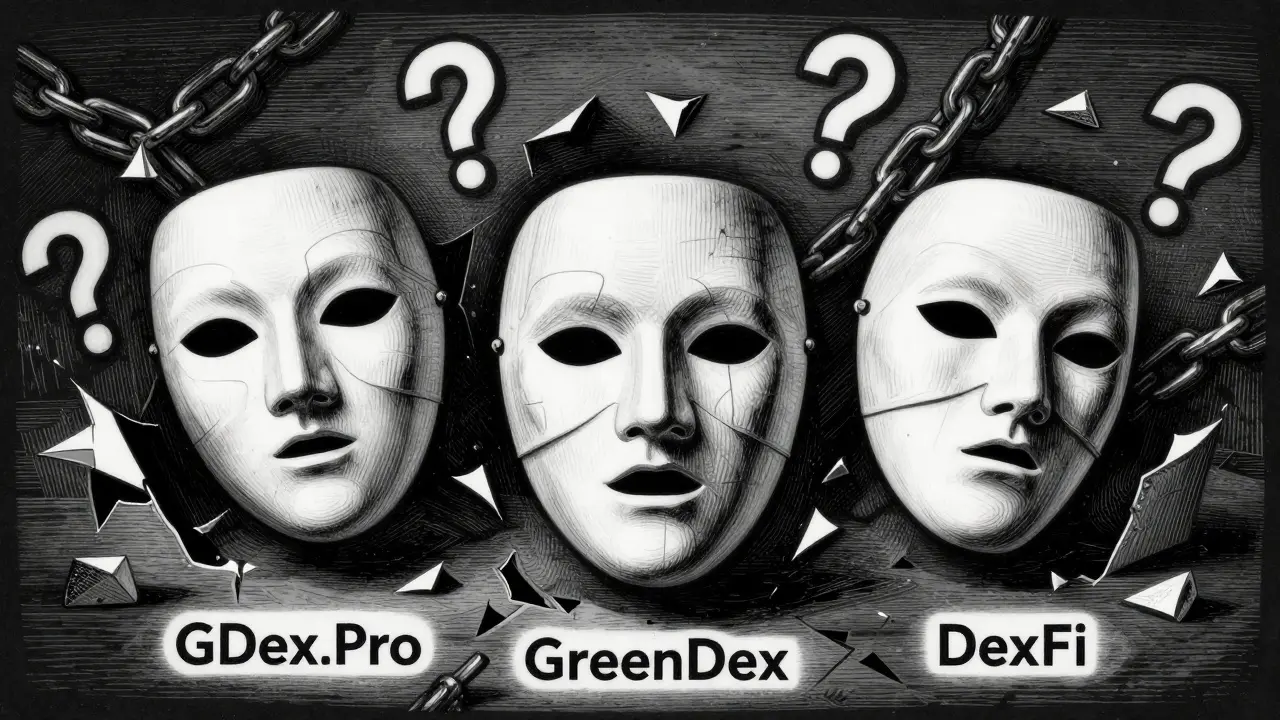
You’ve probably seen the name GDEX pop up in your crypto feeds. Maybe you’re looking for a new decentralized exchange to trade on, or perhaps you bought some tokens with that ticker and want to know if they have any real value. Here is the hard truth right out of the gate: there is no single "GDEX" platform. The name is shared by at least three completely different projects, and most of them are struggling to find users, liquidity, or even a clear purpose.
If you are thinking about depositing money into a platform called GDEX, you need to pause. In the world of decentralized finance (DeFi), confusion is often a red flag. This review breaks down exactly what these entities are, why they share a name, and whether any of them deserve your attention in 2026.
The Identity Crisis: Which GDEX Are You Looking At?
The biggest problem with researching GDEX is that you aren’t looking at one company. You are likely looking at one of three distinct entities that happen to use similar branding. This isn’t just a minor naming overlap; it’s a fundamental difference in technology, tokens, and viability.
First, there is GDex.Pro, developed by Gemach DAO, a decentralized cross-chain exchange interface launched in late 2023. This platform tries to position itself as a user-friendly aggregator for swapping tokens across networks like Ethereum and BNB Chain.
Second, there is GreenDex, which uses the token symbol GED. This project claims to have been in development since 2019 but remains largely invisible in the actual market. It promises AI-powered analysis but has failed to list its token on major exchanges.
Third, there is DexFi Governance, which uses the token symbol GDEX. This is an ERC-20 governance token for a protocol called DexFi. It allows holders to vote on platform changes, but it is not an exchange itself.
Understanding which one you are dealing with is step one. If you see a site promising high returns using the GDEX name, check the URL carefully. Are you on gemach.io? gdex.finance? Or somewhere else entirely? The difference matters immensely for your security.
Deep Dive: GDex.Pro by Gemach DAO
Of the three, GDex.Pro is the most active in terms of marketing and feature updates. Launched by Gemach DAO in Q3 2023, it positions itself as a modern DeFi interface. But does it deliver?
The platform boasts six core features designed to simplify trading:
- DISCOVERY: Helps you find new token pairs before they hit mainstream charts.
- PORTFOLIO: A dashboard to track your assets across chains.
- MEMESCOPE: A feed specifically for meme coins, catering to speculative traders.
- BUBBLE MAP: Visualizes market cap data to spot trends quickly.
- BRIDGE: Facilitates cross-chain swaps between Ethereum, Arbitrum, and Aptos.
- COPYTRADE: Allows users to replicate the strategies of successful wallets.
One unique selling point for GDex.Pro is its integration with Apple Pay for fiat onboarding. Most DEXs require you to already have crypto to start trading. GDex.Pro claims you can buy crypto directly with a $50 minimum via Apple Pay. However, independent verification of this feature’s reliability is scarce. While Gemach DAO reports high internal satisfaction scores, external reviews on platforms like Trustpilot are non-existent as of late 2024.
Technically, GDex.Pro supports Ethereum, BNB Chain, Arbitrum, and Aptos. They announced plans to integrate zkSync and Optimism in early 2025. But here is the catch: despite the fancy interface, the underlying liquidity is thin. You might be able to swap tokens, but the slippage (the difference between expected price and executed price) can be significant because there aren’t enough deep pools backing the trades.
The Ghost Project: GreenDex (GED)
If you are holding GED tokens, you are likely frustrated. GreenDex is a classic example of a project that talks more than it delivers. Claiming implementation since 2019, GreenDex promised an AI-driven exchange ecosystem across SUI, ARB, ZK, and APT networks.
Here is the reality check from 2026: GreenDex is effectively dormant. According to data from HOLDER.IO in mid-2024, the GED token was not listed on any major exchange. Its price was unknown because there was no public market for it. The token allocation plan looked ambitious on paper-29% reserved for staking, 15% for presale-but without liquidity, those percentages mean nothing.
Community sentiment is overwhelmingly negative. On Reddit, experienced DeFi users warned against buying GED, citing the five-year delay in listing as a sign of abandonment. When a project cannot get its token onto a reputable exchange after half a decade, it usually indicates technical failure or lack of investor interest. For anyone considering buying GED, the advice is simple: don’t. The risk of total loss is near certain.
DexFi Governance (GDEX Token): Minimal Impact
Then there is the GDEX token associated with DexFi Governance. Unlike GreenDex, this token is live and tradable, but its impact is negligible. Listed on CoinGecko since 2022, it serves purely as a governance tool. Holding 1,000 GDEX tokens gives you voting rights on protocol parameters.
But who is voting? In all of 2024, only three governance proposals were submitted, and they passed with over 90% approval. These were trivial changes, suggesting a lack of active community engagement. The token ranks beyond #500 on major trackers, with daily trading volumes hovering around $12,000. Compare that to Uniswap’s UNI token, which sees billions in volume, and the disparity is stark.
For investors, GDEX offers little utility outside of speculation. There are no revenue-sharing mechanisms, no staking rewards that compete with industry standards, and no technological breakthroughs. It is a governance token for a protocol that few people use.
Liquidity and Performance: The Real Problem
In crypto, liquidity is king. Without it, you cannot buy or sell efficiently. All GDEX-branded platforms suffer from severe liquidity issues.
| Platform/Token | 24h Volume | Market Status | User Feedback |
|---|---|---|---|
| Uniswap (Benchmark) | $1B+ | Leader | High trust, deep liquidity |
| GDex.Pro | <$1M/month | Niche | Slow access, high slippage |
| GreenDex (GED) | $0 | Unlisted | No trading possible |
| DexFi (GDEX) | $12k/day | Low Cap | Empty order books |
Revain, a crypto review platform, gave an earlier version of a GDEX exchange zero stars in 2021, citing "zero liquidity" and website load times exceeding 15 seconds. While GDex.Pro has improved its interface, the fundamental issue remains: there simply aren’t enough traders using these platforms to provide smooth execution. If you try to move a large amount of funds through GDex.Pro, you will likely lose money to slippage.
Security and Regulatory Red Flags
When evaluating any crypto exchange, security audits and regulatory compliance are non-negotiable. Here, the GDEX ecosystem falls short.
None of the GDEX entities hold licenses from major financial regulators like the SEC (USA), FCA (UK), or MAS (Singapore). This means there is no legal recourse if the platform fails or disappears. Furthermore, academic research from the University of California’s 2023 DeFi Security Report cited unnamed "GDEX-branded platforms" as examples of projects with unclear token utility that failed basic security audit standards.
Gemach DAO has not published comprehensive, third-party smart contract audits for GDex.Pro in public repositories. Without these audits, you are trusting code that hasn’t been vetted by independent security firms. In the wake of numerous DeFi hacks in recent years, this is a massive risk.
Verdict: Should You Use GDEX?
So, is GDEX worth your time? For the vast majority of users, the answer is no.
If you are looking for a reliable place to trade crypto, established players like Uniswap, PancakeSwap, or centralized exchanges like Coinbase and Binance offer far better liquidity, security, and user support. GDex.Pro might appeal to niche traders interested in specific meme coin feeds or copy-trading features, but you must accept the risks of low liquidity and unverified security.
GreenDex (GED) should be avoided entirely. It shows all the signs of a stalled project with no path to recovery. DexFi Governance (GDEX) is too illiquid and inactive to serve as a meaningful investment or governance tool.
In 2026, the DeFi space is crowded with sophisticated tools. Projects that rely on confusing branding and lack transparent fundamentals are quickly left behind. Stick to platforms with proven track records, deep liquidity, and verified security audits. Your capital is safer elsewhere.
Is GDEX a scam?
While not all GDEX entities are outright scams, several exhibit high-risk characteristics. GreenDex (GED) appears abandoned, having failed to list its token after years of promises. GDex.Pro lacks independent security audits and has extremely low liquidity, making it risky for large transactions. Always exercise extreme caution and never invest more than you can afford to lose.
What is the difference between GDex.Pro and GreenDex?
They are completely separate projects. GDex.Pro is a decentralized exchange interface built by Gemach DAO, launched in 2023, focusing on cross-chain swaps. GreenDex is an older project (claiming 2019 origins) that issued the GED token but has never successfully listed it on major exchanges. Do not confuse the two.
Can I buy GDEX tokens with Apple Pay?
GDex.Pro claims to support Apple Pay for purchasing cryptocurrency with a $50 minimum. However, this feature is specific to the GDex.Pro interface and not available for GreenDex or DexFi Governance tokens. Verify the exact platform you are using before attempting any transaction.
Is GDEX listed on Coinbase or Binance?
No. Neither the GDEX token (DexFi Governance) nor the GED token (GreenDex) is listed on major centralized exchanges like Coinbase or Binance. GDex.Pro is a decentralized platform, meaning you interact with it directly via your wallet, not through a central exchange account.
Why is there so much confusion around the GDEX name?
The confusion stems from multiple unrelated projects using similar branding (GDEX, GDex, GreenDex) in the decentralized finance space. This creates ambiguity for users trying to identify legitimate platforms. Always check the official website URLs and token contracts to ensure you are interacting with the correct entity.
Listen up, because I’m only going to say this once: if you are even thinking about putting real money into GreenDex (GED), you are literally handing your wallet to a scammer with a smile. 🚩 It’s been five years since they promised an AI-driven ecosystem, and what do we have? Nothing. Zero liquidity. Zero listings. It’s a ghost town, folks. The article is spot on about the identity crisis here too. You can’t just slap "GDEX" on three different projects and expect people to not get confused. That’s not innovation; that’s negligence. And don’t get me started on GDex.Pro claiming Apple Pay integration without any third-party audits. That’s like buying a used car from a guy in a parking lot who swears the engine is fine but won’t let you look under the hood. Stick to Uniswap or PancakeSwap where the liquidity actually exists. Don’t be the exit liquidity for some abandoned project.
Honestly, reading through this breakdown feels like watching a train wreck in slow motion, but at least someone is pointing out the tracks! 📉✨ The part about DexFi Governance having only $12k in daily volume really puts things in perspective. Imagine trying to make a splash in a puddle instead of an ocean. 🌊 It’s wild how many people still fall for these "governance token" narratives when there’s no actual utility backing them up. If I wanted to vote on trivial changes for a protocol nobody uses, I’d just stay home and ignore my chores. 😂 Great write-up though, it saves people from burning their savings on vaporware.
The concept of value is often tied to perception rather than reality in these spaces, yet the lack of transparency here makes any perceived value illusory. When a platform cannot provide basic security audits or clear regulatory standing, it ceases to be an investment opportunity and becomes a gamble with skewed odds. We must consider the ethical implications of supporting entities that thrive on confusion and obscurity. It is not merely about financial loss but about enabling a system that preys on hope and misinformation. Silence is complicity, and continuing to engage with such opaque structures validates their existence.
I find it absolutely fascinating, and frankly quite troubling, when one considers the broader cultural impact of these fragmented identities within the decentralized finance sector, particularly when we look at how projects like GreenDex and GDex.Pro seem to operate in a vacuum of accountability, which raises serious questions about the integrity of the entire ecosystem, especially given that the University of California report specifically called out these types of unverified platforms as high-risk entities that fail basic security standards, suggesting that perhaps we need a more rigorous approach to vetting these so-called innovations before we allow them to proliferate and potentially harm unsuspecting investors who are looking for legitimate opportunities in a space that is already fraught with complexity and danger.
This entire mess is exactly why I stopped touching anything labeled "DeFi gem" unless it’s on CoinGecko’s top 50. The slippage on GDex.Pro alone should scare anyone off. You’re not trading; you’re donating to the protocol owners via hidden fees. End of story.