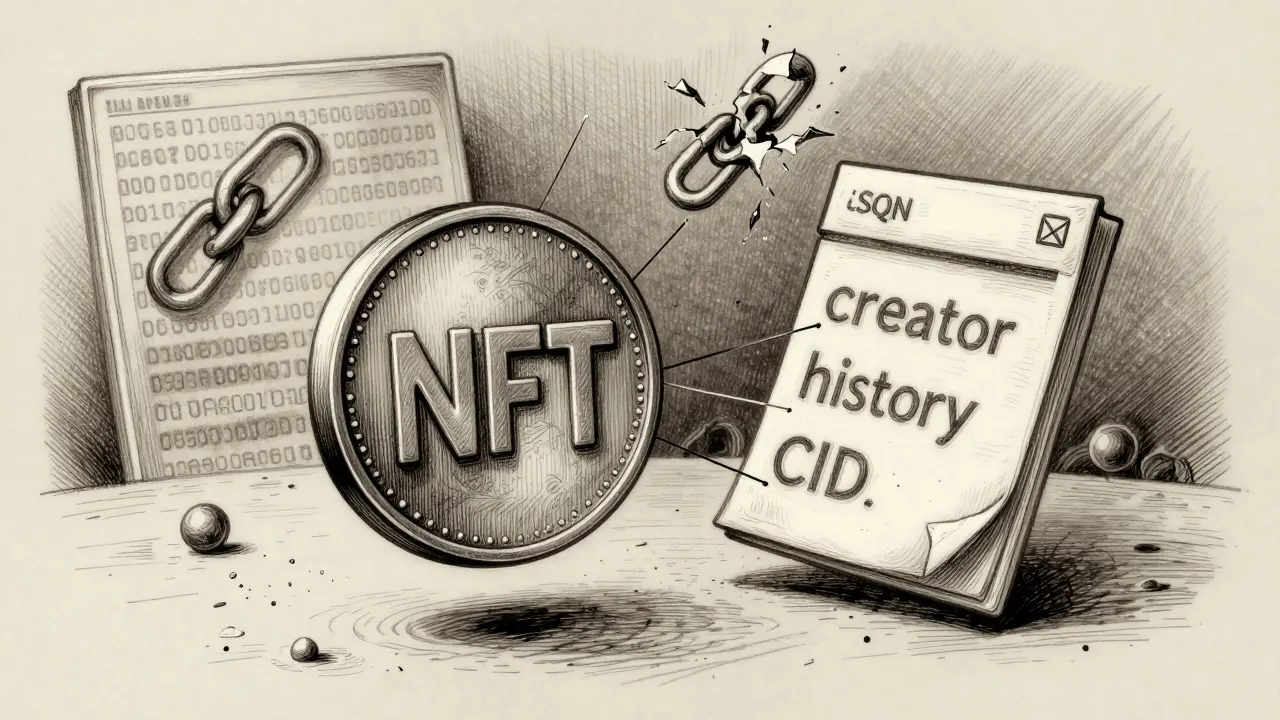
NFT metadata is the hidden engine behind digital ownership. It’s not just a file that says what an NFT looks like - it’s the permanent record of where that asset came from, who owned it, and whether it’s been tampered with. Without good metadata, an NFT is just a fancy link that could vanish tomorrow. But with the right structure, it becomes an unbreakable chain of truth - a digital birth certificate for your pixel art, music, or virtual land.
What Exactly Is NFT Metadata?
NFT metadata is a structured data file - usually in JSON format - that lives outside the blockchain but connects directly to it. Think of the blockchain as a public ledger that says, "Person A owns Token #420." The metadata tells you what Token #420 actually is: its name, description, image, traits, and most importantly, its history.
This metadata file contains fields like:
- name - The title of the NFT
- description - A short explanation of the asset
- image - A link to the visual or audio file
- attributes - Traits like rarity, color, or edition number
- creator - Who made it
- creationDate - When it was minted
- history - A log of past owners and transfer timestamps
These aren’t optional extras. They’re the foundation of trust. If someone buys a Bored Ape, they’re not just buying a JPEG - they’re buying proof that this exact image was created by Yuga Labs, minted on April 12, 2021, and passed through three wallets before landing in their wallet. That’s provenance. And it’s all stored in metadata.
How Provenance Is Built Into the Data
Provenance isn’t magic. It’s math. Every time an NFT changes hands, the blockchain records the transaction. But that’s only half the story. The metadata must carry forward the full chain of custody.
Here’s how it works in practice:
- The original creator uploads the image to a decentralized storage system like IPFS.
- IPFS generates a unique Content Identifier (CID) - a cryptographic hash like
QmXoypizjW3WknFiJnKLwLc21454632. - The metadata file includes this CID as the link to the image, not a regular URL.
- When the NFT is minted, the CID is written into the token’s on-chain record.
- Every time the NFT is sold, the blockchain logs the transfer, but the metadata stays unchanged.
Why does this matter? Because if someone alters the image file later, the CID changes. The new version won’t match the one stored on-chain. Anyone can check: "Does the current file match the hash recorded when the NFT was created?" If not, it’s fake. This is how you know an NFT hasn’t been swapped out.
Some collections go further. The "0N1 Force" collection, for example, stores both the image and metadata on IPFS and includes a cryptographic signature that proves the original creator approved every change. This makes tampering impossible.
Where Metadata Is Stored - And Why It Matters
Not all storage is equal. Where you put your metadata determines whether your NFT survives five years - or five days.
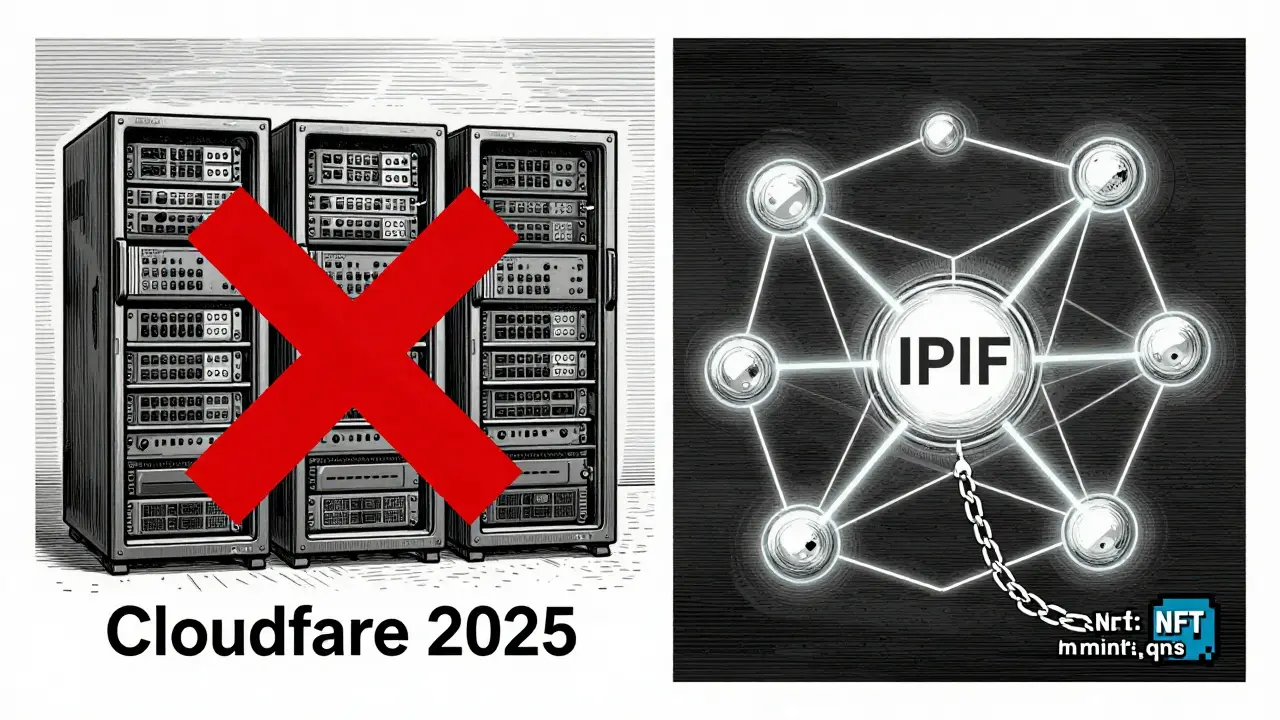
Centralized storage (like AWS, Cloudflare, or a company server) is easy to use. About 63% of NFT projects still rely on it. But here’s the problem: in April 2025, Nike’s CloneX collection lost access to its artwork when Cloudflare blocked their domain over a Terms of Service violation. Thousands of NFTs still showed up as "owned" on the blockchain - but the images vanished. Buyers were left with empty boxes. No provenance. No value.
Off-chain decentralized storage (like IPFS) fixes this. IPFS doesn’t rely on a single server. Instead, files are distributed across hundreds of nodes. The CID acts as a fingerprint - if the file changes, the fingerprint changes. As of 2024, 32% of NFTs use IPFS. But there’s a catch: if no one "pins" (keeps actively hosting) the file, it can disappear. Studies show unpinned IPFS content has a 47% chance of vanishing within six months.
Arweave solves this with a "pay once, store forever" model. You pay a small fee (around $0.03 per MB) to store data permanently. Only 5% of NFTs use it - mostly high-value collections like art and music - because it’s more expensive upfront. But for collectors who want assurance their NFT will still exist in 2040, it’s worth it.
On-chain storage is the gold standard - but it’s rare. Only 0.3% of NFTs store full metadata on the blockchain. Why? Ethereum charges about $1,200 per MB. That’s why CryptoPunks, one of the earliest NFT projects, stores everything on-chain: their simple 24x24 pixel images fit in under 4,000 characters. But for anything with audio, video, or complex traits? Impossible.
The Hidden Risks: Mutable Metadata and Broken Links
Even with decentralized storage, provenance can break. The biggest threat? Mutable metadata.
Some NFTs allow creators to update metadata after minting. That means a project can change the image, traits, or description of your NFT - even if you own it. According to Nansen’s July 2024 report, 41% of NFT collections allow this. It sounds convenient for developers - "We’ll fix bugs!" - but it destroys trust. If the creator can change what your NFT represents, then its history is fake.
Another issue: broken links. If your metadata points to a URL that goes dark, your NFT becomes a ghost. That’s why experts like Vitalik Buterin warn: "NFTs without persistent metadata are merely pointers to potentially ephemeral content." You can own a token, but if the asset it represents is gone, what did you really buy?
The best solution? Store the hash of the asset on-chain, and store the file off-chain. That way, you can always verify: "Does this file match the hash recorded when I bought it?" If yes - it’s authentic. If no - it’s been replaced.
What’s Changing Now: New Standards and Tools
Things are improving. In June 2024, the Ethereum Name Service (ENS) launched its "Provenance Protocol," which embeds immutable provenance records directly into metadata with cryptographic verification. NFT.Storage, which handled 2.7 million uploads in Q2 2024, now integrates with the Filecoin Virtual Machine - letting smart contracts verify that files are still stored and unchanged.
Industry leaders agree: the future is cryptographic anchoring. The World Economic Forum’s June 2024 report recommends "mandatory cryptographic anchoring of metadata to blockchain records" as the new standard. That means: every NFT should have a hash on-chain that matches the file stored off-chain. No exceptions.
Meanwhile, enterprise adoption is rising. Deloitte found that 78% of corporate NFT projects now use on-chain verification for asset provenance. The gaming sector is leading the charge - 63% of blockchain game developers now build metadata standards to track in-game items across platforms, ensuring players keep ownership even if a game shuts down.
What You Should Do
If you’re buying NFTs:
- Check if the metadata uses IPFS or Arweave - not a regular website link.
- Use a block explorer to find the token’s metadata URI and verify the CID matches the file.
- Avoid collections that allow creators to update traits or images after minting.
If you’re creating NFTs:
- Always store images and metadata on IPFS or Arweave.
- Pin your files - use services like Pinata or NFT.Storage to keep them live.
- Include a "history" field that logs every transfer.
- Never allow post-mint changes to core attributes.
Provenance isn’t a feature. It’s the point of NFTs. Without it, you’re not owning a digital asset - you’re just holding a ticket to a website that might disappear tomorrow.
What is NFT metadata?
NFT metadata is a structured data file (usually JSON) that contains details about an NFT, such as its name, image, traits, creator, and ownership history. It links the blockchain record of ownership to the actual digital asset, making it possible to verify authenticity and track provenance.
How does metadata prove ownership history?
Metadata stores a history field that logs each transfer, along with timestamps and wallet addresses. When paired with on-chain transaction records, this creates a complete, verifiable trail of ownership from the original creator to the current holder. The file’s cryptographic hash (CID) ensures the asset hasn’t been altered.
Why do most NFTs use off-chain storage?
On-chain storage on Ethereum costs about $1,200 per MB, which is impractical for images, videos, or complex traits. Off-chain storage on IPFS or Arweave costs fractions of a cent per file, making it affordable while still preserving integrity through cryptographic hashes.
Can NFT metadata be changed after minting?
Yes - and that’s a major risk. About 41% of NFT collections allow creators to update metadata after minting, which can change the asset’s appearance or traits. This breaks provenance. The safest NFTs lock metadata permanently using immutable storage like Arweave or cryptographic hashing.
What happens if an NFT’s metadata disappears?
If the metadata file is hosted on a centralized server and that server goes down, the NFT becomes a blank token - you still own it on the blockchain, but you can’t see the asset. This happened in 2025 with Nike’s CloneX collection. Decentralized storage like IPFS or Arweave prevents this by distributing files across many nodes.
Is on-chain metadata better than off-chain?
On-chain metadata is immutable and permanent, but it’s extremely expensive and limited in size - only suitable for simple SVGs like CryptoPunks. For most NFTs, off-chain storage with cryptographic verification (like IPFS CID + on-chain hash) is the practical and secure standard.
NFT metadata is the unsung hero of digital ownership. Seriously, think about it - without that JSON file holding the hash and history, you're just holding a blockchain receipt for a JPEG that could vanish like a Snapchat message. I've seen projects where the image link died because someone forgot to pin it on IPFS. Total nightmare. The fact that 63% still use centralized storage is insane. It's like buying a house and trusting the deed is stored in a single file on someone's Dropbox.
Arweave is the real MVP here. Pay once, store forever. It's not cheap, but neither is losing your entire digital collection because a cloud provider had a bad day. If you're minting anything worth more than $100, spend the extra bucks. Your future self will thank you.
Stop pretending metadata is magic. It’s just a file. If you can’t pin it, it’s gone. If you allow updates, it’s worthless. The whole ‘provenance’ thing is a marketing scam if the asset isn’t cryptographically anchored on-chain. And don’t even get me started on collections that let creators change traits - that’s not ownership, that’s a lease agreement with a sketchy landlord.
Only real NFTs are the ones with on-chain hashes and immutable off-chain files. Everything else is digital glitter.
63% still use centralized storage? That’s not ignorance, that’s negligence. And the fact that people still buy NFTs with links to AWS or Cloudflare shows how badly the market has been dumbed down. This isn’t blockchain - it’s a fancy website with a token attached.
And let’s be real - if your NFT’s image disappears because Nike’s domain got blocked, you didn’t lose a JPEG. You lost your entire belief system. Welcome to Web3, where trust is optional and permanence is a fantasy.
Hey everyone - just wanted to say I love how deep this thread is going. Seriously, this is the kind of stuff that makes Web3 worth it. I’ve been minting since 2021 and I used to think metadata was just ‘nice to have.’ Now I check every CID before I buy.
If you’re new to this, here’s the cheat sheet: Always look for IPFS or Arweave. Never trust a link that starts with https://example.com. Use NFT.Storage or Pinata to pin your own stuff. And if a project lets the creator change your NFT after you buy it? Run. Don’t walk.
You got this. You’re learning the real rules now - not the hype.
so like… i just found out that my nft had a broken link because the creator didn’t pin it on ipfs. i was so mad. i spent 0.5 eth on it and now it’s just a blank box. i checked the cid on etherscan and it matched, but the file was gone. i had to use archive.org to find a cached version.
point is: if you’re not using arweave or pinning your files, you’re playing russian roulette with your digital art. i’m now only buying stuff that has a verified hash + permanent storage. no exceptions.
also, if you’re a creator - PLEASE pin your files. i know it’s a pain, but it’s the only way to keep trust alive.
Been watching this space since 2020. What people don’t get is that NFTs aren’t about owning pixels. They’re about owning a verifiable story. The metadata is the diary. The blockchain is the timestamp. Together, they’re proof that this thing existed, who made it, and who held it before you.
I bought a music NFT last year. The metadata included the original studio session logs, the producer’s signature, and a hash of the WAV file. When I play it, I know it’s the same one the artist uploaded. That’s not tech - that’s legacy.
Arweave isn’t expensive. It’s an investment in permanence. And if you’re not thinking 20 years ahead? You’re not ready for Web3.
Look, I get the hype. But let’s cut through the noise. NFT metadata is just a JSON file with a hash. The real value isn’t in the file - it’s in the ecosystem that verifies it. If everyone agrees on the CID, and it’s anchored on-chain, then it’s real. If not? It’s a meme.
Also - yes, 41% of collections allow metadata updates. That’s terrifying. But it’s also why we need standards like ENS Provenance Protocol. It’s not about being perfect - it’s about moving toward something that can’t be gamed.
And yes, on-chain storage costs $1200/MB. But for 0.3% of projects? It’s worth it. For the rest? IPFS + hash verification is the sweet spot.
Oh wow. So we’re now equating NFT metadata with the soul of digital existence? How poetic. How existential.
Let me ask you - if a tree falls in the forest and no one pins the IPFS hash, does the NFT still exist? Or is it merely a quantum state of belief, collapsing only when someone checks the CID?
Provenance isn’t a technical problem - it’s a metaphysical one. We’re not storing files. We’re storing meaning. And meaning, as Hegel would say, is only real when it’s recognized by the Other.
So yes. Arweave. Hashes. Immutable records. But also… *feel* it.
✨
This entire post is a textbook example of technocratic delusion. You’re treating metadata like it’s sacred scripture. It’s not. It’s a file. A file that can be deleted, altered, or ignored.
The blockchain records ownership. That’s it. The rest is theater. You’re paying for a promise - not a product. And when the promise breaks - as it always does - you’ll be left holding a token that points to nothing.
Wake up. NFTs are a speculative asset wrapped in a fairy tale. Metadata doesn’t make them real. It just makes them look real.
James Burke nailed it - the key is cryptographic anchoring. Not storage. Not marketing. Not community. Hash on-chain, file off-chain. That’s the only model that survives attacks, server failures, and corporate negligence.
And to Christina: yes, 63% using centralized storage is criminal. But it’s also predictable. Most devs are just trying to ship something fast. They don’t care about legacy. They want to sell NFTs this quarter.
So the real solution isn’t blaming them. It’s building tools that make immutable storage the default. Like NFT.Storage’s Filecoin integration. Or ENS Provenance. Or smart contracts that auto-pin on mint.
We don’t need more lectures. We need better infrastructure.