
For years, Portugal was the golden ticket for crypto investors. You moved there, got NHR status, and watched your digital assets grow with minimal tax friction. But if you are planning to move now, or even recently applied, the landscape has shifted dramatically. The original Non-Habitual Resident (NHR) program is gone for new applicants. It was replaced by a stricter regime called IFICI. Does this mean Portugal is no longer worth it for your Bitcoin portfolio? Not necessarily-but the rules of engagement have changed.
As of mid-2026, the confusion is real. Many still talk about "NHR" as if nothing happened. Others think Portugal is now just like any other European country with heavy taxes. The truth sits somewhere in between. This guide cuts through the noise to explain exactly how the new IFICI program affects your crypto gains, what the current tax rates are, and whether you can still optimize your wealth in Lisbon or Porto.
The End of an Era: From NHR to IFICI
To understand where we stand in 2026, we have to look at what vanished. The original Non-Habitual Resident (NHR) regime was established in 2009 under Law 30/2009. It offered a flat 20% tax rate on Portuguese-sourced income and exempted most foreign-sourced income for ten years. For crypto traders, this was huge because it created a predictable, low-tax environment while they built their portfolios.
But the government pulled the plug. In October 2023, they announced that new NHR applications would close in January 2024. There was a brief transition window until March 31, 2025, allowing a final rush of applicants. As of today, that door is shut. If you did not secure your NHR status before April 2025, you are looking at the new system: the Tax Incentive for Scientific Research and Innovation (IFICI), often dubbed NHR 2.0.
Here is the catch: IFICI is not a blanket benefit for all foreigners. It targets specific high-value professions-scientists, researchers, and highly qualified tech professionals. Pure crypto investors or full-time traders who do not fit into these narrow categories often find themselves locked out. According to data from Global Citizen Solutions, applications dropped sharply in 2024 as people realized the bar had been raised. While 14,850 people secured NHR in 2023, only about 5,200 applied in 2024 as the deadline loomed.
Current Crypto Tax Rules in Portugal (2026 Status)
Whether you qualify for IFICI or not, you need to know how Portugal taxes cryptocurrency today. The big change came with the 2023 national budget reform, which officially integrated cryptocurrencies into the Portuguese Tax Administration (IRS). Before this, the rules were vague; now, they are explicit.
Here is the breakdown:
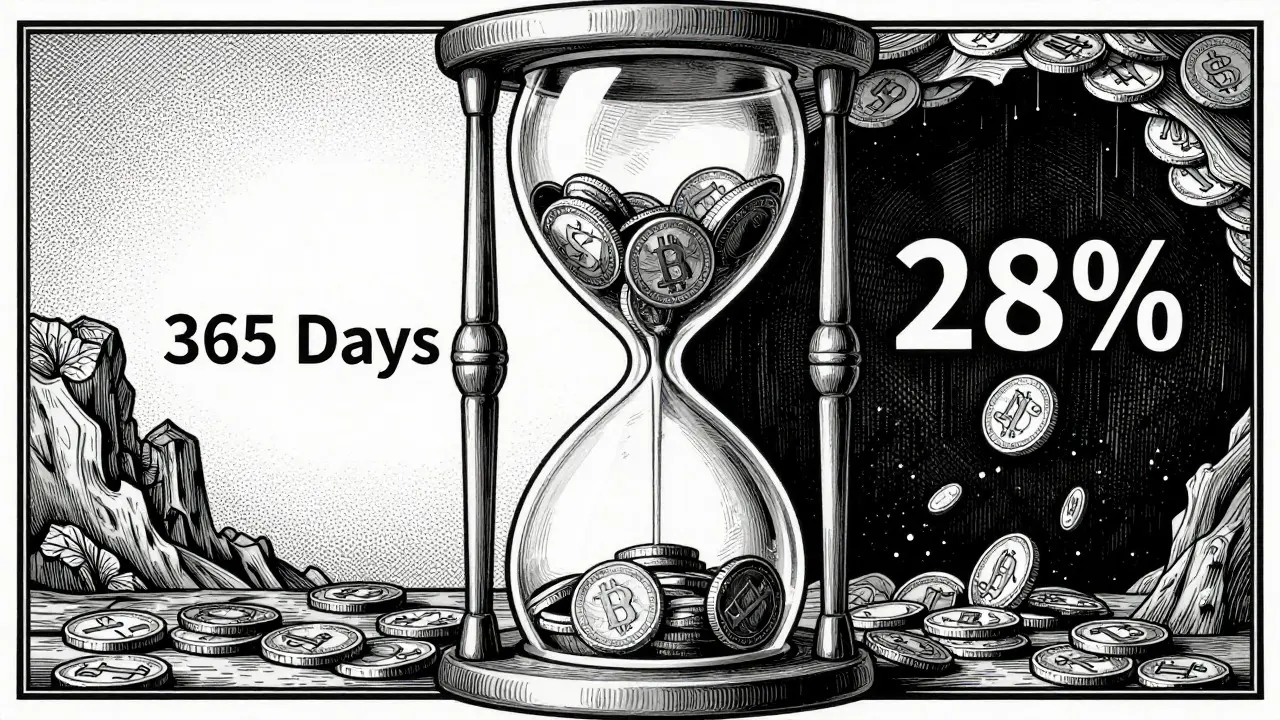
- Long-Term Holdings (>365 days): Capital gains from selling crypto held for more than one year are generally tax-free. This remains one of the biggest advantages in Europe.
- Short-Term Holdings (<365 days): Gains are taxed at a flat rate of 28% under Category G.
- Crypto-to-Crypto Trades: These are not immediately taxable events. You can swap Bitcoin for Ethereum without triggering a tax bill, provided you keep detailed records.
- Passive Income: Staking rewards, lending interest, and airdrops are taxed at 28%.
This structure encourages patience. If you hold your assets for over a year, you pay zero capital gains tax. However, if you are an active day trader, that 28% bite adds up quickly. Under the old NHR, some non-professional traders enjoyed broader exemptions, but under the current standard rules, the 365-day threshold is king.
| Scenario | Tax Rate | Notes |
|---|---|---|
| Selling after >1 year | 0% | Tax-free capital gains |
| Selling within <1 year | 28% | Flat rate on profits |
| Staking/Lending Rewards | 28% | Treated as passive income |
| Crypto-to-Crypto Swap | Deferred | Taxable upon conversion to fiat |
Does IFICI Help Crypto Investors?
If you are a software engineer working for a blockchain startup, IFICI might still save you money. The new regime maintains the 20% flat tax rate for qualifying income in scientific and technological fields. However, for someone whose primary income comes from trading Bitcoin or managing DeFi portfolios, the path is unclear.
Get Golden Visa reports that IFICI prioritizes individuals in "highly qualified professions." Unless you can frame your crypto activities as part of a recognized professional role (like a fintech developer), you likely fall outside the scope. This means most pure crypto investors in 2026 will face the standard 28% short-term tax rate and the 0% long-term exemption, without the additional foreign income shields that NHR provided.
User experiences reflect this shift. On Reddit’s r/digitalnomad community, users noted that while early NHR adopters saved significant percentages on gains, post-2025 applicants found IFICI’s professional requirements too restrictive. One user mentioned being excluded despite earning €150k annually because they were classified as a trader rather than a researcher.
Strategies for Crypto Investors in Portugal
Even without the old NHR perks, Portugal remains attractive compared to many EU neighbors. Here is how to navigate the current system effectively:
- The 365-Day Rule: This is your best friend. Hold every asset for at least one year before selling. Koinly’s 2025 guide emphasizes that this simple strategy can eliminate capital gains tax entirely. Convert to stablecoins like USDC or USDT after holding, then cash out to fiat to minimize risk during volatility.
- Meticulous Record Keeping: The Portuguese Tax Authority (AT) requires proof of purchase dates. Use specialized crypto tax software to track timestamps, wallet addresses, and fiat valuations at the time of each transaction. Misclassifying a crypto-to-crypto trade as non-taxable when converting to euros is a common mistake that leads to penalties.
- Residency Requirements: To claim tax residency, you must spend at least 183 days in Portugal per year. Alternatively, you can demonstrate clear ties to the country. Ensure your physical presence aligns with your tax claims.
- Consider IFICI Eligibility: If you work in tech or science, consult a specialist to see if your role qualifies for IFICI. Even if your crypto gains aren’t directly covered, the 20% flat rate on your salary could offset higher taxes elsewhere.

How Portugal Compares to Other Jurisdictions
Is Portugal still the best place for crypto expats? It depends on your profile. Germany offers tax-free gains after one year, similar to Portugal, but with different residency complexities. Switzerland has cantonal variations that can be favorable but lack a unified federal framework. Spain and Italy have introduced more complex and often heavier taxation structures.
Despite the NHR phaseout, Portugal ranks 12th globally for crypto adoption according to Chainalysis’s 2025 index. It remains a top choice for digital nomads due to its quality of life, English proficiency, and EU access. The Digital Nomad Index by Nomad List ranked Portugal 5th in 2025, down from 2nd in 2023, citing tax changes as a factor. Yet, the absence of wealth tax and dividend tax on foreign income (for those who still hold legacy NHR status) keeps it competitive.
Future Outlook: What Comes Next?
The regulatory landscape is not static. The European Union’s MiCA regulations, fully implemented in July 2025, require consistent frameworks across member states. This pressure may lead to further harmonization. Deloitte Portugal analysts predict a possible extension of the 365-day threshold to two years in future reforms to align with EU directives. Keep an eye on Q1 2026 updates from the Ministry of Finance.
For those who secured NHR before March 2025, your 10-year clock continues uninterrupted. You retain your benefits until 2035. For everyone else, the focus shifts to strategic holding periods and professional classification under IFICI.
Can I still apply for NHR in 2026?
No. The original NHR program closed for new applicants in March 2025. New residents must apply under the IFICI regime, which has stricter eligibility criteria focused on scientific and technological professions.
What is the tax rate for short-term crypto gains in Portugal?
Capital gains from cryptocurrency held for less than 365 days are taxed at a flat rate of 28%. This applies to both residents and non-residents depending on their specific tax status.
Are crypto-to-crypto trades taxable in Portugal?
No, swapping one cryptocurrency for another is not an immediate taxable event. Tax is triggered only when you convert crypto to fiat currency (like Euros) or use it to purchase goods and services.
Does IFICI cover full-time crypto traders?
Generally, no. IFICI is designed for highly qualified professionals in science, research, and technology. Pure crypto traders usually do not meet the professional criteria unless they can demonstrate alignment with approved technical roles.
How do I prove my crypto holding period?
You need detailed transaction records showing the date of acquisition and sale. Use crypto tax software to generate reports with timestamps and wallet addresses. The Portuguese Tax Authority may request this documentation during audits.