Remember the crypto gold rush of 2021? If you were active on social media back then, you likely saw countless "free token" campaigns promising life-changing wealth. One such campaign was the Peanut.Trade airdrop for its native NUX token. It wasn't just another scammy giveaway; it had specific mechanics, a defined winner pool, and a clear goal: building a community around a decentralized finance (DeFi) tool designed to fix slippage issues on exchanges.
But what actually happened with those tokens? Did winners cash out at the peak, or are they still holding bags that have lost nearly all their value? This guide breaks down exactly how the Peanut.Trade airdrop worked, who got what, and where the NUX token stands today in October 2026. Whether you missed out back then or are wondering if your old wallet holds any forgotten assets, here’s the full story.
What Was the Peanut.Trade Airdrop?
In August 2021, during the tail end of the major bull run, Peanut.Trade launched a promotional airdrop via CoinMarketCap. The goal was simple: spread awareness and reward early adopters. They set aside a total pool worth $22,000 USD at the time, which translated to 71,000 NUX tokens. This might sound like a lot of money now, but remember, crypto markets move fast.
The distribution wasn't random luck alone. To enter, users had to jump through several hoops designed to boost the project's social metrics. You needed to add NUX to your CoinMarketCap watchlist, join their Telegram groups (both the main chat and the announcement channel), follow their Twitter account (@PeanutTrade), and fill out a registration form. It was a classic growth-hacking strategy common in that era.
The results were announced on August 27, 2021. Exactly 2,000 winners were selected from the thousands of participants. Each winner received up to 35.50 NUX tokens. The actual distribution of these tokens happened over the following week, between August 27 and August 31, 2021. If you were one of those 2,000 people, you had a small stack of tokens sitting in your wallet, waiting for the market to decide their fate.
Understanding the Peanut Protocol
Why did people care about NUX in the first place? Peanut wasn't just a meme coin. It positioned itself as a serious utility project within the DeFi space. The core problem it tried to solve was inefficiency in Automated Market Makers (AMMs). If you've ever traded on Uniswap or similar platforms, you know the pain of "slippage"-where the price changes between the moment you click buy and the moment the trade executes, often costing you more than expected.
Peanut used a unique architecture to balance prices. Here is how it worked:
- 90% of Assets: Allocated directly to decentralized exchanges (DEXs) like Uniswap to provide liquidity.
- 10% of Assets: Held by an intermediary mechanism that actively balanced prices between DEXs and centralized exchanges (CEXs).
This split aimed to reduce arbitrage opportunities for bots that usually exploit regular traders. By smoothing out price discrepancies, Peanut promised better execution prices for everyday users. The project raised roughly $7.96 million across five funding rounds before its Token Generation Event (TGE) on February 15, 2021. This significant backing gave many investors confidence that this wasn't just another fly-by-night operation.
Tokenomics and Vesting Schedule
If you participated in the airdrop or bought tokens early, understanding the vesting schedule is crucial. Many projects unlock tokens slowly to prevent immediate dumping. Peanut followed this trend, though not without controversy.
| Feature | Details |
|---|---|
| Total Supply | Fixed allocation (specific total varies by source, circulating supply ~50M) |
| TGE Date | February 15, 2021 |
| Initial Unlock | 3.5% of tokens unlocked immediately at TGE |
| Vesting Period | Remaining 96.5% released linearly over 700 days (~23 months) |
| Airdrop Allocation | 71,000 NUX distributed to 2,000 winners |
The slow unlock meant that while airdrop winners got their tokens quickly, the broader investor base had to wait years for full access. This structure typically supports price stability in the short term but can lead to sell pressure once the vesting cliffs pass. For airdrop recipients, however, the tokens were fully liquid upon receipt, meaning they could sell them immediately if they chose.
The Rise and Fall: From Peak to Bottom
Let's talk numbers, because this is where the story gets painful for holders. Peanut (NUX) hit an all-time high (ATH) of $31.69 per token. At that peak, the 35.50 NUX tokens given to a lucky airdrop winner would have been worth over $1,100. That’s a solid return for filling out a form and joining a Telegram group.
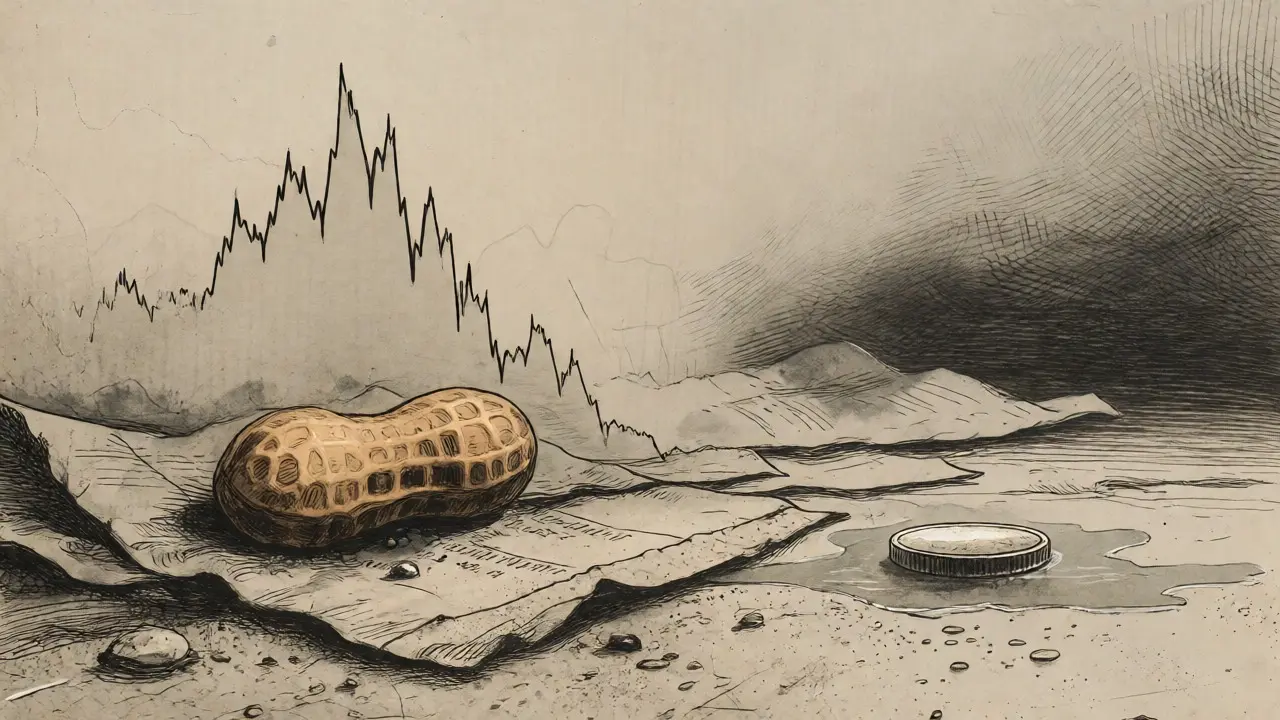
Fast forward to late 2025 and early 2026. The market reality has been brutal. As of recent data, NUX trades at approximately $0.0042. Yes, you read that right. Four-tenths of a cent. This represents a decline of 99.99% from its all-time high.
So, what happened to those airdrop winners? If they held onto their 35.50 NUX tokens from August 2021 until today, their portfolio is now worth about $0.15. That’s a loss of over 99.98%. Most savvy traders likely sold during the initial hype or shortly after the TGE when the price was still relatively high compared to today's floor. Those who held through the bear market faced near-total wipeout.
The current market cap sits around $210,000, placing Peanut deep in the long tail of cryptocurrencies, ranked around #6594 on major aggregators. Trading volume is thin, mostly concentrated on Gate.io and LATOKEN, with some activity on Uniswap V2. This low liquidity makes it difficult for large buyers to enter without moving the price significantly.
Current Market Status and Predictions
Is there hope for a comeback? Price prediction models offer wildly different answers, reflecting the uncertainty surrounding micro-cap tokens like NUX.
Some optimistic algorithms, like those from CoinLore, suggest a potential recovery driven by future bull markets. They project NUX could reach $1.80 in 2026 and potentially climb higher in subsequent years, reaching over $6.00 by 2029. These forecasts rely heavily on technical indicators like RSI and MACD, assuming historical patterns repeat.
On the other hand, conservative analysts like CoinDataFlow predict NUX will remain below $0.01 throughout 2025 and into 2026. Their models suggest a range of $0.0034 to $0.0065, indicating continued stagnation rather than explosive growth. Given the lack of major news or development updates recently, the conservative view seems more grounded in current trading realities.
For investors considering buying now, the risk is high. With such a low price, even a small percentage increase looks impressive mathematically (e.g., doubling from $0.004 to $0.008), but the absolute gain remains negligible unless the token finds renewed utility or massive adoption.
Lessons from the Peanut.Trade Airdrop
The Peanut.Trade case study offers valuable lessons for anyone interested in crypto airdrops:
- Sell Early or Hold Forever: There is rarely a middle ground. Tokens like NUX tend to spike early due to hype and then bleed value as the novelty wears off. Waiting for the "next big thing" often results in losses.
- Utility Matters More Than Hype: Despite raising millions and having a clever technical solution for slippage, Peanut failed to sustain user engagement. Without continuous development and marketing, even good tech can fade away.
- Liquidity is King: Low trading volume means you might not be able to sell when you want to. Peanut’s current status highlights how illiquid micro-caps can trap capital.
If you’re hunting for the next big airdrop, look beyond the free tokens. Investigate the team’s activity, GitHub commits, and community sentiment. Peanut had all the boxes ticked initially, yet it couldn’t escape the gravity of the broader market correction and internal momentum loss.
How much was the Peanut.Trade airdrop worth?
The total airdrop pool was valued at $22,000 USD at the time of distribution in August 2021. Individual winners received up to 35.50 NUX tokens each. Depending on the exact price when they sold, this could have ranged from a few dollars to over $1,000 if sold near the all-time high.
Are Peanut (NUX) tokens still valuable?
Currently, NUX has very low value, trading around $0.0042 as of late 2025/early 2026. This represents a drop of over 99% from its all-time high of $31.69. While it retains some speculative value, it is considered a micro-cap asset with high risk.
Where can I trade NUX tokens?
The primary exchange for trading NUX is Gate.io, specifically the NUX/USDT pair. Other options include LATOKEN and Uniswap V2 on the Ethereum network. However, trading volumes are low, so expect wider spreads and potential slippage.
Did Peanut.Trade do anything else besides the airdrop?
Yes, Peanut raised approximately $7.96 million across five funding rounds, including an Initial Exchange Offering (IEO). The project developed a DeFi protocol aimed at reducing slippage on decentralized exchanges by balancing prices between DEXs and CEXs.
Is it worth investing in NUX now?
This depends on your risk tolerance. Analysts disagree significantly, with some predicting a rise to $1.80+ and others forecasting continued stagnation below $0.01. Given the 99% drop from highs and low liquidity, it is a high-risk speculation play rather than a safe investment.