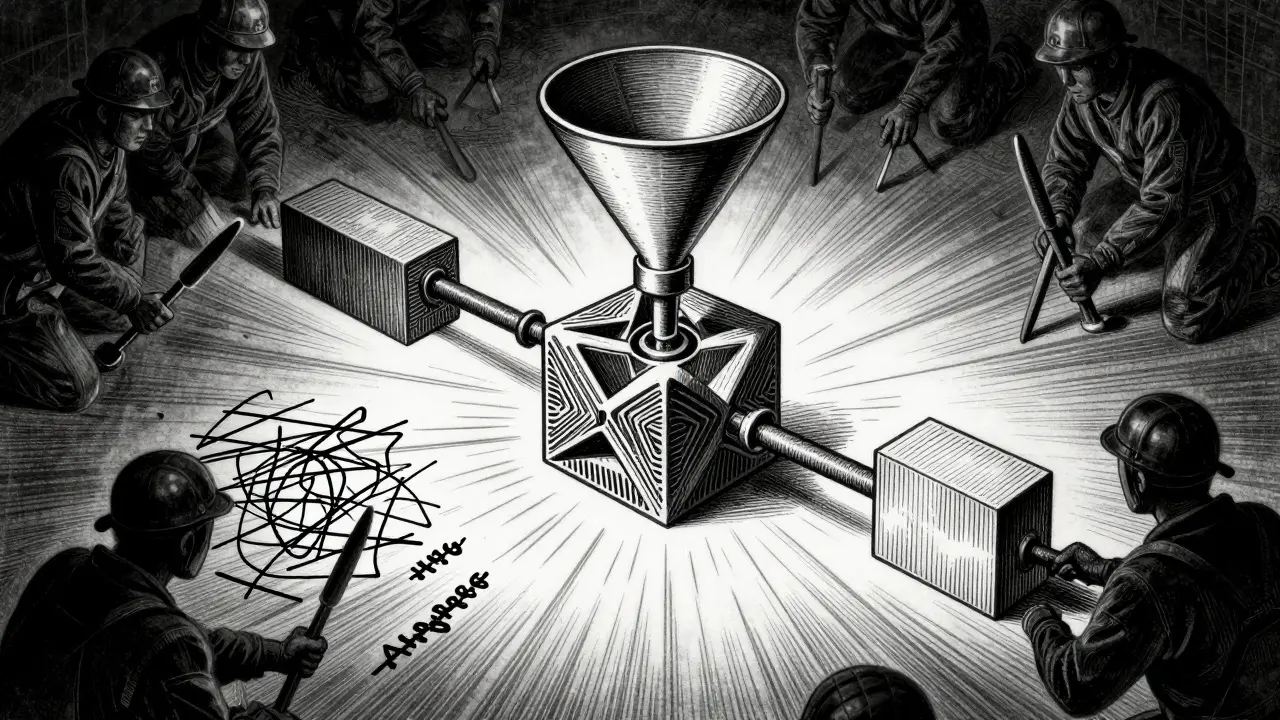
Imagine trying to agree on the truth without a boss, a bank, or a government telling you who's right. That’s the core problem Proof of Work is a consensus mechanism that uses computational effort to validate transactions and secure decentralized networks. In simple terms, it forces participants to solve a difficult math puzzle before they can add new data to the ledger. If you’ve ever wondered how Bitcoin stays secure without a central server, this is why.
This isn’t just theory. Since 2009, Proof of Work has kept the world’s largest digital currency running with near-perfect uptime. But it comes with a massive price tag in electricity and hardware. Understanding how it actually works helps you decide if it’s the right model for your projects or investments, and why some blockchains are moving away from it while others double down.
The Core Mechanism: Solving the Puzzle
At its heart, Proof of Work relies on a concept called a cryptographic hash function. Think of it like a digital fingerprint. You take a set of data (like a list of transactions) and run it through an algorithm, such as SHA-256 in Bitcoin. The output is a fixed-length string of characters. The catch? The result looks random. Change one tiny bit of input, and the entire output changes completely.
Miners compete to find a specific number, called a nonce, that when added to the block data, produces a hash that meets a certain difficulty target. For example, the network might require the hash to start with a specific number of zeros. Finding this combination requires brute force-trying millions of nonces per second. Once a miner finds the correct hash, the rest of the network can verify it instantly. This asymmetry is crucial: hard to create, easy to check.
- Input: Block header + Nonce
- Process: SHA-256 Hashing
- Output: Hexadecimal Hash
- Goal: Hash value below current difficulty target
This process ensures that adding a fake block requires redoing all the work since the last valid block, making tampering economically unfeasible for most attackers.
Why Do We Need It? Solving Double-Spending
In traditional banking, a central authority prevents you from spending the same dollar twice. In a peer-to-peer network, there’s no referee. This is known as the Byzantine Fault Tolerance problem. Proof of Work solves this by making it expensive to cheat. To change a past transaction, a malicious actor would need to outpace the entire network’s combined computing power. They’d have to do more work than everyone else combined to rewrite history. Since the network is distributed globally, this requires controlling over 51% of the total hashrate-a feat that costs billions of dollars in hardware and energy.
Satoshi Nakamoto, the pseudonymous creator of Bitcoin, implemented this in 2008 to create the first trustless digital cash system. Before this, digital signatures could be copied infinitely. PoW introduced scarcity and finality. When a block is mined, the reward (currently 3.125 BTC after the 2024 halving) incentivizes miners to stay honest because their investment in hardware and electricity only pays off if the chain remains valid.
The Hardware Reality: From CPUs to ASICs
You can’t mine Bitcoin effectively with a laptop anymore. The industry has evolved rapidly. Early adopters used standard CPUs, then shifted to GPUs, and now rely on specialized hardware called ASICs (Application-Specific Integrated Circuits). These chips are designed solely to solve the SHA-256 puzzle. A modern unit like the Bitmain Antminer S19 Pro can perform 110 terahashes per second while consuming about 3,250 watts of power.
This specialization creates a barrier to entry. Setting up a competitive mining operation requires significant capital. Entry-level farms often cost over $50,000 for just 50 machines. Electricity is the biggest ongoing expense, typically accounting for 60-70% of operational costs. If your local power rate is high, your margins shrink fast. Many miners now locate their facilities in regions with cheap hydroelectric power or stranded natural gas to stay profitable.
| Hardware Type | Typical Use Case | Efficiency Level | Current Viability for Bitcoin |
|---|---|---|---|
| CPU | Early experimentation | Very Low | Obsolete |
| GPU | Altcoins, Ethereum (pre-Merge) | Moderate | Unprofitable for BTC |
| ASIC | Bitcoin, Litecoin | High | Standard Industry Practice |
Energy Consumption: The Big Debate
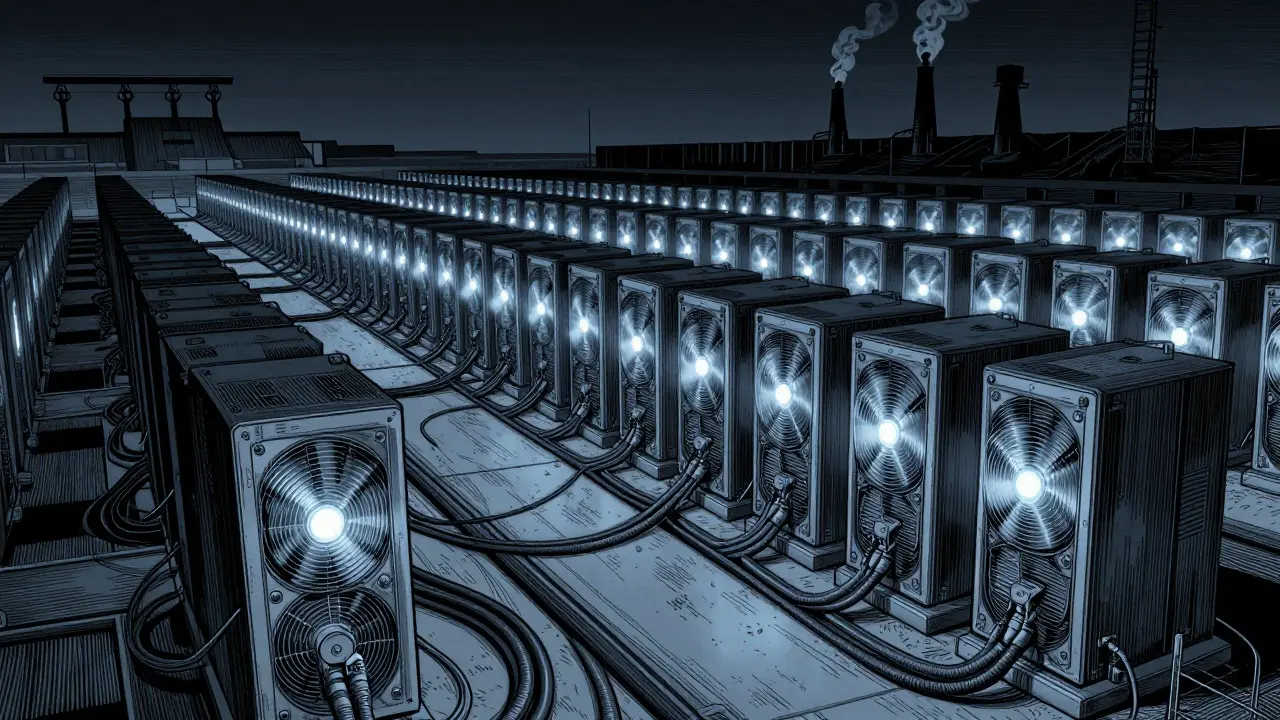
The elephant in the room is energy. Critics argue that PoW wastes electricity. The Cambridge Bitcoin Electricity Consumption Index estimated Bitcoin’s annual usage at roughly 121 TWh in late 2023, comparable to the entire country of Argentina. Supporters counter that this energy secures a global financial asset and that much of it comes from renewable sources or otherwise wasted energy streams.
When Ethereum switched to Proof of Stake in September 2022, its energy use dropped by 99.95%. This stark contrast fueled regulatory pressure. The EU’s MiCA regulation now requires crypto assets to disclose environmental impact. However, Bitcoin’s hash rate hit an all-time high of 600 exahashes per second in March 2024, showing that despite the noise, miners remain confident in the network’s long-term viability.
Proof of Work vs. Proof of Stake
Most new blockchains today choose Proof of Stake (PoS) instead of PoW. So, which is better? It depends on what you value more: absolute security or efficiency.
PoW has been battle-tested for over 15 years. No major PoW chain has suffered a successful 51% attack on its mainnet. PoS, while theoretically sound, is younger and relies on staking validators. If a validator acts maliciously, they lose their stake. In PoW, the penalty is economic loss of mining rewards and hardware depreciation.
Throughput is another key difference. Bitcoin processes about 4-7 transactions per second. Ethereum’s PoS version handles 15-30 TPS. For high-frequency trading or gaming, PoS feels faster. But for a store of value like gold, speed matters less than immutability. Gartner predicts that while PoW will dominate the "digital gold" segment through 2027, 95% of new enterprise blockchain implementations will avoid it due to ESG concerns.

Is Proof of Work Dying?
Not exactly. It’s evolving. While its market share has dropped from 98% in 2015 to around 58% in recent years, the coins that use it hold the majority of the market cap. Bitcoin alone accounts for a huge chunk of that value. Innovations like the Taproot upgrade improved transaction privacy and efficiency without changing the underlying PoW security model.
There are also experimental concepts like "Proof of Useful Work," where mining computations solve scientific problems instead of arbitrary hashes. While still early-stage, this approach aims to turn energy consumption into a productive resource rather than a waste product. For now, though, the classic PoW model remains the gold standard for decentralization and security in the cryptocurrency space.
Frequently Asked Questions
How does Proof of Work prevent double-spending?
It makes rewriting the blockchain history computationally expensive. An attacker would need to control more than 50% of the network's total computing power to create a conflicting chain, which requires massive capital and energy investment.
What is the difference between Proof of Work and Proof of Stake?
Proof of Work requires solving mathematical puzzles using hardware and electricity. Proof of Stake requires validators to lock up (stake) a portion of their coins as collateral. PoW is generally considered more secure against certain types of attacks but consumes significantly more energy.
Can I mine Bitcoin with a regular computer?
Technically yes, but it is not profitable. The competition is dominated by industrial-scale ASIC miners. Using a CPU or GPU for Bitcoin mining will likely cost more in electricity than you earn in rewards.
Which cryptocurrencies currently use Proof of Work?
Major examples include Bitcoin (BTC), Litecoin (LTC), Monero (XMR), and Ethereum Classic (ETC). These chains prioritize long-term security and decentralization over high transaction speeds.
How often does Bitcoin mining difficulty change?
The difficulty adjusts every 2,016 blocks, which takes approximately two weeks. This adjustment ensures that new blocks are found roughly every 10 minutes, regardless of how many miners join or leave the network.
I really appreciate how this breaks down the 'why' behind the energy usage. It’s not just about wasting power, it’s about buying security for a system that has no other boss. It makes me think about how we trust institutions that are invisible, like the internet itself. The idea that you can verify the truth without asking permission is kind of beautiful in a weird way.
great article but misses the point entirely. its all about who controls the hash rate. if you dont have cheap electricity you are already dead. stop pretending its some noble math puzzle. its a casino for rich guys with data centers. the rest of us are just holding bags while they burn coal to keep their charts green
India should be leading this space. We have the engineering talent and the need for financial inclusion. Why are we still relying on foreign tech standards? PoW is a tool, we must use it wisely for our own digital sovereignty.
Love the breakdown! Just want to highlight the nuance around 'stranded natural gas.' It’s not just 'waste,' it’s often flaring from oil fields where capturing it would cost more than burning it. So technically, mining there *is* adding value to a previously zero-value resource. Also, the shift to Proof of Stake isn't just an efficiency play; it’s a centralization risk play. If your validators are staking huge amounts of capital, you’re creating a different kind of oligarchy. PoW keeps the barrier to entry high in terms of hardware, which ironically keeps the network more decentralized in practice, even if it looks less 'green' on paper. The jargon around 'finality' is also key here-PoS finality is probabilistic until the epoch ends, whereas PoW gives you immediate, hard finality once a block is confirmed. That distinction matters for enterprise adoption!
Ooh, so you’re telling me my laptop fan spinning up when I open a spreadsheet is basically the same concept as securing a global currency? How delightfully ironic. I suppose I should start charging rent to the Bitcoin miners for using my ambient heat to warm my office. Or maybe just buy a GPU and join the club, since apparently 'efficiency' is a myth invented by people who haven’t seen an ASIC farm. Nice read, very educational, especially the part about how we’ve been 'wasting' energy for 15 years and now it’s a feature, not a bug. Who knew?
Oh, darling, did you know that the 'energy waste' argument is actually quite... quaint? 🌟 While the peasants argue about kilowatts, the real elite understand that energy IS the product. It’s the fuel for the new gold standard. Those who complain about the environmental impact simply lack the vision to see the grander design. We are building a fortress against fiat currency collapse, and yes, it takes a lot of juice to build a fortress. But would you complain about the cost of building a castle? Of course not. You’d marvel at its strength. This is the same principle. Embrace the power, or be left in the dust of the old world. 💎🚀
Let’s be clear, shall we? The 'security' provided by PoW is largely illusory for the average user. It’s a security model designed for industrial-scale players, not individuals. The fact that 99% of the hash rate is controlled by a handful of mining pools proves that decentralization is a marketing term, not a reality. Furthermore, the 'environmental impact' is not just a debate; it’s a measurable crisis. To suggest that 'stranded gas' justifies the carbon footprint is a stretch, even for the most optimistic models. We need to move past the nostalgia for Bitcoin’s early days and accept that the technology has outgrown its original ethical framework. The future is PoS, or better yet, a hybrid model that doesn’t require burning the planet to maintain a ledger. Until then, let’s not pretend this is a democratic process. It’s a monopoly dressed in a tuxedo.
Ugh, reading this made me feel so tired just thinking about all those servers humming. Like, why do we need so much work to prove something is true? It feels so exhausting just knowing that somewhere a giant machine is crunching numbers for no reason other than to make a coin go up. I guess that's the price of freedom, I suppose, but it really gets to me when I think about how much energy could be used for actual things like hospitals or schools. Anyway, thanks for the info, I guess.
The historical context provided here is particularly illuminating. It is crucial to recognize that Satoshi Nakamoto’s choice of Proof of Work was not merely a technical decision, but a philosophical one rooted in game theory and economic incentives. By tying security to physical resources (energy and hardware), the protocol ensures that the cost of attack scales linearly with the value of the asset being protected. This creates a self-regulating equilibrium that is difficult to replicate in purely algorithmic systems. Moreover, the transition from CPUs to ASICs represents a fascinating case study in technological specialization and market consolidation. While critics view this as a threat to decentralization, proponents argue that it increases the overall resilience of the network by raising the barrier to entry for malicious actors. The debate surrounding energy consumption, therefore, should not be viewed in isolation, but as part of a broader discussion on the trade-offs between efficiency, security, and decentralization in distributed systems.
It’s interesting to consider the long-term implications of these mechanisms. While the current focus is often on immediate costs and benefits, the durability of the consensus model may be the more critical factor. Proof of Work has demonstrated remarkable stability over time, suggesting that its underlying principles are robust. However, as the global landscape shifts towards greater emphasis on sustainability, the pressure to adopt more efficient alternatives will likely intensify. This does not necessarily mean that Proof of Work will become obsolete, but rather that it may evolve to incorporate more sustainable practices or coexist with other models in a hybrid ecosystem. The key will be finding a balance that preserves the security and decentralization advantages of Proof of Work while addressing legitimate concerns about environmental impact. It is a complex challenge, but one that requires thoughtful consideration from all stakeholders involved.