Stablecoin Risk Assessment Tool
Assess Your Stablecoin Risk
Imagine holding a digital dollar that’s supposed to be worth exactly $1 - but one day, it drops to $0.90. Then $0.80. Then it keeps falling. No warning. No recovery. That’s what stablecoin depegging looks like in real life. It’s not a theoretical glitch. It’s happened. And it’s cost people billions.
Stablecoins were built to be the calm in the crypto storm. While Bitcoin swings 20% in a day and Ethereum jumps on tweets, stablecoins like USDT and USDC were meant to stay flat. $1.00. Always. That’s the promise. But when that promise breaks, the fallout isn’t just about one coin. It rips through exchanges, lenders, DeFi protocols, and even traditional banks that didn’t think crypto could touch them.
What Exactly Is a Stablecoin Depeg?
A depeg happens when a stablecoin’s market price drifts away from its target value - usually $1 for USD-pegged coins. A small slip to $0.99 might be normal. But when it hits $0.90, $0.80, or worse, you’re in depeg territory. It’s not a bug. It’s a breakdown.
Most stablecoins claim to be backed 1:1 by real assets - cash, treasury bills, or commercial paper. But backing doesn’t mean the money is sitting in a vault. It’s often invested in short-term bonds, corporate loans, or even risky crypto assets. When those assets lose value or can’t be sold quickly, the stablecoin can’t keep its promise.
There are three main types:
- Fiat-backed - USDT, USDC, BUSD: backed by cash or cash equivalents.
- Crypto-backed - DAI: overcollateralized with Ethereum and other cryptos.
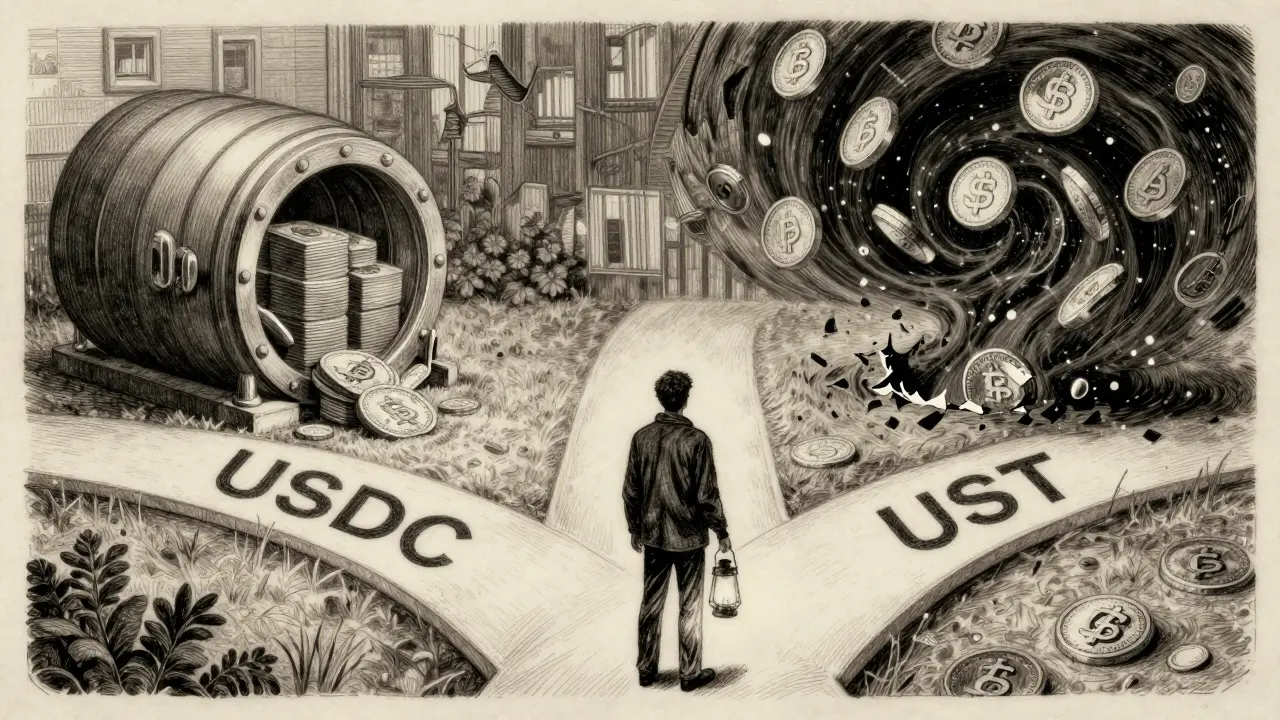
- Algorithmic - TerraUSD (UST): no collateral. Relies on code to balance supply and demand.
Only one of these has ever collapsed completely. And it changed everything.
The TerraUSD Collapse: When Code Couldn’t Save $1
On May 7, 2022, TerraUSD (UST) started to slip. By May 12, it was trading at $0.10. It never recovered.
UST wasn’t backed by dollars. It was backed by another crypto token called LUNA. The system worked like this: if UST dropped below $1, users could burn $1 worth of LUNA to mint one UST - and vice versa. The idea was that arbitrage would keep UST stable.
But when big investors started pulling out, the system couldn’t keep up. There wasn’t enough LUNA to absorb the flood of UST being sold. LUNA’s price crashed. More people panicked. More UST was dumped. The feedback loop was unstoppable.
In less than a week, $40 billion in market value vanished. LUNA went from $80 to $0.0001. Hundreds of DeFi protocols collapsed. Savings accounts in crypto lending platforms froze. People lost life savings.
UST’s failure wasn’t just a technical flaw. It was a design flaw. No real assets. No safety net. Just math. And math can’t fight panic.
Tether (USDT): The $70 Billion Question
While UST died, Tether (USDT) survived - barely. It’s the most used stablecoin in the world, with over $110 billion in circulation as of 2025. But it’s also the most controversial.
In 2021, the U.S. Commodity Futures Trading Commission (CFTC) fined Tether $41 million for misleading claims that it was fully backed by U.S. dollars. The truth? Only about 2.9% of its reserves were cash. The rest? Commercial paper, corporate bonds, and even loans to affiliated companies.
That’s not fraud - at least not legally. But it’s risky. If those assets lose value or freeze up, Tether can’t pay out. And since USDT is used everywhere - from exchanges to crypto ATMs to cross-border payments - a depeg here would be global.
USDT has depegged before. In March 2023, after the Silicon Valley Bank collapse, it dropped to $0.95. Traders panicked. Exchanges paused withdrawals. It recovered - but only because Tether sold some of its Treasury bills to buy back USDT on the open market. They had the liquidity. Not everyone does.
What Causes a Stablecoin to Depeg?
Depegging doesn’t happen by accident. It’s triggered by one or more of these:
- Loss of confidence - If people think the issuer is hiding something, they rush to sell. Rumors spread faster than facts.
- Liquidity crunch - If too many people want to cash out at once, the issuer can’t sell assets fast enough. Especially if those assets are illiquid.
- Undercollateralization - If you’re supposed to have $1 in assets for every $1 of stablecoin, but you only have $0.80, you’re one bad day away from trouble.
- Market panic - Crypto crashes, and everyone runs for the door. Stablecoins aren’t safe havens if no one trusts them.
- Regulatory action - When the SEC or a bank regulator cracks down, confidence evaporates. BUSD’s depeg in 2023 followed New York’s order to stop minting it.
- Technological failure - Smart contract bugs, network congestion, or hacked reserves can break the peg instantly.
It’s not just about money. It’s about trust. And trust is fragile.
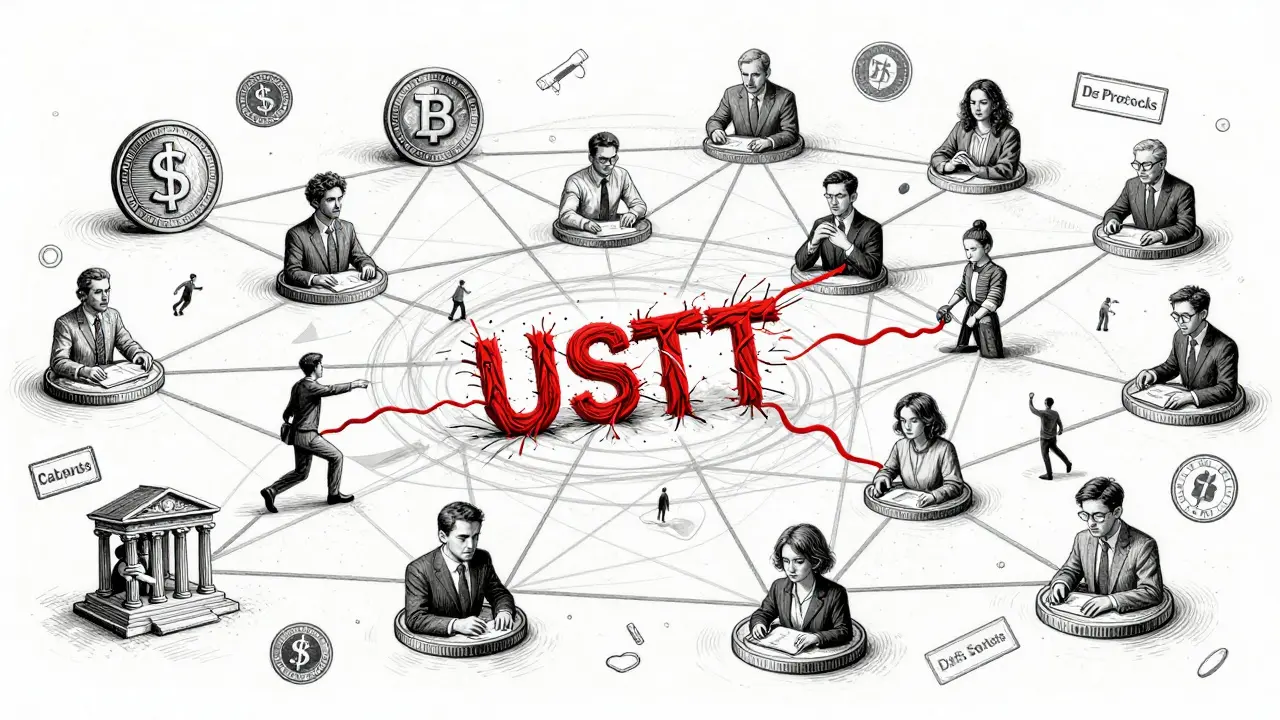
Who Gets Hurt When a Stablecoin Depegs?
It’s not just the people holding the coin.
Exchanges that list the stablecoin get hit with massive withdrawal requests. Some freeze withdrawals. Others go bankrupt.
DeFi protocols that use stablecoins as collateral - like Aave or Compound - suddenly see loans underwater. When USDT drops, people’s collateral isn’t enough. Their positions get liquidated. Entire lending markets freeze.
Even traditional finance gets dragged in. Banks that hold stablecoins as part of their treasury reserves - yes, some do - see their balance sheets shift. Hedge funds that use stablecoins to move money between crypto and fiat get stuck. Payment processors that accept USDT for goods face losses.
And then there are the everyday users. The person who saved $500 in USDT to buy a car. The freelancer paid in USDC. The grandmother who heard stablecoins were “safe.” When the peg breaks, there’s no FDIC insurance. No refund. No recourse.
How to Spot a Risky Stablecoin
Not all stablecoins are created equal. Here’s how to tell which ones might survive a crisis:
- Check the reserve report - Look for monthly, independent audits. USDC publishes them. Tether’s are less frequent and less detailed.
- Look at the asset breakdown - Is 90%+ in cash and U.S. Treasuries? That’s good. Is 30% in corporate bonds or crypto? That’s risky.
- See who backs it - USDC is issued by Circle, regulated in the U.S. DAI is managed by MakerDAO, a decentralized group. Tether is offshore, with murky oversight.
- Watch trading volume - Low volume = easy to manipulate. High volume = harder to crash.
- Check if it’s banned anywhere - If a major regulator like the SEC or EU says “stop,” that’s a red flag.
As of 2025, USDC and USDP (PayPal’s stablecoin) are considered the safest. DAI is stable but complex. USDT is still widely used - but treat it like a high-risk bond, not cash.
What’s Changed Since the UST Crash?
After Terra, the industry didn’t just patch things. It rebuilt.
Regulators are moving fast. The U.S. passed the Stablecoin Transparency Act in 2024, requiring all major stablecoins to publish weekly reserve reports and hold at least 80% of assets in cash or U.S. Treasuries. The EU’s MiCA law, effective in 2025, bans algorithmic stablecoins entirely.
Issuers are responding. Circle (USDC) now holds nearly 100% of reserves in cash and short-term Treasuries. Tether has slowly shifted away from commercial paper - but still holds $15 billion in corporate bonds. DAI now holds more than 60% of its collateral in real-world assets like U.S. Treasuries, reducing crypto volatility exposure.
But here’s the truth: the system is still fragile. There are over 200 stablecoins in circulation. Most are tiny. Most are unregulated. Most are just code with no real assets behind them.
What Should You Do?
If you hold stablecoins:
- Don’t assume they’re safe. Treat them like a risky investment, not cash.
- Stick to USDC or USDP if you want real safety.
- Avoid algorithmic stablecoins entirely. They’re designed to fail under stress.
- Don’t keep large amounts in one stablecoin. Spread it out.
- Watch for sudden price drops. If USDT hits $0.97, don’t wait for $0.90. Exit early.
If you’re using stablecoins in DeFi or lending:
- Use only well-audited protocols.
- Know what collateral you’re using. If your loan is backed by USDT and it depegs, you could lose everything.
- Keep emergency cash outside crypto. Always.
Stablecoins were supposed to make crypto useful. But they’re only as strong as their weakest link. And that link isn’t technology. It’s human trust.
History shows us: when trust breaks, money disappears. And in crypto, it disappears fast.