
Crypto Scam Risk Calculator
This tool helps you assess the likelihood of encountering a cryptocurrency scam. Based on patterns identified in Cambodia's underground crypto trading operations and global scam networks, it evaluates common warning signs.
Assess Your Opportunity
Answer the questions below to evaluate the risk level of a crypto investment opportunity.
Risk Assessment
When Cambodia banned cryptocurrency in 2019, people thought it would die. Instead, it went deeper - into hidden compounds, encrypted Telegram channels, and offshore bank accounts controlled by violent criminal syndicates. What started as a simple prohibition became a breeding ground for one of the most sophisticated financial crime networks in the world. Today, underground crypto trading in Cambodia isn’t just a loophole - it’s a full-scale criminal enterprise that moves billions, exploits thousands, and evades law enforcement across continents.
How a Ban Created a Criminal Empire
The National Bank of Cambodia’s 2019 ban on all crypto transactions was meant to protect citizens. But without enforcement, oversight, or legal alternatives, it created a vacuum. Criminal groups didn’t disappear - they adapted. They built physical operations: scam compounds in Sihanoukville and Chrey Thom, where trafficked workers were forced to run fake cryptocurrency investment schemes under threat of torture or death. These weren’t small-time operations. The Prince Group, led by Chen Zhi, turned these compounds into factories of fraud. One, called the Jinbei Compound, sat inside a hotel and casino. Another, the Golden Fortune Science and Technology, looked like a tech startup - but inside, victims were held against their will, forced to message strangers on WhatsApp and Facebook, pretending to be rich investors who made millions in crypto. If they didn’t hit daily targets, they were beaten. Some were starved. Others were sold to other gangs. Meanwhile, the money flowed. Huione Guarantee, a shadowy financial hub tied to Prince Group, became the central pipeline. It didn’t just move crypto - it cleaned it. According to U.S. Justice Department filings, Huione laundered at least $4 billion between 2021 and early 2025. That includes $37 million stolen by North Korean hackers, $36 million from fake crypto investment scams, and $300 million from dark web markets and ransomware attacks. This wasn’t random crime. It was a business model.The Underground Infrastructure: Telegram, Cash, and Illegal Banks
You won’t find these operations on Binance or Coinbase. They operate on Telegram - not the public channels, but encrypted, invite-only groups. Huione once ran a full-service crime platform there, offering tools to hack wallets, fake KYC documents, and money laundering services. Telegram shut it down in 2015. So they moved deeper. Now, they use private bots, burner phones, and coded messages that change daily. The money doesn’t go through banks. Cambodia’s formal banking system is weak - ranked 128th out of 180 countries for corruption by Transparency International in 2024. Instead, funds flow through what court documents call “illegal banks and underground money houses.” These aren’t real banks. They’re storefronts in Phnom Penh or Siem Reap that take cash or crypto, then send equivalent amounts overseas through shell companies, fake invoices, or casino chips. Prince Group didn’t just use crypto. They mixed it with real-world assets. They bought hotels, casinos, and construction firms. Then they layered the dirty money into legitimate revenue streams. A $10,000 crypto deposit? It gets converted into fake casino winnings, paid out in cash, and deposited into a shell company’s account. Suddenly, it’s clean. South Korea became a major pipeline. In 2023, only $9.22 million in Korean won flowed from Korean exchanges to Huione. By 2024, that jumped to 12.8 billion won - over $8.9 million - a 1,400-fold increase. By October 2025, it was still growing, hitting 3.15 billion won. Victims in Korea, the U.S., and Australia sent money believing they were investing in crypto. They got nothing back. Just silence.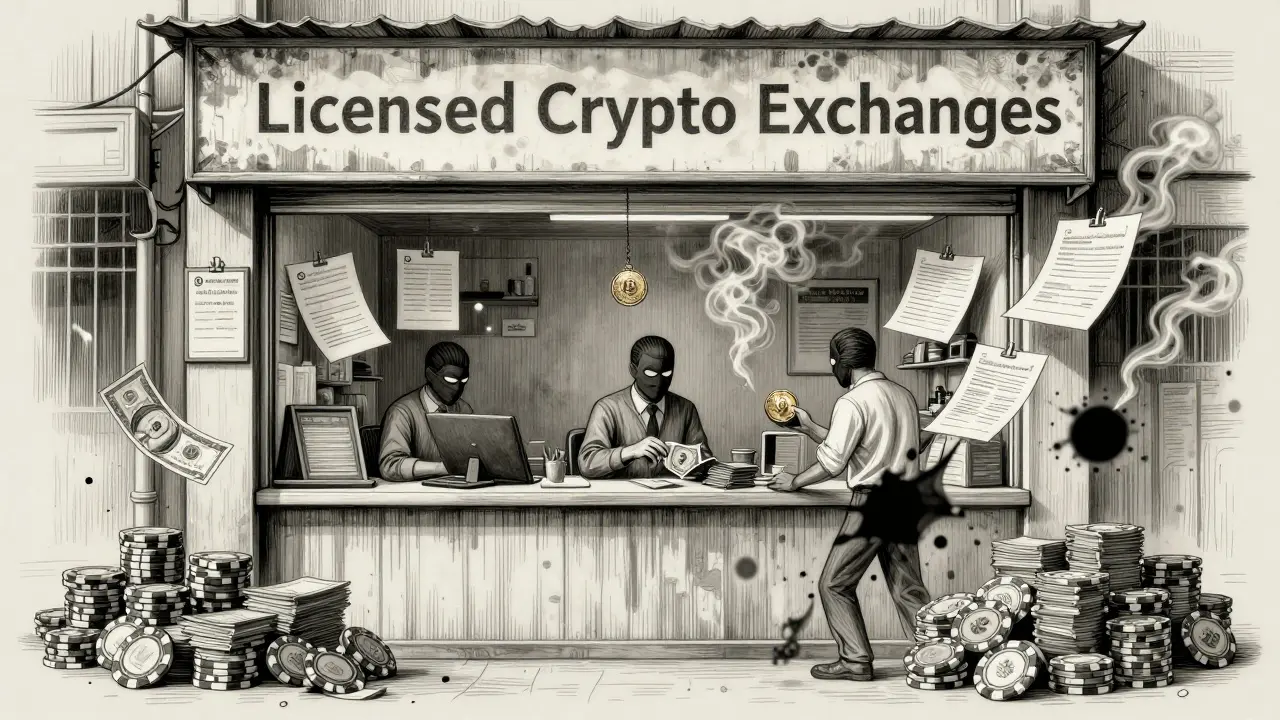
The Global Reach: How Americans Lost Billion
This isn’t just a Cambodia problem. It’s a global one. The U.S. Department of Justice called Prince Group “one of the largest transnational criminal organizations in Asia.” Their scams targeted everyday people - teachers, nurses, retirees - with messages promising 10x returns on crypto investments. They built fake websites that looked like Binance. They hired actors to livestream fake trading floors. They even created fake customer support teams. The Brooklyn Network, documented by TRM Labs, moved over $18 million from U.S. victims directly to Prince Group accounts between 2021 and 2022. Victims lost between $5,000 and $250,000. One Reddit user in r/Scams wrote in September 2025: “I sent $120,000 to a guy who said he was a crypto trader in Cambodia. He disappeared after I withdrew $10,000. No one answers calls. No one replies.” According to experts like Jacob Sims from Harvard’s Asia Center, these scams are now “rivaling the global drug trade in terms of gross profits.” In 2024 alone, Americans lost an estimated $10 billion to Southeast Asian crypto scams - the majority tied to Cambodia. The scale is staggering. And unlike drugs, there’s no physical product to intercept. Just data, wallets, and lies.Regulation That Helped the Criminals
In late 2024, Cambodia changed its approach. Instead of banning crypto, it started issuing licenses. Prakas B7-024-735 Prokor created a permission-based system - meaning companies could now legally operate crypto exchanges, as long as they got government approval. It sounded like progress. But it backfired. Huione and Prince Group didn’t shut down. They applied for licenses. They hired lawyers. They opened offices with signs that said “Licensed Crypto Exchange.” They used the new rules to appear legitimate - while still laundering billions through their underground network. The government didn’t catch them. They were too busy approving new applicants. Lightspark’s 2025 analysis called this a “regulatory blind spot.” Criminals now had a veneer of legality. Banks that once refused to work with crypto now had to vet applicants - but without access to real transaction data, they couldn’t tell the difference between a real exchange and a front for fraud. The result? More money flowing, more victims, and less trust in the system.
The Billion Seizure - And Why It Might Not Be Enough
In October 2025, the U.S. Department of Justice made history. In coordination with the U.K. and South Korea, they seized $15 billion in Bitcoin tied to Prince Group and Huione Guarantee. It was the largest asset forfeiture in U.S. history. But here’s the truth: they didn’t shut down the network. They just took the money. Huione’s operations kept running. New wallets were created. New shell companies were registered. The same people who ran the scams before are now running them again - just with new addresses. Why? Because the infrastructure isn’t digital. It’s human. The scam compounds still operate. The trafficked workers are still there. The underground money houses still exchange cash for crypto. The Telegram bots still send out messages. The money moves. The seizure was a victory - but not an end. As Jeremy Douglas from the U.N. Office on Drugs and Crime said, “Thousands of people are working in scam compounds in Cambodia. Many are trafficked. Until you free them, dismantle the compounds, and cut the local protection networks, this won’t stop.”What’s Next? The Fight Isn’t Over
Cambodia’s government claims it’s cracking down. The National Bank says it’s monitoring transactions. The U.S. is pressuring them. But progress is slow. Cambodia has no central bank digital currency (CBDC) yet - even though it was announced in 2019. Without a real alternative, people still turn to crypto. And with 10.63% of Cambodians still using it, according to Standard Insights’ 2025 report, demand hasn’t faded. The underground market survives because it’s not just about money. It’s about power. Prince Group controls territory. It pays off police. It owns businesses. It has political connections. Taking down a wallet address doesn’t touch that. Real change will require more than seizures. It needs coordinated raids. It needs international task forces. It needs safe houses for victims. It needs Cambodia to stop pretending it’s serious about regulation - and start enforcing it. Until then, underground crypto trading in Cambodia won’t vanish. It will evolve. And the next wave will be even harder to track.Is crypto trading legal in Cambodia today?
Technically, yes - but only if you have a government license. In late 2024, Cambodia replaced its 2019 ban with a permission-based system. However, many licensed entities are fronts for criminal networks like Huione Guarantee and Prince Group. The system is easily exploited, and most underground trading still happens outside official channels.
How do scammers in Cambodia trick people into sending crypto?
They pose as successful investors on social media, dating apps, or messaging platforms. They share fake screenshots of profits, livestream fake trading floors, and build trust over weeks. Once victims send money, they’re told to deposit into a “secure wallet” - which is actually controlled by the scam group. Withdrawals are blocked, support disappears, and the account vanishes.
What role does Huione Guarantee play in this system?
Huione Guarantee acts as the central money laundering hub for Prince Group and other criminal networks. It processes crypto from scams, dark web sales, ransomware, and illegal gambling - then converts it into clean funds through shell companies, casinos, and underground banks. The U.S. Justice Department says it laundered over $4 billion between 2021 and 2025.
Are there any safe crypto exchanges in Cambodia?
No. Even licensed exchanges are suspected of being used by criminal groups. The government lacks the resources to properly monitor them. Most experts advise against using any crypto platform based in Cambodia. If you’re in Cambodia and want to trade crypto, use international exchanges with strong KYC and AML controls - and never send funds to local wallets.
Why hasn’t Cambodia shut down the scam compounds?
Because many are protected by local officials. Prince Group has deep ties to law enforcement and political figures. Raids are rare, and when they happen, key targets often disappear beforehand. International pressure has increased, but without sustained cooperation and funding, Cambodian authorities lack the will or capacity to fully dismantle these networks.
Can victims recover their lost crypto?
Almost never. Once crypto is sent to a scammer’s wallet, it’s nearly impossible to trace or reverse. The $15 billion seized in 2025 came from assets tied to the network - not from individual victims’ wallets. Recovery is not part of Cambodia’s legal system. Victims are left with no recourse, no support, and no hope.

This is monstrous. And yet, no one’s doing anything! People are being TORTURED-starved, beaten, sold like livestock-and we’re talking about crypto prices? This isn’t a ‘loophole’-it’s a slave empire with blockchain branding. The U.S. seized $15 billion? Great. Now where are the bodies? Where are the rescued victims? Where’s the justice?!
I’ve seen similar patterns in Southeast Asia with online gambling rings. The real issue isn’t crypto-it’s governance failure. When a state bans something without offering alternatives or enforcement, it doesn’t stop crime. It just moves it into the shadows, where it grows unchecked. Cambodia’s licensing system wasn’t a mistake-it was a trap. Criminals love regulation if it gives them cover.
International pressure needs to be surgical: freeze assets of officials who protect these networks, not just the wallets. And victims? They need trauma-informed legal aid, not just crypto recovery fantasies.
Real change starts with protecting people, not just seizing coins.
One must acknowledge the systemic epistemological rupture that occurs when state-led prohibitionism collides with decentralized financial innovation. The National Bank of Cambodia’s 2019 edict constituted a classic case of regulatory myopia-failing to account for the emergent properties of peer-to-peer value transfer systems. The Prince Group’s operational architecture is not merely criminal-it is a Darwinian adaptation to institutional vacuum.
Huione Guarantee, in its perverse elegance, functions as a de facto central bank for illicit capital flows, leveraging the opacity of offshore shell entities and the institutional inertia of compromised financial intermediaries. The $15 billion forfeiture is a pyrrhic victory; the network’s topology is resilient, non-linear, and decentralized at the human level-where coercion, not code, sustains the ecosystem.
Until transnational law enforcement transcends bureaucratic silos and adopts a cyber-physical integration framework-combining blockchain forensics with human trafficking interdiction protocols-the game remains unwinnable. We are fighting ghosts with paper trails.
Oh wow. The U.S. seized $15 billion. How heroic. And yet, the same people who ran the scam compounds are probably sipping cocktails in Phnom Penh right now, laughing at our ‘historic forfeiture’ while their next batch of trafficked workers is already being trained to message new victims on WhatsApp.
Let’s be real-this isn’t a crypto problem. It’s a human trafficking problem with a blockchain veneer. And the real crime isn’t the wallets-it’s the fact that we treat this like a financial audit instead of a genocide in slow motion.
Someone please tell me why we’re still letting Cambodia ‘license’ these monsters. Is the government paying them in bribes or just bad policy?
There is a metaphysical irony in the fact that the very technology designed to liberate finance from the shackles of centralized authority has, in this instance, become the scaffolding for a new kind of feudalism-one where the serfs are not bound to soil, but to screens; where their labor is not extracted by landlords, but by algorithmic sadists operating from hotel rooms in Sihanoukville.
The seizure of Bitcoin, however monumental, is but the removal of a symptom. The disease is the collapse of moral imagination in governance-the willingness to permit the commodification of human suffering under the euphemism of ‘market efficiency.’
Until we recognize that behind every wallet address lies a trembling hand, a silenced scream, a life erased-not as data, but as flesh-we are not fighting crime. We are merely cataloging its inventory.