
A Sybil attack on a blockchain is when one person creates dozens, hundreds, or even thousands of fake identities to trick the network into thinking they’re many different users. It’s like showing up to a meeting with 50 fake business cards, each claiming to represent a different company - but they’re all just you. The goal? To gain control over the network, manipulate votes, or steal money. This isn’t science fiction. It’s a real, proven threat that’s been studied since the early 2000s.
Where Did the Name Come From?
The term "Sybil" comes from a 1973 book about a woman with multiple personalities. The book was called Sybil, and researchers borrowed the name because it perfectly described what happens in this kind of attack: one person pretending to be many. In blockchain, each fake identity is called a Sybil node. These aren’t just random usernames - they’re fully functional nodes that connect to the network, store data, and participate in validation. The attacker controls them all from a single machine or network of machines. The network can’t tell the difference.
How Does It Actually Work?
Blockchains rely on consensus. That means decisions - like which transactions are valid - are made by the majority of nodes. In Bitcoin, for example, miners compete to add blocks. In Ethereum, validators stake cryptocurrency to vote on the next block. If an attacker can control enough of these nodes, they can sway votes, block transactions, or even rewrite history.
Here’s how it plays out:
- The attacker sets up hundreds of fake nodes.
- Each node pretends to be a separate user with its own IP address and identity.
- The network accepts them because there’s no way to verify who’s real - at least not without safeguards.
- Once the fake nodes make up a large enough portion of the network, the attacker can start manipulating outcomes.
Imagine a small town council where 10 people vote on new rules. One person shows up with 51 fake IDs and votes every time. Suddenly, they control the council. That’s a Sybil attack.
What Can It Do to a Blockchain?
It’s not just about voting. A successful Sybil attack can trigger several cascading problems:
- Network fragmentation: The attacker isolates honest nodes from each other. One group of nodes sees one version of the blockchain; another group sees a different version. This breaks trust.
- Eclipse attacks: The attacker surrounds a single honest node with Sybil nodes, feeding it lies. That node starts believing false data - like a transaction that never happened - and spreads it to others.
- Double spending: If the attacker controls enough nodes, they can spend the same cryptocurrency twice. They send coins to a merchant, then use their fake nodes to confirm a conflicting transaction that reverses it. The merchant gets nothing.
- Blocking transactions: Sybil nodes can refuse to relay valid transactions, effectively censoring users.
And here’s the scariest part: Sybil attacks often serve as the first step toward a 51% attack. If you control more than half the network’s voting power - whether through computing power or staked coins - you can rewrite the blockchain. You can delete transactions. You can reverse payments. You can stop new ones from being added. That’s not just theft. That’s destroying trust in the entire system.

Why Are Blockchains So Vulnerable?
Blockchains are open by design. Anyone can join. No ID check. No background verification. That’s what makes them decentralized. But it’s also their weakness. In traditional banking, you need a passport or Social Security number to open an account. In Bitcoin? You download software and generate a key. That’s it.
That openness is great for freedom. But it’s terrible for security if no one checks who’s really there. Without defenses, an attacker with a few thousand dollars in cloud computing could flood a small blockchain with fake nodes. Even larger networks like Ethereum or Bitcoin aren’t immune - they just make it harder.
How Do Blockchains Fight Back?
There’s no magic bullet. But there are proven defenses:
Proof of Work (PoW)
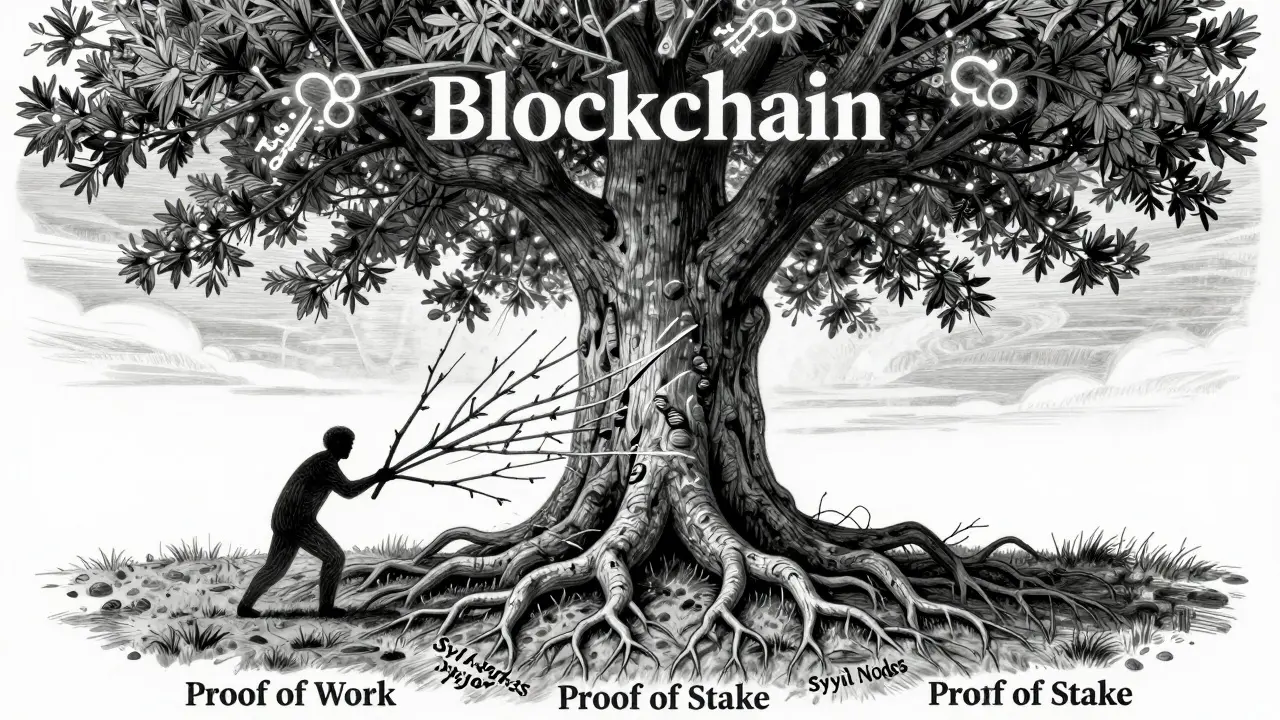
This is how Bitcoin works. To create a new block, you need to solve a math puzzle. It takes real computing power - and real electricity. Running a Sybil attack here means buying or renting thousands of powerful machines. The cost quickly becomes astronomical. A single attacker might spend $100,000 just to try. And even then, they’d need to outpace the entire network’s combined power. It’s not impossible - but it’s so expensive that it rarely makes sense.
Proof of Stake (PoS)
Ethereum, Cardano, and others use this. Instead of computing power, you need to lock up (or "stake") real cryptocurrency. To control 51% of the network, you’d need to own over half of all the coins in circulation. For Ethereum, that’s over $60 billion worth. Why would anyone spend that much just to attack? They’d crash the value of their own holdings. The economic incentive works against them.
Node Reputation Systems
Some blockchains track how long a node has been online, how often it behaves honestly, and whether it’s connected to trusted peers. Nodes that suddenly appear, vanish, or act suspiciously get ignored. This isn’t perfect, but it raises the bar.
Atomic Ownership Blockchains
Some newer systems avoid the problem entirely. Instead of relying on node voting, they use cryptographic signatures tied directly to assets. Each coin or token is controlled by one owner - no voting needed. If you want to transfer it, you sign it with your private key. No fake nodes can fake that. This removes the whole Sybil problem by design.
Has It Ever Happened?
Full-scale Sybil attacks on major blockchains like Bitcoin or Ethereum haven’t succeeded - not because they’re impossible, but because the cost is too high. But smaller blockchains? Yes. In 2018, a small cryptocurrency called Verge suffered a 51% attack that was enabled by Sybil nodes. Attackers flooded the network with fake miners, rewrote transaction history, and stole over $1 million. It took days to recover. Smaller networks with low hash rates or low staked coins are sitting ducks.
What’s Next?
Developers are always building better defenses. Some are testing identity verification through decentralized identifiers (DIDs) tied to real-world credentials - without revealing personal data. Others are using machine learning to detect abnormal node behavior. But the core truth remains: if a blockchain doesn’t make it expensive or impossible to create fake identities, it’s vulnerable.
The most secure networks aren’t the ones with the most users - they’re the ones that make Sybil attacks too costly to bother with. That’s why Bitcoin and Ethereum are still standing. Not because they’re perfect. But because attacking them would cost more than the reward.
Can a Sybil attack steal my crypto directly?
No, a Sybil attack doesn’t hack your wallet or guess your private key. Instead, it manipulates the network to reverse transactions or block yours. If you send crypto to someone and the attacker controls enough nodes, they can make the network forget that payment ever happened. Your coins don’t disappear - they just get spent twice.
Are all blockchains equally at risk?
No. Large networks like Bitcoin and Ethereum have so much computing power or staked value that launching a Sybil attack would cost millions - and likely fail. Smaller blockchains with low hash rates, low market caps, or weak consensus rules are far more vulnerable. Always check how a network prevents Sybil attacks before trusting it with your funds.
Can I protect myself from a Sybil attack?
You can’t stop it directly, but you can reduce your risk. Use wallets and services that connect to well-established, secure blockchains. Avoid sending funds to new or obscure networks. Check if the network uses Proof of Work or Proof of Stake - these make Sybil attacks expensive. And never trust a transaction until it has several confirmations.
Is a Sybil attack the same as a 51% attack?
Not exactly. A Sybil attack is about creating fake identities. A 51% attack is about controlling more than half the network’s power - whether through computing, staking, or node count. Sybil attacks are often used to enable a 51% attack. You use fake nodes to build up influence, then use that influence to gain majority control.
Why haven’t we solved Sybil attacks completely?
Because decentralization and anonymity are core values in blockchain. If you require ID verification to join a network, you’re no longer truly decentralized. The challenge is finding a balance: making fake identities expensive to create without excluding real users. That’s why most networks rely on economic costs - not identity checks - to deter attackers.