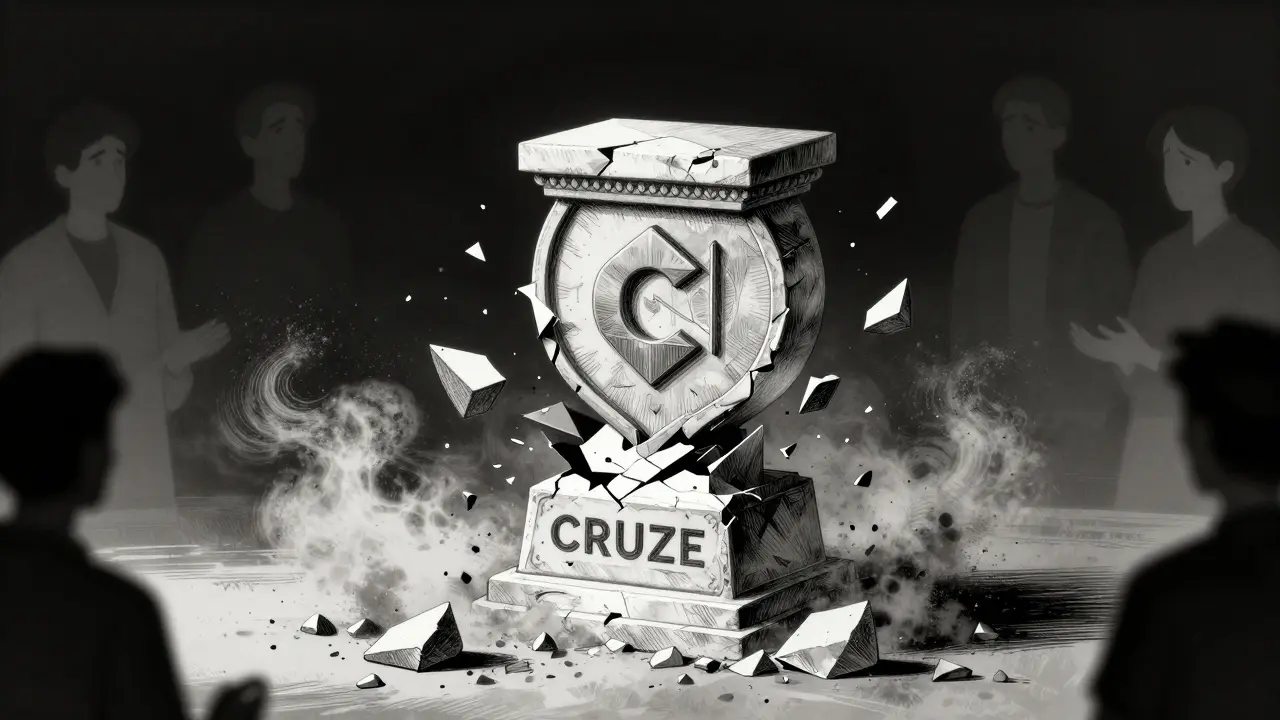
You might have seen the name Cruze pop up in your feed or heard whispers about it being the next big thing for content creators. The promise was simple: a 100% crypto platform designed to help creators monetize their work directly. But if you are looking at the current state of the CRUZE token, you are likely seeing something very different from that promise. You are probably wondering why the price is hovering near zero, why there is no activity, and whether this is a temporary dip or a permanent failure. The short answer is that Cruze has effectively collapsed, leaving investors with little to show for their risk.
To understand what happened here, we need to look past the marketing hype and examine the actual data. This isn't just a story about bad timing; it's a case study in how quickly a crypto project can lose its value when the fundamentals aren't there. Whether you are holding CRUZE tokens or considering buying them because they are cheap, understanding the reality behind the scenes is crucial for protecting your capital.
The Promise vs. The Reality of Cruze
When Cruze Platform launched in October 2023, the marketing materials were aggressive. They claimed a "massive debut" with over 1 billion combined impressions globally. For a new entrant in the crowded space of creator economy tokens, that sounds impressive. The idea was to create an ecosystem where creators could earn, tip, and govern using the CRUZE utility token. On paper, this fits into a growing sector that includes successful players like Theta Network and Audius.
However, the reality on the ground was starkly different. Within weeks of launch, the momentum vanished. There were no major partnerships announced, no significant user adoption metrics released, and certainly no working platform features that matched the hype. Instead of building a community, the project seemed to disappear. By late 2023, reports started surfacing that the official website had become inaccessible, and social media channels went silent. The "1 billion impressions" claim turned out to be unverifiable marketing fluff rather than genuine organic growth.
| Feature | Cruze (CRUZE) | Theta Network (THETA) | Audius (AUDIO) |
|---|---|---|---|
| Primary Use Case | Content Creator Platform | Decentralized Video Delivery | Music Streaming |
| Price Stability | Catastrophic Collapse (>97% drop) | Relatively Stable | Volatile but Active |
| Technical Documentation | Missing/Unavailable | Extensive Whitepaper & Docs | Open Source GitHub |
| Community Activity | Negligible/Silent | High Engagement | Active Developer Community |
| Market Viability | Effectively Dead | Leading Player | Established Niche |
Comparing CRUZE to established projects highlights the gap. Theta Network has a clear technical infrastructure for video delivery and a multi-billion dollar market cap. Audius, despite facing its own challenges, maintains a functional music streaming protocol with active developers. Cruze had neither. It lacked the technical backbone to support its claims and the community engagement to sustain interest. When you strip away the buzzwords, there was simply no product to speak of.
The Price Crash: What the Numbers Tell Us
If you want to know the health of a crypto project, look at the charts. The performance of CRUZE is not just a correction; it is a collapse. Data from exchanges like Binance showed the token dropping by over 97% within just 90 days of its launch. In October 2023, the price fell from around $0.0011 to mere fractions of a cent, trading as low as $0.000033 USD. Other platforms like Symlix reported even steeper declines, with some listings showing the price as effectively $0.00 due to extreme devaluation.
This kind of volatility is a red flag for several reasons. First, it indicates a complete lack of liquidity. Without buyers, sellers cannot exit their positions without crashing the price further. Second, the discrepancies between exchange prices suggest fragmented markets and potential manipulation. If one exchange lists it at $0.000033 and another at $0.000015, you are dealing with a broken market structure. Finally, such a rapid decline usually signals that early insiders dumped their tokens, leaving retail investors holding the bag.
Experts in the field don't mince words about this pattern. William M. Peaster from Bankless categorizes tokens with >95% drops in 90 days as "zombie tokens," often indicating either market manipulation or total abandonment. Dr. Michal Zargham of BlockScience notes that tokens losing this much value without technical documentation are almost invariably exit scams or abandoned projects. These aren't just opinions; they are patterns observed across thousands of failed ICOs and token launches.
Red Flags: Why Investors Lost Trust
Trust is the currency of the internet, and Cruze spent none of it wisely. Several critical failures contributed to the loss of confidence among users and investors. The most glaring issue was the absence of technical transparency. Unlike legitimate projects that publish whitepapers, host code on GitHub, and undergo security audits, Cruze offered none of these. There was no way to verify how the platform worked, who controlled the funds, or if the smart contracts were secure.
User feedback paints a grim picture. On review platforms like Trustpilot, the associated entities received ratings as low as 1.2 out of 5 stars. Common complaints included tokens becoming worthless within weeks and promises of tools that never materialized. On Reddit, threads dedicated to CRUZE frequently labeled it a "classic pump and dump." One highly upvoted comment noted that the "1 billion impressions" claim was fake marketing-a sentiment echoed by many who felt misled.
Social sentiment analysis supports this view. Over 98% of mentions on Twitter regarding CRUZE were negative, focusing on the inability to sell holdings and the disappearance of the team. When a project loses public trust this thoroughly, recovery becomes statistically improbable. Messari’s Crypto Recovery Index suggests that tokens with >95% declines and no functionality have less than a 1% chance of returning to meaningful valuation.
Is Cruze Still Alive? Checking the Pulse
As of mid-2026, the status of Cruze remains unchanged: dormant. The official website, which was once the hub of information, became inaccessible in November 2023 and has not returned. Archive records confirm that the domain has been inactive for years. There have been no updates to the roadmap, no beta launches, and no mobile app releases as originally promised. The silence from the development team is deafening.
For anyone still holding CRUZE tokens, the situation is difficult. The trading volume is negligible-sometimes totaling less than $100 in a day on minor exchanges. This means that even if you wanted to sell, finding a buyer at any reasonable price is nearly impossible. The token has entered what analysts call the "crypto graveyard," where assets linger with no utility, no community, and no future development.
It is also worth noting the regulatory landscape. Projects that make grand claims about user bases and impressions without verifiable data often attract scrutiny from bodies like the SEC. While specific legal action against Cruze may not be widely publicized, the pattern mirrors other cases where promoters faced penalties for misleading investors. This adds another layer of risk for anyone involved with such tokens.

Lessons Learned: Protecting Yourself in Crypto
The story of Cruze serves as a cautionary tale for all crypto investors. It highlights the importance of due diligence before putting money into any token. Here are key lessons to take away:
- Verify Technical Documentation: Always look for a whitepaper, GitHub repository, and audit reports. If these are missing, walk away.
- Check Community Engagement: Real projects have active communities discussing development, not just price speculation. Look for sustained conversation on Discord, Telegram, or Reddit.
- Beware of Hype Metrics: Claims like "1 billion impressions" should be backed by transparent data. If you can't verify it, assume it's false.
- Monitor Liquidity: Low trading volumes and wide price spreads between exchanges indicate a fragile market that can collapse instantly.
- Watch for Team Transparency: Anonymous teams or those who go silent after launch are major red flags.
In the broader context of the creator economy, there are better options. Platforms like Theta Network and Audius have proven models, active development, and real utility. Investing in established projects with clear roadmaps and transparent teams is always safer than chasing the next unproven hype.
Conclusion: Moving Forward
Cruze (CRUZE) stands as a reminder that not every crypto token will succeed. Despite its ambitious start, it failed to deliver on its promises, resulting in a catastrophic loss of value and trust. For current holders, the outlook is bleak, with little hope for recovery. For prospective investors, it is a clear signal to avoid similar projects that lack substance.
The crypto market is full of opportunities, but it is also rife with traps. By staying informed, asking tough questions, and demanding transparency, you can protect yourself from the next "Cruze." Focus on projects with real utility, active development, and honest communication. Your portfolio will thank you for it.
What is the current price of CRUZE?
The price of CRUZE is effectively near zero, trading at fractions of a cent (e.g., $0.000033 or lower) on various exchanges. Due to extremely low liquidity, the price can vary significantly between platforms, and selling holdings may be difficult or impossible.
Is Cruze (CRUZE) a scam?
While definitive legal classification requires regulatory action, many experts and users consider Cruze to exhibit characteristics of a failed project or potential exit scam. Indicators include the sudden collapse in value, lack of technical documentation, disappearance of the team, and unverifiable marketing claims.
Where can I buy CRUZE tokens?
CRUZE tokens were previously available on exchanges like Binance Web3 Wallet, Phemex, and Symlix. However, due to the token's near-zero value and lack of liquidity, availability may be limited, and trading carries high risks.
Why did CRUZE fail?
CRUZE failed due to a combination of factors: lack of a functional product, absence of technical documentation, poor community engagement, and potential insider dumping. The project did not deliver on its promises, leading to a loss of investor confidence and a massive price crash.
Are there better alternatives for content creator crypto?
Yes, established projects like Theta Network (THETA) and Audius (AUDIO) offer more reliable ecosystems for content creators. These platforms have active development, transparent teams, and proven utility in video delivery and music streaming, respectively.
typical american hype train gone off the rails
i told you guys this was gonna happen from day one
you people are so naive thinking crypto is real money
its just gambling with extra steps
look at the chart its a straight line down
no product no team no future
waste of time reading about it
I must take issue with the rather pedestrian analysis presented here. While the author correctly identifies the collapse of CRUZE, the assertion that this represents a 'failed token' in isolation ignores the broader systemic failures of the entire creator economy narrative within blockchain technology. It is not merely that Cruze failed; it is that the very premise of utility tokens for content monetization is fundamentally flawed due to regulatory overreach and user apathy. The comparison to Theta Network is also disingenuous, as Theta relies on infrastructure subsidies rather than genuine organic demand. To suggest that investors should simply 'protect their capital' by avoiding such projects is akin to advising pedestrians to avoid roads because cars exist. One must engage with the market forces, even when they are brutal.
Oh man, I can feel the pain radiating from these comments.
I remember when I first heard about Cruze too.
The promise was so beautiful.
Creators getting paid directly.
No middlemen.
It felt like hope.
And now?
Just silence.
But hey, we learn.
We grow.
Let's support each other through this.
You did nothing wrong.
The system is broken.
Keep your head up.
Tomorrow is another day.
We will find better ways.
Together we rise.
actually i think you're all missing the point
this wasn't a failure
it was a lesson
and honestly? i'm glad it happened
because now we know what to look for
so instead of crying about lost money
let's celebrate the clarity
it's kind of refreshing isn't it?
Hello everyone! I wanted to chime in here because I think there is a lot of valuable information being shared, but also a lot of emotion.
As someone who has been following the creator economy space closely, I can tell you that while CRUZE is indeed dormant, it is important not to generalize this experience to all decentralized platforms.
There are many projects out there that are working hard to build sustainable models.
Let's keep the conversation constructive and helpful for those who might be new to this space.
We all make mistakes, but learning together is key.
It is quite evident that the lack of rigorous technical documentation served as the primary catalyst for the eventual demise of the project in question which is a phenomenon that has been observed repeatedly in the history of speculative financial instruments particularly those that purport to offer utility without demonstrating any tangible mechanism for said utility thereby leading to a situation where the market participants are left with nothing but empty promises and a significant loss of capital which serves as a stark reminder of the importance of due diligence in an era where transparency is often sacrificed for the sake of rapid expansion and marketing hype which ultimately proves to be unsustainable in the long run as the fundamental value of any asset must be derived from its ability to provide real-world benefits rather than mere speculation based on unverifiable claims made by anonymous developers who have no skin in the game
u guys are so dumb
the token is dead but the meme lives on
who cares if its zero
we got the story
next time buy the dip earlier
or dont
whatever
crypto is wild