Most cryptocurrencies promise endless growth through new coin issuance. Diamond (DMD) is a scarce layer-1 cryptocurrency network launched in 2013 as a community-governed fork of Bitcoin, featuring a fixed maximum supply of 4,380,000 coins and advanced consensus mechanisms like Honey Badger BFT. It flips that script entirely. With a hard cap of just 4.38 million tokens-issued all at once at genesis-DMD positions itself not as a speculative pump-and-dump, but as a deflationary asset designed for long-term holding and efficient payments. But what exactly makes this decade-old project different from the thousands of other coins out there?
The Evolution: From Bitcoin Fork to Modern Smart Contract Platform
To understand where DMD is today, you have to look at where it started. Launched in 2013, DMD began as a direct response to Bitcoin’s growing pains. Back then, Bitcoin was suffering from high transaction fees, slow confirmation times (averaging 10 minutes per block), and increasing centralization among miners. The DMD team forked the Bitcoin codebase to create a faster, cheaper alternative focused on peer-to-peer digital payments.
For years, DMD operated using a Proof-of-Work model similar to Bitcoin but with optimizations. In 2017, it underwent a significant technical overhaul by adopting the PIVX codebase (known as DMD V3). This update introduced masternodes, anonymized transactions via "mixTX," and instant transaction confirmations called "quickTX." Running a masternode required locking up 10,000 DMD, creating a decentralized infrastructure layer secured by stakeholders rather than just miners.
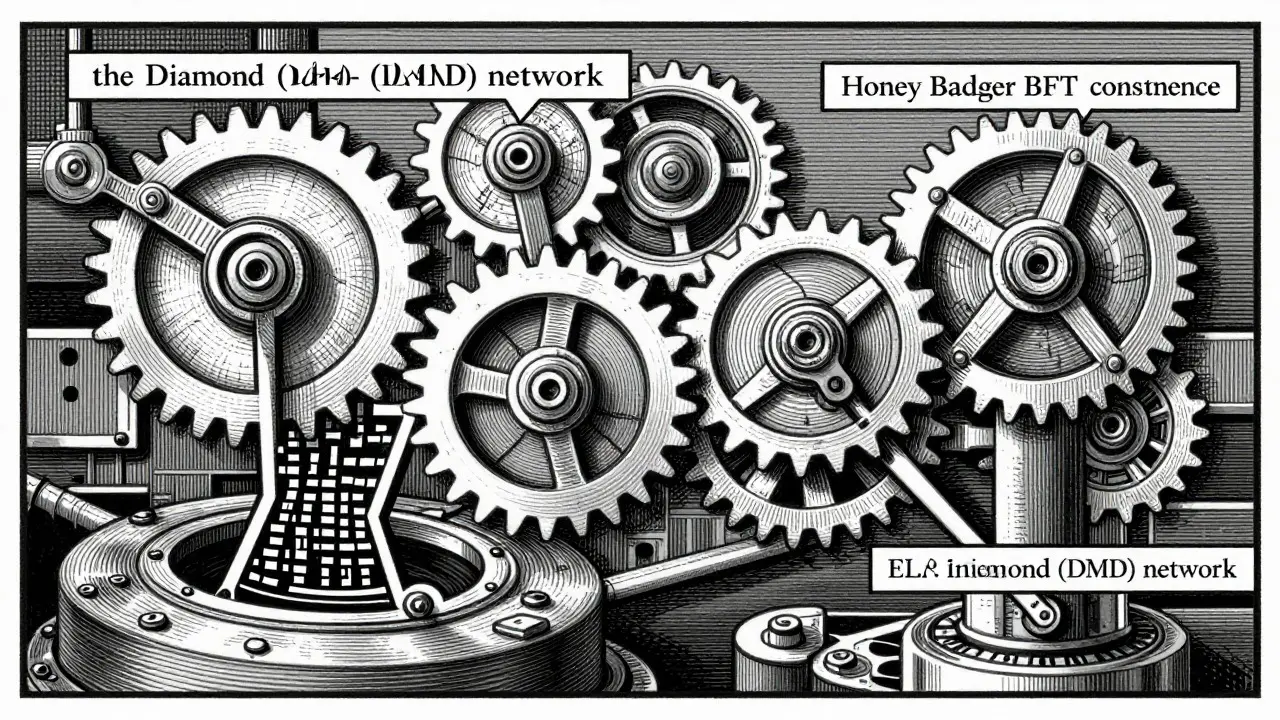
However, the most dramatic shift happened recently with the launch of DMDv4. This upgrade moved the network away from traditional mining toward a modern hybrid architecture. It now utilizes Honey Badger BFT (HBBFT) cooperative consensus combined with Delegated Proof-of-Stake (DPoS). More importantly, DMDv4 added full support for the Ethereum Virtual Machine (EVM). This means developers can write smart contracts in Solidity and deploy decentralized applications (dApps) on the DMD network, just like they would on Ethereum or Binance Smart Chain, but with lower fees and higher finality speeds.
Tokenomics: The Power of Absolute Scarcity
The defining characteristic of Diamond (DMD) is its supply schedule. Unlike Bitcoin, which releases 90% of its supply over 160 years, or Ethereum, which has an elastic supply based on staking rewards and burn mechanisms, DMD has a static supply.
| Asset | Max Supply | Circulating Supply (Mid-2026) | Issuance Model |
|---|---|---|---|
| Diamond (DMD) | 4,380,000 | ~3.8 million | Fully pre-mined at Genesis |
| Bitcoin (BTC) | 21,000,000 | ~19.7 million | Mined gradually until ~2140 |
| Ethereum (ETH) | No Hard Cap | ~120 million | Inflationary/Deflationary dynamic |
All 4.38 million DMD tokens were created in the very first block. No new coins will ever be mined or minted. This eliminates inflation risk entirely. If demand increases while supply remains fixed, basic economic principles suggest price appreciation potential. The project markets this as being "three times scarcer than Bitcoin," though mathematically, with Bitcoin’s 21 million cap, DMD is actually nearly 5 times scarcer per unit. Regardless of the marketing phrasing, the scarcity narrative is central to DMD’s value proposition.
As of mid-2026, approximately 3.8 to 3.9 million DMD tokens are in circulation. The remaining tokens are either locked in wallets, held by early investors, or reserved for specific ecosystem purposes, resulting in a fully diluted market cap that reflects the total 4.38 million figure.
Technical Architecture: HBBFT and EVM Integration
What powers the DMD network today? The answer lies in two key technologies: Honey Badger BFT and EVM compatibility.
Honey Badger BFT (HBBFT) is a consensus algorithm designed to solve the "long-range attack" problem common in Byzantine Fault Tolerant systems. Unlike standard BFT protocols that require validators to communicate synchronously (which slows down the network if connections are unstable), HBBFT allows the network to reach consensus even if some validators are offline or experiencing high latency. This makes the DMD network highly resilient and fast, capable of finalizing blocks quickly without waiting for perfect network conditions.
Combined with Delegated Proof-of-Stake (DPoS), token holders can vote for validators who secure the network. These validators process transactions and execute smart contracts. Because the supply is fixed, validator rewards likely come from transaction fees rather than new coin emission, aligning incentives with network usage rather than inflation.
The addition of EVM support is a game-changer for adoption. Developers don’t need to learn a new programming language. They can use existing tools like Remix IDE, Hardhat, or Truffle to build dApps on DMD. This opens the door for DeFi protocols, NFT marketplaces, and DAOs to operate on a low-cost, high-speed chain. While the ecosystem is still emerging compared to giants like Ethereum, the technical foundation is robust.
Market Performance and Liquidity in 2026
How does DMD perform in the real world? As of July 2026, DMD trades as a micro-cap asset. Prices fluctuate between $1.08 and $2.85 depending on the exchange and liquidity depth. Market capitalization ranges from approximately $4.1 million to $11 million USD across major data aggregators like CoinGecko, CoinMarketCap, and Bybit.
Liquidity is modest. Daily trading volumes typically hover between $30,000 and $67,000 USD. Most activity is concentrated on centralized exchanges such as BitMart, P2B, XeggeX, and Biconomy. The DMD/BTC pair on BitMart often sees the highest volume, indicating that traders prefer pairing it against Bitcoin rather than stablecoins or fiat currencies.
This low liquidity means DMD is volatile. Large buy or sell orders can significantly impact the price. For retail investors, this presents both opportunity (potential for high percentage gains) and risk (slippage and difficulty exiting large positions). It is crucial to check multiple price feeds before trading, as discrepancies between platforms can be wide due to thin order books.
Use Cases: Payments, Staking, and Governance
So, what can you actually do with DMD?
- Peer-to-Peer Payments: Thanks to quickTX and low fees, DMD is designed for everyday transactions. You can send value globally without relying on banks. The original vision included niche uses like purchasing gemstones directly, bypassing traditional financial intermediaries.
- Staking and Validation: Holders can stake their DMD to participate in network security. Validators earn rewards from transaction fees, providing a passive income stream for those willing to lock up their assets.
- DAO Governance: With the v4 upgrade, DMD introduced on-chain governance. Token holders can propose and vote on protocol changes, treasury allocations, and future development directions. This ensures the network remains community-driven rather than controlled by a single entity.
- Smart Contract Development: Developers can deploy EVM-compatible dApps. While the app store isn't vast yet, the infrastructure supports complex financial instruments, token launches, and decentralized autonomous organizations.

Risks and Considerations
No investment is without risk. Here’s what you need to watch out for with DMD:
- Liquidity Risk: Low daily volume means you might struggle to sell large amounts quickly without affecting the price. Always check the order book depth before entering a trade.
- Exchange Availability: DMD is not listed on top-tier exchanges like Coinbase Pro or Kraken (though Coinbase lists it with limited pairs). Reliance on mid-tier exchanges introduces counterparty risk. Keep your coins in a self-custody wallet when possible.
- Ecosystem Maturity: While EVM support is live, the number of active dApps and users is small compared to established chains. Adoption takes time, and there’s no guarantee of widespread developer interest.
- Data Discrepancies: Different trackers report varying circulating supplies and prices. Cross-reference data from CoinGecko, CoinMarketCap, and official sources to get an accurate picture.
Conclusion: Is DMD Worth Your Attention?
Diamond (DMD) is not trying to be the next Bitcoin or Ethereum. It’s carving out a unique niche as a scarce, community-governed Layer-1 blockchain with modern technical features. Its fixed supply of 4.38 million coins offers a deflationary hedge against inflationary assets, while its HBBFT consensus and EVM compatibility provide speed and functionality.
If you’re looking for a high-liquidity, blue-chip asset, DMD probably isn’t for you. But if you’re interested in early-stage, technically sound projects with strong scarcity narratives and active development since 2013, DMD deserves a spot on your radar. Just remember to do your own research, manage your position size carefully, and never invest more than you can afford to lose.
Is Diamond (DMD) a good investment in 2026?
Whether DMD is a good investment depends on your risk tolerance. As a micro-cap asset with low liquidity, it carries higher volatility and risk than major cryptocurrencies. However, its fixed supply of 4.38 million coins and recent technical upgrades (HBBFT, EVM) offer potential upside if adoption grows. Always conduct thorough research and diversify your portfolio.
Where can I buy Diamond (DMD) tokens?
You can buy DMD on several centralized exchanges, including BitMart, P2B, XeggeX, and Biconomy. BitMart typically offers the highest liquidity for the DMD/BTC trading pair. Check current listings on CoinGecko or CoinMarketCap for the most up-to-date exchange availability.
What is the maximum supply of DMD?
The maximum supply of Diamond (DMD) is fixed at 4,380,000 coins. All tokens were issued at the genesis block in 2013, meaning no new coins will ever be mined or created. This makes DMD significantly scarcer than Bitcoin or Ethereum.
Does DMD support smart contracts?
Yes. With the DMDv4 upgrade, the network now supports the Ethereum Virtual Machine (EVM). This allows developers to deploy Solidity-based smart contracts and decentralized applications (dApps) on the DMD blockchain, enabling DeFi, NFTs, and DAOs.
How does DMD consensus work?
DMD uses a hybrid consensus mechanism combining Honey Badger BFT (HBBFT) cooperative consensus with Delegated Proof-of-Stake (DPoS). Validators are elected by token holders to secure the network and process transactions. HBBFT ensures fast finality and resilience against network partitions, making it more efficient than traditional Proof-of-Work.

It is obvious to anyone with eyes that this "scarcity" narrative is merely a sophisticated illusion designed to manipulate the masses into hoarding digital nothingness while the central banks quietly adjust the levers of global inflation.
The fact that all tokens were issued at genesis suggests a pre-planned distribution among the elite few who knew the value before the common person was even aware of its existence, which is a classic hallmark of a rigged system intended to enrich the already wealthy at the expense of the working class.
One must question why a project launched in 2013 has only now decided to embrace EVM compatibility, as if it were suddenly realizing the error of its ways after years of obscurity, or perhaps it is simply trying to ride the coattails of Ethereum’s success without having earned the trust of the community through genuine innovation rather than marketing hype.
The mention of Honey Badger BFT sounds like technobabble meant to confuse those who do not understand the underlying mathematics, serving as a shield against scrutiny by making the technology appear more complex and therefore more trustworthy than it actually is.
We are being told that this is a deflationary asset, but deflation in currency often leads to economic stagnation because people hoard money instead of spending it, which hurts small businesses and local economies, so why should we celebrate a coin that encourages such behavior?
The liquidity issues mentioned in the article are not just minor inconveniences but red flags indicating that the market is thin enough for whales to manipulate prices at will, trapping retail investors who believe they are participating in a fair exchange when they are merely providing exit liquidity for early insiders.
I suspect that the "community-governed" aspect is a facade, as true governance requires active participation from a diverse range of stakeholders, whereas most crypto projects are controlled by a handful of developers and venture capitalists who pull the strings from behind closed doors.
The comparison to Bitcoin is misleading because Bitcoin has a proven track record of decentralization and security over more than a decade, whereas DMD is a fork that has changed its consensus mechanism multiple times, showing a lack of conviction in its original design and a willingness to pivot whenever the wind changes direction.
Furthermore, the reliance on mid-tier exchanges like BitMart and P2B exposes holders to significant counterparty risk, as these platforms have less regulatory oversight and fewer safeguards against insolvency or fraud compared to larger, more established entities.
In conclusion, one should approach this investment with extreme skepticism, recognizing that the allure of scarcity is often used to distract from fundamental flaws in the project’s architecture and its questionable history of development and adoption.
hey i read through this and honestly the technical shift to hbbft is pretty interesting because it solves the partition tolerance issue which is a big deal for any network trying to be reliable
most people overlook how hard it is to maintain consensus when nodes drop offline but honey badger bft handles that gracefully so you dont get stuck waiting for confirmations during network instability
i noticed the article mentions the supply is fully pre-mined which means no new coins will ever enter circulation so if demand goes up the price has nowhere to go but up assuming basic economics hold true
the evm support is also a huge plus because it allows developers to port their existing solidity contracts without rewriting everything from scratch which lowers the barrier to entry for building dapps on the network
however the liquidity situation is definitely something to keep an eye on since trading volumes are quite low compared to major chains like ethereum or binance smart chain
this means slippage can be high if you try to move large amounts of dmd so its probably better suited for smaller transactions or long term holding rather than active trading
the masternode requirement of 10000 dmd creates a decent stake for validators which helps secure the network against attacks since attackers would need to acquire a significant portion of the total supply
i think the project has potential if the team continues to focus on developer tools and ecosystem growth but right now it is still in the early stages of adoption
just make sure to use a self-custody wallet and check multiple price feeds before buying since discrepancies between exchanges can be wide due to the thin order books
Another foreign experiment trying to steal our financial sovereignty with its fancy buzzwords and half-baked technology.
Americans don't need some obscure Canadian or European-backed token telling us how to manage our wealth when we have the strongest economy in the world backed by real assets and military power.
This diamond coin nonsense is just another distraction from the real issues facing our nation, and anyone who falls for this scarcity trap is clearly ignoring the fundamentals of sound money that have served us well for centuries.
Keep your crypto out of my country and let us focus on rebuilding our infrastructure and supporting domestic industries instead of gambling on volatile digital tokens that could vanish overnight.
Oh wow!!! This is such an exciting development for the crypto space!! 🌟 I love how they are focusing on scarcity and sustainability rather than just pumping out endless coins like everyone else!! 💎 It gives me so much hope for a future where digital assets are truly valuable and sustainable!! 😊 The fact that it supports EVM is amazing because it means developers can build cool stuff without starting from scratch!! 🚀 And the HBBFT consensus sounds super robust and reliable!! 🛡️ I really think this project has a lot of potential to grow and help people achieve financial freedom!! 💪 Let's support these innovative thinkers who are trying to make a difference!! 🙌 Just remember to DYOR and invest wisely though!! 😉
in the grand tapestry of existence what is a coin but a symbol of our collective belief in value itself?
dmd represents a paradox of scarcity in an age of abundance forcing us to confront the nature of worth and desire
we cling to these digital artifacts as if they hold the key to salvation yet they are merely reflections of our own anxieties about the future
perhaps the true value lies not in the coin but in the journey of understanding what drives us to seek security in the ephemeral
the blockchain is a mirror showing us our greed our fear and our hope all encoded in lines of code
so ask yourself why do you want this diamond? is it for the money or is it for the meaning?
The data is clear. Low liquidity equals high risk. Stop pretending otherwise.
This coin is a micro-cap trap. You buy in hoping for a moonshot, but you're just providing exit liquidity for the insiders who dumped on you months ago.
The tech stack is derivative. EVM compatibility is table stakes now, not a selling point.
Don't waste your time. Move on.
My goodness, the passion here is palpable! 😲 On one hand, we have the cynics warning of conspiracies and traps, and on the other, the optimists seeing a beacon of hope in the darkness of traditional finance! ✨ Isn't it beautiful how divided we are yet united in our curiosity? 🤝 Perhaps the truth lies somewhere in the middle, in that delicate balance between caution and courage. 🕊️ Let us not judge each other too harshly, for we are all navigating this uncharted territory together. 🌊 Maybe DMD is not the answer, but maybe it is part of the question. 🤔 Let's keep the dialogue open and respectful, shall we? 🙏 After all, isn't that what community is all about? ❤️
So you're sitting there reading this guide thinking you've found the next big thing, huh? 🧐 Let me tell you something about "scarcity"-it's a psychological trigger, plain and simple. 🧠 The devs know exactly what they're doing by capping the supply; they're playing on your fear of missing out (FOMO) while keeping the actual utility vague enough to avoid scrutiny. 📉
You see, most of you aren't looking at the order books closely enough. 📊 That "low liquidity" isn't just a risk factor; it's a feature for the whales who want to pump and dump without resistance. 🐋 They create the volatility, you chase the green candles, and then boom-your bags are left holding the bag. 🎒💥
And don't get me started on the EVM integration. 🤷♂️ Every other L1 has it now. It's not special anymore. It's just a copy-paste job to attract lazy devs who don't want to learn a new language. 🛠️ The real question is: who is using this network besides bots and wash traders? 🤖🔄
I've seen this pattern a hundred times. A quiet launch, a scarcity narrative, a sudden spike in social media mentions, and then... silence. 🤫 The community dies, the devs fade away, and you're left with a useless token on a dead exchange. 📉👻
But hey, if you want to play Russian roulette with your savings, who am I to stop you? 🎰 Just don't come crying to me when you realize that "Honey Badger BFT" doesn't protect you from bad decisions. 🦡💸 Stay sharp, or stay poor. Your choice. 🧐👇