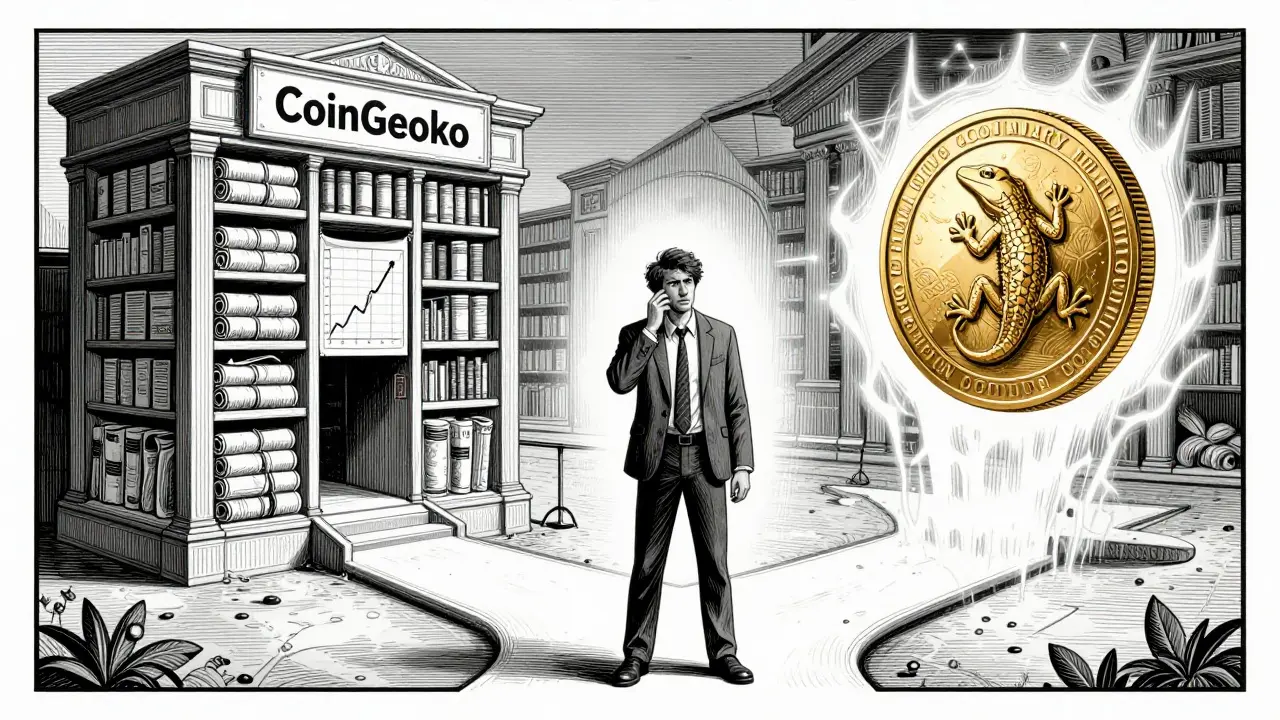
The Big Mix-Up: CoinGecko vs. Gecko Coin
To understand why people get confused, we first have to look at CoinGecko. For anyone in the crypto space, CoinGecko is a global cryptocurrency data aggregator headquartered in Kuala Lumpur, Malaysia. Founded back in 2014 by T.M. Lee, it is essentially the "Wikipedia of crypto prices." It tracks over 10,000 different assets across hundreds of exchanges. Now, here is where the trap is. Because CoinGecko is so dominant in the market, scammers and opportunistic developers often create tokens with names like "Gecko Coin" or use the GECKO ticker to trick beginners. They want you to believe that the platform has finally launched its own token. But if you look at the official CoinGecko channels, you will find no mention of a native GECKO coin. In the world of Blockchain, names are often stolen or mimicked to create a false sense of legitimacy. If a project claims to be the "official coin of CoinGecko," it is almost certainly a fake.How to Spot a "Ghost" Token
When you come across a coin like GECKO that lacks official backing, there are a few red flags you can look for. Most legitimate projects have a clear paper trail. If you can't find a whitepaper that explains the actual utility of the coin-meaning what it actually *does* besides being bought and sold-you should be worried. Check the liquidity. Many of these imitation coins are launched on Decentralized Exchanges (DEXs) like Uniswap or PancakeSwap. While DEXs are great for innovation, they allow anyone to create a token in five minutes. If GECKO is only available on a tiny, obscure exchange and isn't listed on the very platform it's trying to mimic, that's a glaring warning sign. Ask yourself: why would the world's leading crypto data site not list its own coin on its own platform?
The Role of Data Aggregators in Your Strategy
Since you're interested in Gecko-related terms, it's worth understanding why tools like CoinGecko are actually more valuable than any single "meme coin." These platforms provide the infrastructure for the entire market to function. They offer real-time price tracking, market cap calculations, and NFT floor prices. Using a data aggregator allows you to perform a "sanity check" on any coin you find. For example, if you see a GECKO token on a random site, you can search for it on a reputable aggregator. If the project is marked as "untracked" or has a warning about low liquidity, you've just saved yourself from a potential loss. Professional traders don't guess; they use these tools to verify the contract address and the circulating supply of an asset before putting a single cent into it.| Feature | CoinGecko (The Platform) | "Gecko Coin" (The Token) |
|---|---|---|
| Purpose | Data tracking and analysis | Speculative trading / Mimicry |
| Official Status | Industry Standard | Unofficial / Third-party |
| Value Source | Service utility and traffic | Hype and confusion |
| Risk Level | Low (it's a tool) | Extremely High |
Common Crypto Traps: The "Name Game"
This isn't just about one coin. The crypto market is full of "name game" scams. You'll see tokens that try to ride the coattails of Ethereum or Bitcoin by adding slightly different suffixes. The goal is to confuse the reader into thinking there is a partnership or a parent-child relationship between the established entity and the new token. One common tactic is the "celebrity or company endorsement" lie. You might see a tweet or a fake press release saying a major company is launching a coin. Always go back to the primary source. If the company's official blog or verified X (formerly Twitter) account hasn't announced it, ignore the noise. In the case of GECKO, the lack of any official announcement from the team in Malaysia is the only proof you need.
What to Do if You Already Bought GECKO
If you've already put money into a token called Gecko Coin, don't panic, but do be realistic. First, check if you can still sell it. Some of these tokens are "honeypots," meaning the code is written so that you can buy the coin, but you can't ever sell it. If you can still trade it, evaluate if the project has any actual development. Is there a Github repository with active updates? Is the community talking about technology, or just the price? If it's all about the price, you are in a bubble. The best move in these scenarios is usually to recover what you can and move your funds into assets with proven Utility.Better Alternatives for New Investors
Instead of gambling on coins that sound like famous platforms, look for assets that provide actual services. If you like the idea of data and infrastructure, look into Oracles-projects that bring real-world data onto the blockchain. These are the actual "engines" of the crypto world, similar to how CoinGecko is the "dashboard." Focus on the cryptocurrency assets that have a clear use case, a transparent team, and a history of delivering on their roadmap. Remember, the most sustainable gains in crypto don't come from finding a "secret" coin that sounds like a famous company; they come from understanding the underlying tech and the problem the project is solving.Is GECKO the official coin of CoinGecko?
No. CoinGecko is a data aggregator platform and does not have an official cryptocurrency token. Any token trading under the name Gecko Coin or GECKO is a third-party project and is not affiliated with the CoinGecko company.
Where can I track real crypto prices?
You can use established aggregators like CoinGecko or CoinMarketCap. These sites track thousands of coins across hundreds of exchanges to give you an accurate average price.
How can I tell if a coin is a scam?
Check for a few key things: a legitimate whitepaper, a verified team (not anonymous), high liquidity on reputable exchanges, and official confirmation from any company the coin claims to be associated with.
What is a honeypot in crypto?
A honeypot is a malicious smart contract that allows users to buy a token but prevents them from selling it. This creates a fake price increase because only buyers are entering the market, while no one can exit.
Does CoinGecko have an app?
Yes, CoinGecko offers official mobile applications for both Android and iOS users to track portfolios and market data on the go.
crypto is just a mirror of our own greed anyway lol
They want us to think it is just a mistake but it is all a setup. The big platforms create these fake coins to trap the little guys and steal their money while the elites laugh. It is all connected to a bigger plan to control our wallets and track every single cent we move. Don't believe anything you read on a corporate site. They are all lying to keep us in the dark about how the money actually flows. This is just a distraction from the real games being played by the shadow government. Wake up and stop trusting these digital ghosts before you lose everything you have.
It is honestly embarrassing that some people still fall for this. A simple search for a whitepaper takes two minutes and yet people still lose their life savings. It is a matter of basic intellectual discipline. If you cannot verify the contract address on a block explorer, you have no business trading. The moral failing here is the lack of personal responsibility. People want a magic button to get rich without doing the actual work of researching. It is just common sense, really.
I think it's really helpful to break down the difference between the tool and the token. For those just starting out, focusing on the utility of oracles as suggested is a great way to build a safer portfolio. It is so easy to get overwhelmed by the jargon, so having a checklist for red flags is a wonderful addition to the community knowledge base.
The sheer banal nature of these scams is almost impressive in its simplicity. While the masses are lured by a name, the true architects of these schemes rely on the cognitive dissonance of the retail investor. It is an institutionalized failure of education. Of course, the apathetic majority will continue to ignore the structural warnings of the blockchain until their liquidity is drained by a script written by a teenager in a basement.
Stay safe everyone! Just take it slow and do your own research. You've got this!
I must concur with the assessment provided regarding the necessity of verifying contract addresses. It is imperative that novice investors exercise extreme caution when encountering tokens that mimic established brands. I would further suggest that one employs a multi-signature wallet to enhance security protocols and mitigate the risks associated with interacting with unverified smart contracts.
USA ALL THE WAY! 🇺🇸 We need more of this honesty in the market! These scammers are probably all foreign bots trying to rip off hardworking Americans! 😡 Get out of our markets! 💥💰
This is such a goldmine of info for the newbies! 🌟 Just imagine the chaos if people actually bought into every 'ghost' coin they saw. Keep those eyes peeled and stay sparkly! ✨🌈
It is so encouraging to see these kinds of warnings being shared. It really helps protect people who are just trying to improve their financial future. I appreciate the reminder to look for projects with transparent teams and a history of delivery. Let's all keep supporting each other in learning the right way to invest!