
Imagine paying for a doctor's visit with a coin that also rewards you for sharing your health data. That was the bold pitch behind MDsquare, a cryptocurrency project launched in 2018 to merge telemedicine with blockchain technology. But here’s the kicker: as of 2026, its native token, TMED, shows near-zero trading volume on major exchanges. So, what exactly is this coin, and does it still matter?
If you’re digging into niche crypto assets or healthcare innovations, understanding MDsquare requires looking past the hype of its launch. It wasn’t just another meme coin; it aimed to solve real problems in remote healthcare-like cross-border language barriers and lack of patient incentives. However, the gap between its ambitious whitepaper and its current market status tells a cautionary tale about early-stage blockchain projects.
The Core Concept: Telemedicine Meets Blockchain
At its heart, MDsquare is a telemedicine ecosystem built on the Ethereum blockchain. The team, based in South Korea, designed it to connect patients and doctors globally through video consultations, AI-powered chatbots, and health monitoring devices. The central idea was simple yet complex: use blockchain to secure medical data and create a fair economic model where everyone gets paid.
Unlike traditional telehealth platforms where only the provider earns money, MDsquare introduced a "virtuous economic ecosystem." Patients earn tokens for uploading health data from wearables. Doctors earn tokens for providing consultations. Device makers and content providers also get rewarded. This incentive structure relies entirely on the TMED token, an ERC-20 standard cryptocurrency issued on the Ethereum network.
Why Ethereum? Because it offers smart contract compatibility and broad wallet support. By choosing a public blockchain, MDsquare prioritized transparency and interoperability over privacy-focused private ledgers. This means every transaction, reward distribution, and data verification attempt is logged on the Ethereum ledger, ensuring auditability-a critical feature for healthcare compliance.
How TMED Works: The Dual-Token System
One of the most interesting aspects of MDsquare’s design is its dual-token system. This setup attempts to solve the biggest pain point in using crypto for daily services: volatility. You don’t want the price of your doctor’s visit to swing 20% because Bitcoin had a bad day.
To fix this, MDsquare uses two units:
- TMED Tokens: These are the tradable cryptocurrency assets. They are used for rewards, staking, and speculative investment. Users can trade these on external exchanges.
- MD Points (MDP): These are stable, non-crypto utility points pegged to fiat currency (like USD or KRW). When you pay for a consultation, you buy MDPs with cash or TMED. The service cost is fixed in MDPs, shielding users from market fluctuations.
This separation allows the platform to function like a normal app for end-users while maintaining the blockchain benefits for backend operations and investor speculation. If you hold TMED, you might see its value rise if the platform gains adoption. If you just want to see a doctor, you buy MDPs at a fixed rate, exchange them for services, and never worry about the token price crashing mid-consultation.
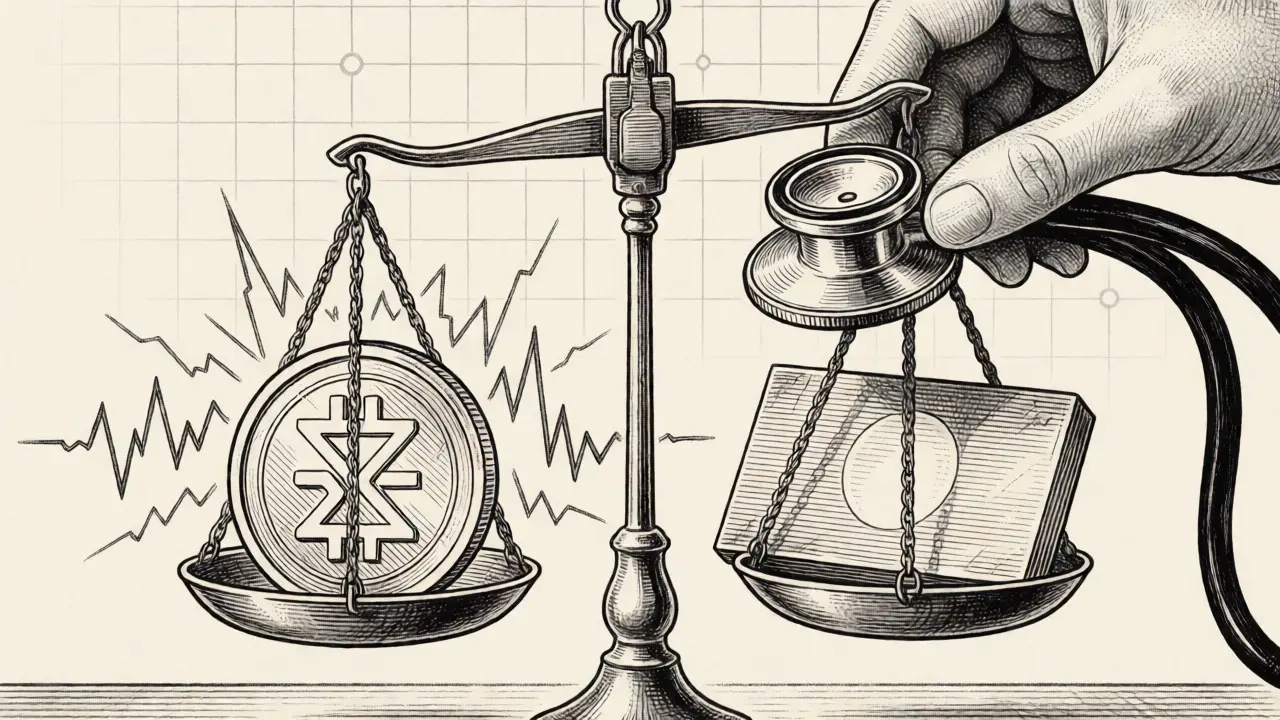
Tokenomics and Market Reality
Let’s look at the hard numbers, because they reveal why MDsquare is often overlooked today. The total supply of TMED is fixed at 28 billion tokens. However, data from major trackers like CoinMarketCap and Bitget as of early 2026 reports a circulating supply of nearly zero. This discrepancy is crucial. It suggests that either the tokens are locked, burned, or simply not distributed widely enough to create active markets.
| Metric | MDsquare (TMED) | Typical Active Small-Cap |
|---|---|---|
| Total Supply | 28,000,000,000 | Varies (often billions) |
| Circulating Supply | ~0 (Reported) | High % of Total |
| Price (Approx.) | $0.00000000 - $0.000009 | $0.01 - $1.00+ |
| 24h Volume | $0 - $566 USD | $10k - $1M+ USD |
| Blockchain | Ethereum (ERC-20) | Various (SOL, ETH, BSC) |
The price metrics are fragmented. Some aggregators show a price of $0.00000000, implying no trades occurred recently. Others, like P2P.Army, report micro-prices around $0.000009 with negligible volume. This lack of liquidity makes TMED a highly illiquid asset. You can technically buy it, but selling it without moving the market significantly-or finding a buyer at all-is difficult.
Technology and User Experience
The technical architecture integrates several services into one mobile and web interface. Users register their health history, sync data from IoT devices (like blood pressure monitors or fitness trackers), and access 24/7 on-call language interpretation. This last feature targets international travelers who need medical advice in their native language but are abroad.
The AI component includes chatbots for preliminary triage, helping route patients to the right specialist before a live video call begins. From a developer perspective, the use of Ethereum smart contracts handles the logic for reward distribution. For example, when a user uploads verified health data, a smart contract triggers a TMED reward transfer. This automation reduces administrative overhead for the platform.
However, there is a notable absence of recent technical updates. Public repositories and developer documentation haven’t seen significant activity since the initial launch phase. While the concept of "blockchain-secured metaverse telemedicine" gained traction in academic circles by 2025, MDsquare hasn’t publicly showcased major upgrades or new hospital partnerships in recent years.
Risks and Current Status
If you’re considering TMED as an investment or a utility tool, you must weigh the risks carefully. The primary risk is obsolescence. The telemedicine sector exploded post-2020, dominated by centralized giants like Teladoc and Amwell. These competitors didn’t need blockchain to scale rapidly. They offered seamless apps, insurance integration, and massive marketing budgets.
MDsquare’s niche approach faces three hurdles:
- Regulatory Complexity: Handling health data across borders involves strict laws like HIPAA (US) and GDPR (EU). Integrating blockchain adds another layer of legal scrutiny regarding data immutability versus the "right to be forgotten."
- Liquidity Trap: With near-zero trading volume, exiting a position is hard. Most investors in such low-cap coins find themselves holding bags they cannot sell.
- Adoption Gap: There is little evidence of widespread offline hospital acceptance of TMED payments. Without real-world utility beyond the app, the token remains speculative.
As of September 2026, MDsquare appears to be in a dormant state. The social media channels are quiet, and news coverage has dried up. This doesn’t mean the project is dead-it could be pivoting or operating quietly-but it signals that TMED is no longer a trending topic in the crypto community.
Frequently Asked Questions
Is MDsquare (TMED) still active in 2026?
Activity levels appear very low. Major crypto trackers report near-zero trading volume and circulating supply. Social media updates have been sparse since the initial launch period, suggesting the project may be inactive or operating privately without public marketing pushes.
What is the difference between TMED and MD Points?
TMED is the volatile, tradable cryptocurrency used for rewards and speculation. MD Points (MDP) are stable utility tokens pegged to fiat currency, used to pay for actual telemedicine services. This dual system protects users from crypto price swings when booking appointments.
Can I buy TMED on major exchanges like Coinbase or Binance?
Listing availability is inconsistent. While some converters exist on Coinbase or Crypto.com, direct spot trading pairs are rare or have extremely low volume. It is primarily traded on smaller, niche exchanges, making liquidity a significant concern for buyers.
Does MDsquare use its own blockchain?
No, MDsquare is built on the existing Ethereum blockchain. TMED is an ERC-20 token, meaning it leverages Ethereum’s security, smart contract infrastructure, and wallet compatibility rather than running its own independent network.
Why did MDsquare choose a dual-token model?
To mitigate volatility. Healthcare costs are predictable, but crypto prices are not. By separating the payment unit (MD Points) from the investment unit (TMED), the platform ensures that service pricing remains stable for patients and doctors, even if the token market fluctuates wildly.