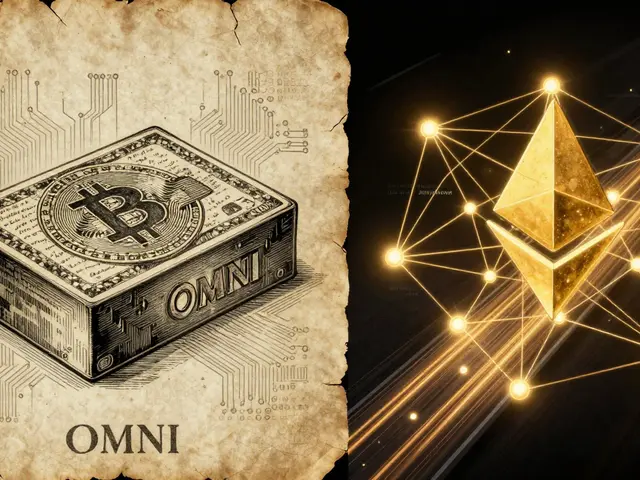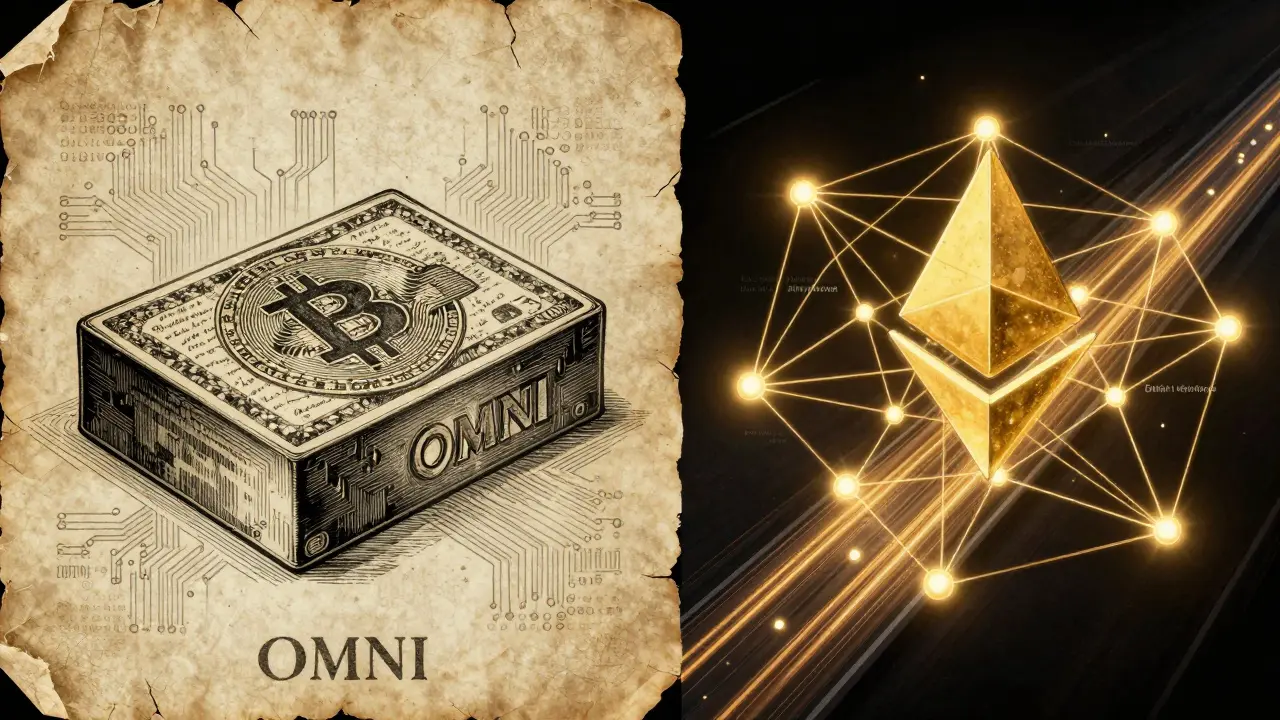
Which OMNI Token Are You Holding?
Important Warning
Many investors accidentally buy the wrong OMNI token. The original Bitcoin-based OMNI is largely obsolete, while the new Ethereum-based Omni Network is actively developing. Check this tool before making any investment decision.
Step 1: Which Blockchain is Your OMNI On?
Step 2: How Did You Get Your OMNI?
Step 3: What's Your Trading Volume?
Your OMNI Token Identification
Based on your selections, you are holding:
Your OMNI Token Identification
Based on your selections, you are holding:
When you search for Omni Network (OMNI), you’re not looking at one cryptocurrency-you’re staring at two completely different projects that share the same ticker symbol. This isn’t a typo. It’s a real, ongoing confusion in the crypto market that’s cost people hundreds of dollars. One version of OMNI runs on Bitcoin. The other runs on Ethereum. They don’t talk to each other. They don’t share code. And they serve opposite ends of the crypto world.
The Original Omni Layer: Bitcoin’s First Token Protocol
The original Omni Network, launched in 2013 as Mastercoin, was one of the first attempts to add smart contract-like features to Bitcoin. At a time when Bitcoin could only send BTC from wallet to wallet, Omni let users create and trade custom tokens-like Tether (USDT)-by embedding data into regular Bitcoin transactions. Think of it like writing a note on the back of a $20 bill. The bill still works as cash, but now it also carries extra information. That’s how Omni worked: it piggybacked on Bitcoin’s security without changing Bitcoin itself.
This was groundbreaking back then. By 2017, Omni-powered tokens had hit a $1.2 billion market cap, mostly because USDT was issued on Omni before it moved to Ethereum. The project used a software called Omni Core, which was basically Bitcoin Core with extra code to read and write token data. Developers who understood Bitcoin could build on it. But the system was slow. Transactions took minutes. The network couldn’t handle complex apps. And as Ethereum rose, with its native support for tokens via ERC-20, Omni’s relevance faded.
Today, the original Omni Layer is still alive-but barely. It’s maintained by a small group of enthusiasts. There’s no active development. No new features. Just enough code to keep existing tokens like USDT (on Bitcoin) working. The OMNI token itself trades at around $1.19, with almost no daily volume. Most traders who buy it today don’t even know what they’re holding. They think they’re getting the new Ethereum project. They’re not.
The New Omni Network: Solving Ethereum’s Rollup Problem
The second Omni Network, launched in 2023, has nothing to do with Bitcoin. It’s an Ethereum-based Layer 1 blockchain built to fix a massive problem: fragmentation. Ethereum now has over 68 different rollups-Optimism, Arbitrum, zkSync, Base, and more-each acting like its own mini-blockchain. They’re faster and cheaper than Ethereum mainnet, but they can’t easily talk to each other. If you have assets on Arbitrum and want to use them on zkSync, you need bridges. Bridges are risky. They’ve been hacked for billions.
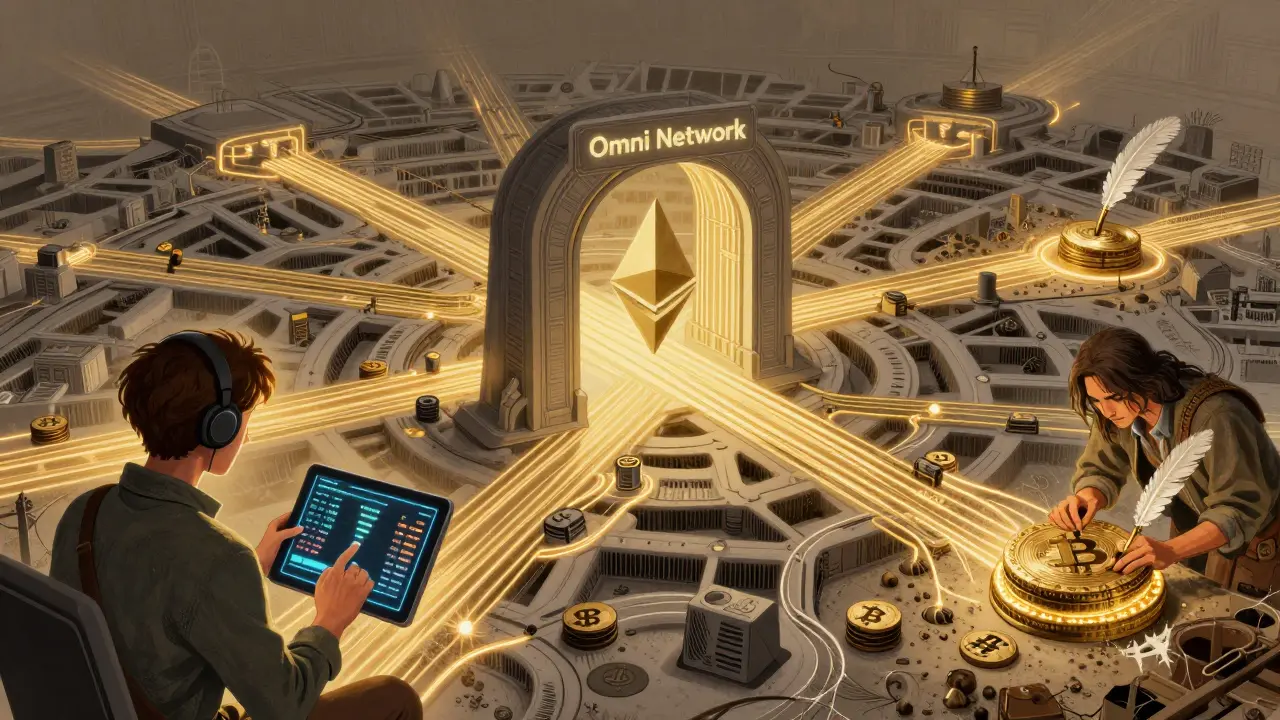
Omni Network’s solution? A single layer that connects all Ethereum rollups. It doesn’t replace them. It unites them. Think of it like a highway system that links all the local roads. Your car (your assets) stays on its local road (rollup), but Omni lets you move between them instantly, safely, and without third-party bridges. It uses a hybrid consensus model: CometBFT for speed and EigenLayer’s restaked ETH for security. That means the network is secured not just by its own OMNI tokens, but by Ethereum’s existing security pool.
The result? Messages between rollups finalize in under half a second. Developers can build apps that work across all rollups without writing separate code for each one. Major DeFi platforms like Aave and Uniswap are already integrating Omni. In November 2023, the project launched its mainnet with 15,389 validators. Its Genesis airdrop distributed 20% of the 1 billion OMNI token supply to early users. As of late 2023, the token traded between $1.19 and $1.88-with a 24-hour volume of $2.18 million, far outpacing the original.
Why the Confusion Matters
The fact that both projects use OMNI is a disaster waiting to happen. On exchanges like Binance and KuCoin, you’ll see one listing: OMNI. No distinction. No warning. If you click to buy the new Omni Network, you might accidentally buy the old Bitcoin one. Reddit is full of stories like this: one user lost $300 thinking they were getting the new airdrop token, but ended up holding the obsolete Bitcoin-layer version. Trustpilot reviews for exchanges show complaints about OMNI confusion as a recurring theme.
Even experts admit it’s messy. CoinDesk reported that 23% of OMNI trades on unregulated exchanges involved the wrong token. The original Omni Network’s documentation is outdated. Its community on Telegram has just over 1,200 members. The new Omni Network has a Discord server with over 42,000 people, professional developer support, and active GitHub updates. The difference isn’t just technical-it’s cultural. One feels like a relic. The other feels like the future.

Which OMNI Should You Care About?
If you’re a Bitcoin maximalist and you care about tokenizing assets directly on Bitcoin, then the original Omni Layer still matters. It’s the only way to issue tokens without touching Ethereum. But for 99% of people-traders, DeFi users, developers-the new Omni Network is the only one worth paying attention to.
Here’s why:
- It’s backed by top investors: Coinbase Ventures, Pantera Capital, Jump Crypto, and Spartan Group all invested. That’s not random money-it’s institutional validation.
- It solves a real bottleneck: Ethereum’s rollups are growing fast, but without interoperability, they’re islands. Omni is building the bridges.
- It’s actively developed: The roadmap includes sharded consensus, institutional custody, and mobile SDKs-all coming in 2024.
- It’s already adopted: 142 dApps have integrated Omni’s SolverNet. That’s not speculation-it’s usage.
The original Omni Layer? It’s a historical footnote. It pioneered tokenization, but Ethereum did it better. Today, it’s like asking someone to use a fax machine because it once worked.
Technical Differences at a Glance
| Feature | Original Omni Layer (Bitcoin) | New Omni Network (Ethereum) |
|---|---|---|
| Blockchain Base | Bitcoin | Ethereum |
| Function | Token creation via data embedding | Rollup interoperability |
| Consensus | Bitcoin PoW | CometBFT + EigenLayer restaking |
| Finality Speed | 10+ minutes | Under 500ms |
| Developer Support | Minimal, outdated docs | Active Discord, SDKs, enterprise channels |
| Current Use Case | Legacy USDT on Bitcoin | DeFi apps across all Ethereum rollups |
| 24h Trading Volume (Late 2023) | Negligible | $2.18 million |
| Market Cap (Est.) | $10 million | $150 million+ |
What Experts Say
Andreas Antonopoulos called the original Omni Layer an "important experiment" in 2014-but said it was quickly overtaken. Vitalik Buterin, in his "Endgame" blog, pointed to rollup interoperability as the next big challenge. That’s exactly what the new Omni Network is built for. Paul Veradittakit from Pantera Capital called it "the most pressing issue in crypto today." But not everyone is sold. Blockchain researcher Hasu warned that relying on restaked ETH could create new attack surfaces that haven’t been tested under real stress.
The bottom line? The new Omni Network isn’t perfect. But it’s solving a real, urgent problem. The old one? It’s done its job.
How to Avoid Getting Scammed
If you’re buying OMNI, here’s how to make sure you get the right one:
- Check the contract address: The new Omni Network’s token is on Ethereum. Look for the contract on Etherscan. The old one is on Bitcoin-no contract, just a transaction ID.
- Look at the exchange listing: On Binance, the new OMNI is listed as "OMNI" with a small note saying "Ethereum." The old one says "OMNI (Bitcoin)." If there’s no note, don’t assume.
- Use a wallet that shows chain info: MetaMask won’t help if you’re not looking at the network. Always confirm you’re on Ethereum, not Bitcoin.
- Don’t trust the price alone: Both trade around $1.19. That’s intentional. The volume tells the real story.
If you’re a developer: the new Omni Network’s SDK cuts cross-rollup app development from months to weeks. The old one? You’ll need to dig up 2020-era documentation and hope it still works.
What’s Next?
The new Omni Network is just getting started. By mid-2024, it plans to roll out sharded consensus for higher throughput, institutional custody support for funds from hedge funds and exchanges, and mobile wallet SDKs so apps can integrate Omni directly into phones. If Ethereum’s rollup ecosystem keeps growing-and it is-Omni could become the standard for moving assets between them.
The original Omni Layer? It’s not going away. But it’s not growing either. It’s a quiet, stable relic. Like a landline phone still working in a basement. Useful for a few, irrelevant to everyone else.
So when someone asks you what Omni Network (OMNI) is, don’t give a one-line answer. Say this: "There are two. One’s old and on Bitcoin. The other’s new, on Ethereum, and it’s trying to fix the biggest problem in crypto right now. Which one you care about depends on what you’re doing."
Is Omni Network (OMNI) a good investment?
It depends on which one you mean. The original OMNI on Bitcoin is not a good investment-it’s stagnant. The new OMNI on Ethereum has strong backing, real adoption, and solves a critical infrastructure problem. But like all crypto, it’s risky. Its value depends on Ethereum’s rollup ecosystem growing. If rollups fail, Omni’s relevance drops. If they succeed, Omni could be essential.
Can I use OMNI on MetaMask?
Only the new Omni Network (Ethereum version) works on MetaMask. You need to add its token contract address manually. The original OMNI (Bitcoin) cannot be stored in MetaMask-it requires a Bitcoin wallet like Omni Core. Never assume the token is the same just because the ticker is identical.
Why does Omni Network use restaking?
Restaking lets the Omni Network borrow Ethereum’s security by letting ETH stakers re-stake their collateral on Omni. This means Omni doesn’t need to bootstrap its own validator set from scratch. It’s faster, cheaper, and more secure than building a new chain from the ground up. But critics say it creates a single point of failure-if Ethereum gets hacked, Omni could be too.
Is Omni Network competing with Chainlink or LayerZero?
Yes, but differently. Chainlink CCIP and LayerZero connect any blockchain-Bitcoin, Solana, Ethereum, etc. Omni Network only connects Ethereum rollups. That narrower focus lets it optimize for speed and cost within one ecosystem. It’s not trying to be everything. It’s trying to be the best at one thing: unifying Ethereum’s fragmented scaling layer.
Can I mine OMNI?
No. The original OMNI was mined using Bitcoin’s PoW, but that’s no longer practical or profitable. The new OMNI is not mineable at all. It’s issued through staking and airdrops. To earn OMNI, you need to stake ETH or OMNI tokens, not mine them.
What happened to Tether on Omni Network?
Tether (USDT) was first issued on the original Omni Network in 2014. But as Ethereum became dominant, Tether moved its issuance to Ethereum’s ERC-20 standard in 2017. Today, over 99.9% of USDT is on Ethereum, BSC, or Solana. The original Omni Network still holds a tiny fraction of USDT, but it’s essentially obsolete for new issuance.