PAI Value Loss Calculator
Calculate Your PAI Loss
Based on article data showing PAI's extreme volatility (priced between $0.05 and $1.03 across exchanges)
Potential Value Loss
0.00%
of your PAI holdings
Estimated Value
$0.00
Important Context: As stated in the article, PAI's market price varies wildly (e.g., $0.05 to $1.03). This calculator uses your inputs to demonstrate potential losses based on real data from the article.
Warning: PAI is an unstable project with inconsistent market data. Actual trading volume is extremely low (under $200 daily), and the project appears inactive since 2022. This tool illustrates the risks described in the article.
Parrot USD (PAI) isn't another Bitcoin or Ethereum. It’s not even close to being a major stablecoin like USDC or DAI. But if you’ve heard of it, you’re probably digging into the weirder corners of Solana’s DeFi scene. So what exactly is PAI? At its core, it’s supposed to be a stablecoin pegged to the US dollar - but instead of being backed by cash, bank reserves, or even ETH, it’s backed by something far more complicated: liquidity provider (LP) tokens.
How PAI Works (In Theory)
Most stablecoins keep their $1 value by holding real assets. USDC? Backed by dollars in a bank. DAI? Backed by crypto like ETH and real estate tokens. PAI does something different. It uses LP tokens - the digital receipts you get when you lock up crypto pairs like SOL/USDC in a decentralized exchange - as collateral to mint new PAI tokens. The idea sounds clever. In DeFi, billions of dollars get locked up in liquidity pools, earning little to no return. Parrot Protocol wanted to unlock that trapped value. Instead of selling your LP tokens to get cash, you could use them as collateral to borrow PAI - a dollar-pegged coin you could spend, trade, or lend elsewhere. That’s the promise: turn idle liquidity into usable money without leaving your position. The protocol also includes a lending market and a virtual automated market maker (vAMM) for margin trading, all built on Solana. The goal? Make PAI the common unit of account for DeFi users who hold LP tokens from different pools. Think of it like a universal currency for a niche group of traders.The Reality: A Stablecoin That Doesn’t Stay Stable
Here’s where things fall apart. On paper, PAI should be stable. In practice, it’s anything but. As of December 2025, PAI’s price swings wildly across exchanges. Binance shows it at $0.96, LiveCoinWatch says $1.03, and LBank lists it at $0.05 - a 2000% difference. That’s not a glitch. That’s a red flag. A real stablecoin doesn’t trade at 5 cents when it’s supposed to be $1. If you tried to use PAI to pay for something or hedge your portfolio, you’d be gambling on which exchange’s data you trust. Its all-time high was $2.19. That’s not a stablecoin. That’s a speculative token that got overhyped and crashed. Today, it trades around 44% of that peak. For a coin meant to hold value, that’s catastrophic. The problem? LP tokens themselves are volatile. If the underlying crypto pair (say, SOL/USDC) crashes, the value of the collateral backing PAI drops. But PAI still needs to stay at $1. There’s no strong overcollateralization system like DAI’s. No emergency auctions. No real-time adjustments. Just a smart contract hoping for the best.Market Data: Tiny, Inconsistent, and Dying
The numbers tell a grim story. - Circulating supply: CoinGecko says 4.2 million PAI. CoinMarketCap says zero. Which one’s right? No one knows. - Market cap: Estimates range from $1.4 million to $16 million. That’s a 10x difference. No credible asset should have this much confusion around its value. - Trading volume: 24-hour volume hovers around $200 on most platforms. That’s less than what a single small-cap altcoin moves in an hour. For context, DAI moves over $1 billion daily. - Exchanges: PAI trades on only a handful of obscure platforms. You won’t find it on Coinbase, Kraken, or even KuCoin. If you want to buy it, you’re stuck on low-liquidity exchanges where slippage hits 15% or more. One user on CryptoSlate said they tried swapping 10,000 PAI and lost 15% just in price impact. That’s not a stablecoin - that’s a trap. Even the number of holders is unclear. CoinMarketCap says 5,760. Reddit has barely three mentions in a year. The Bitcointalk forum has two old threads from 2022. No active community. No developers. No updates.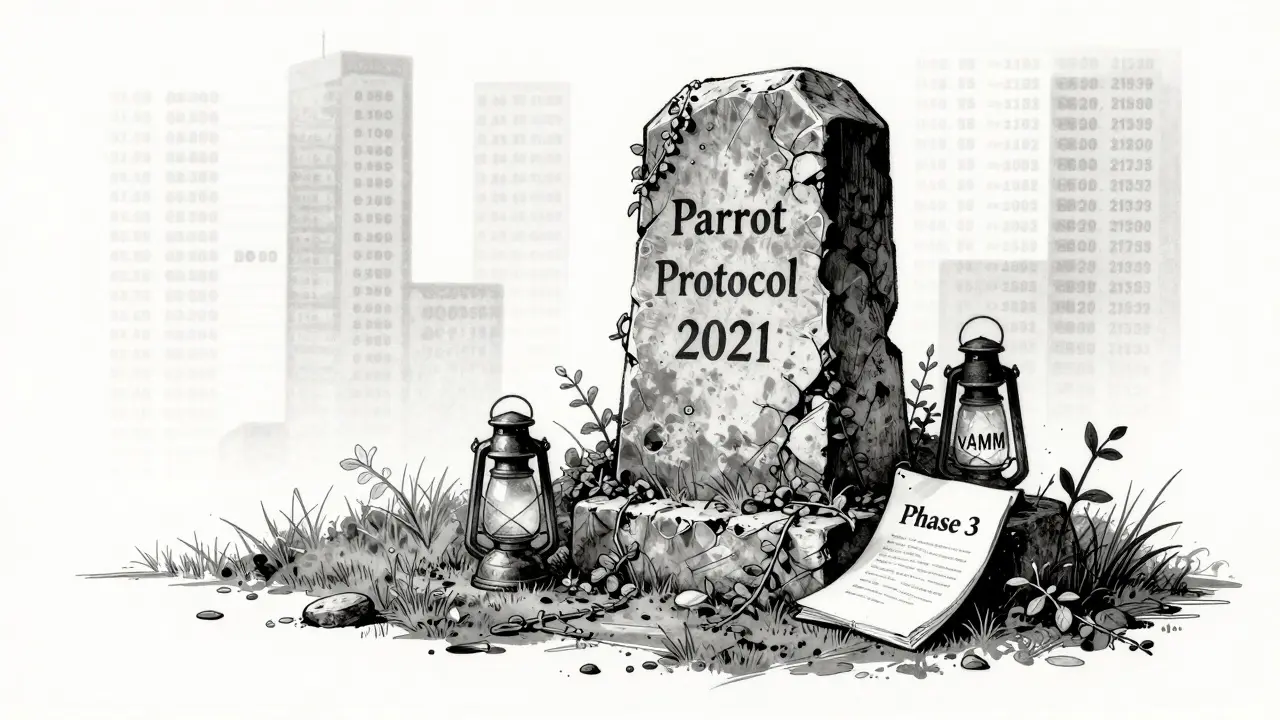
Is the Project Even Alive?
The Parrot Protocol website hasn’t been updated since Q2 2023. The GitHub repo hasn’t had a commit since August 2022. That’s over two years of silence. The team behind it? Anonymous. No public roadmap. No team bios. No Twitter account with more than 2,000 followers. No YouTube tutorials. No Medium posts explaining how to use it. Just a whitepaper from 2021 that laid out a three-phase plan - and then nothing. CoinDesk’s November 2025 DeFi report labeled PAI as “inactive.” Delphi Digital called it a “conceptual proof-of-concept” - meaning it worked in theory, but never in practice. And they’re right. The protocol’s components (lending, vAMM, etc.) were never fully built or adopted.Why This Matters - And Why You Should Avoid It
You might think, “It’s just a small project. Who cares?” But here’s the real issue: PAI represents a dangerous trend. After the TerraUSD collapse in 2022, regulators cracked down on algorithmic stablecoins. The EU’s MiCA rules now require stablecoins to be backed 1:1 by high-quality, liquid assets - cash, government bonds, or short-term treasuries. LP tokens? They’re volatile, illiquid, and unregulated. PAI doesn’t meet any of those standards. It’s not just risky - it’s likely non-compliant. If regulators ever target Solana DeFi projects, PAI will be one of the first to get flagged. And for users? There’s no safety net. No insurance. No recourse. If the peg breaks, your PAI becomes worthless. And since no one’s trading it, you can’t even sell it.