
You’ve probably seen it on a list of altcoins with a funny name and a logo that looks like a leaf. PotCoin is a digital currency created specifically to facilitate transactions within the legal cannabis industry. It was launched in 2014 with a bold mission: solve the banking headache for dispensaries. Since traditional banks often refuse to work with cannabis businesses due to federal regulations in places like the US, PotCoin aimed to be the cashless solution.
But here’s the thing about niche cryptocurrencies. They sound great in theory. In practice? They struggle to gain traction. If you are wondering if POT is still relevant in 2026, or if it’s just another forgotten meme coin, you need to look past the marketing hype. Let’s break down what PotCoin actually is, how it works, and whether it has any real value today.
The Core Problem PotCoin Tried to Solve
To understand why PotCoin exists, you have to understand the "banking crisis" in the cannabis world. Even though many states in the US and countries worldwide legalized recreational or medicinal marijuana, federal laws in key markets like the United States kept it classified as a Schedule I drug. This meant big banks were terrified of holding cannabis money. Dispensaries had to operate largely in cash.
Cash is risky. It invites robberies, requires armored trucks, and is a nightmare for accounting. The creators of PotCoin saw this gap. Their idea was simple: create a decentralized ledger where dispensaries could accept payments without a bank getting involved. It was an early example of using blockchain for a specific real-world problem rather than just speculation.
However, timing matters. PotCoin launched before Bitcoin became widely accepted by merchants and before stablecoins emerged. By the time the infrastructure for crypto payments matured, PotCoin had already established itself as a low-cap, community-driven project rather than a serious financial tool.
How PotCoin Works: The Technical Basics
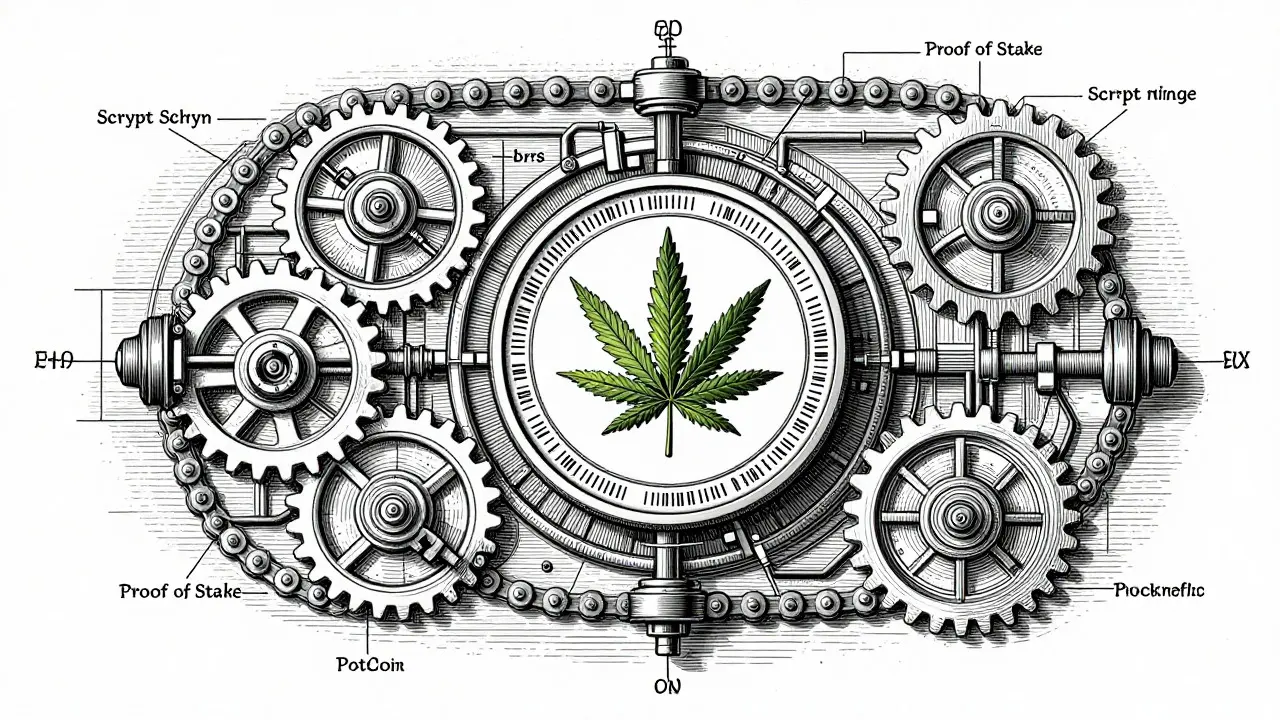
If you dig into the code, PotCoin isn’t exactly groundbreaking tech. It started as a fork of Litecoin, which means it originally used the same Scrypt mining algorithm. Later, the developers tweaked the structure to make it more similar to Reddcoin, shifting towards a hybrid model that included elements of Proof of Stake.
Here is what that means for you:
- Supply Cap: There will never be more than 420,000,000 POT coins. Yes, the number 420 is intentional. It’s a nod to cannabis culture.
- Consensus Mechanism: While it began with Proof of Work (mining), it migrated to allow staking. This means holders can earn interest by locking up their coins, theoretically encouraging people to hold rather than sell.
- Wallets: You can store POT in desktop wallets for Windows, Mac, and Linux, or use mobile apps for Android. There is also a web wallet option, which makes it accessible for casual users who don’t want to deal with complex software setups.
The technology is functional, but it’s not cutting-edge. It doesn’t offer the speed of Solana or the smart contract capabilities of Ethereum. It’s a basic payment layer designed for one purpose: moving value between two parties who agree to use it.
Market Reality: Price, Volume, and Adoption
This is where the dream meets reality. As of mid-2026, PotCoin is a micro-cap asset. Its market capitalization hovers around $400,000 to $500,000. To put that in perspective, major cryptocurrencies like Bitcoin have market caps in the hundreds of billions. Even smaller, newer projects often have valuations in the millions.
Why is the volume so low? Because adoption is minimal. Most cannabis businesses today use specialized fiat payment processors that navigate the regulatory gray areas better than a obscure crypto token. Or, they just stick to cash. Some larger dispensaries might accept Bitcoin or Ethereum because those brands carry weight, but very few ask for POT.
| Metric | PotCoin (POT) | Bitcoin (BTC) |
|---|---|---|
| Primary Use Case | Cannabis Payments | Digital Gold / Store of Value |
| Market Cap Rank | #4000+ | #1 |
| Liquidity | Very Low | Extremely High |
| Merchant Adoption | Niche / Rare | Growing Globally |
The lack of liquidity is a double-edged sword. On one hand, you can buy a lot of POT for very little money. On the other hand, selling large amounts can crash the price because there aren’t enough buyers waiting in the order books. This makes it a high-risk asset for anyone looking to park significant capital.
Is PotCoin a Good Investment?
Let’s be direct. If you are looking for steady growth or reliable dividends, PotCoin is likely not your best bet. It falls into the category of "speculative altcoins." These are coins that trade heavily on sentiment, nostalgia, and niche trends rather than fundamental utility.
Price predictions for POT vary wildly. Some optimistic analysts from earlier years projected massive gains if cannabis legalization went global. Others see it stagnating. The truth lies in the middle. The price is tied to two things:
- Global Cannabis Legalization: If more countries fully legalize and integrate cannabis into the mainstream economy, the narrative around POT might get a boost. However, remember that banks and credit card companies are also adapting. They don’t *need* PotCoin to process these transactions anymore.
- Crypto Market Cycles: When Bitcoin goes up, everything tends to go up. POT is no exception. It often sees spikes during bull markets simply because traders are buying random small-cap coins hoping for a quick flip.
Don’t invest money you can’t afford to lose. Treat POT like a lottery ticket, not a savings account. If you buy it, do it because you believe in the cannabis industry’s future and want exposure to its history, not because you expect it to replace your mortgage payments.
Competitors and Alternatives
PotCoin wasn’t the only one trying to corner the weed market. Tokoin (TOK) is another cryptocurrency focused on the cannabis sector. Interestingly, Tokoin has managed to secure a slightly larger market cap and more visibility in some circles. Then there’s HashMarijuana (HMPJ), which uses a unique proof-of-burn mechanism.
But the biggest competitor to PotCoin isn’t another weed coin. It’s Bitcoin and Ethereum. Why? Because they are recognized everywhere. A dispensary owner is more likely to install a QR code scanner for BTC than to learn about a specific token that only 0.01% of customers use. The network effect favors the giants.
How to Buy and Store PotCoin
If you decide you want some POT in your portfolio, the process is straightforward but requires caution. You won’t find POT on every major exchange. It’s primarily traded on smaller platforms like Binance (if listed), Bitfinex, or local crypto-to-crypto exchanges.
Here is the step-by-step:
- Create a Wallet: Download the official PotCoin wallet from their website. Make sure you verify the URL to avoid phishing scams. Back up your seed phrase offline. Never share it.
- Buy on an Exchange: Find an exchange that lists POT. Deposit Bitcoin or Tether (USDT) since direct fiat pairs might be scarce.
- Swap for POT: Trade your BTC or USDT for POT. Watch out for slippage; because liquidity is low, the price you see might change by the time your order executes.
- Withdraw: Move your POT to your personal wallet. Leaving it on an exchange is risky, especially smaller ones that might shut down or freeze assets.
Keep an eye on transaction fees. While POT aims for low fees, network congestion or miner priorities can sometimes cause delays. Always send a small test transaction first when using a new address.
The Future of PotCoin
Will PotCoin survive? Probably. It has a dedicated community and a clear historical significance as one of the first industry-specific cryptos. But will it thrive? That’s doubtful. The window for niche payment tokens has largely closed. The market has consolidated around a few dominant players.
The real story here isn’t about POT making you rich. It’s about what it represents: the early, chaotic days of crypto where anyone could launch a coin for a specific hobby or industry. Today, we’re in the era of institutional adoption, regulation, and utility. PotCoin remains a relic of that wild west period-a fun curiosity, but not a financial powerhouse.
What is the current price of PotCoin (POT)?
As of mid-2026, PotCoin typically trades between $0.001 and $0.002. Prices fluctuate based on low trading volume and broader crypto market trends. Always check a live tracker like CoinGecko or CoinMarketCap for the exact second-by-second price.
Is PotCoin legal to own?
Yes, owning PotCoin is legal in most jurisdictions where cryptocurrency ownership is permitted. However, using it to purchase illegal substances would violate local drug laws. The coin itself is just a digital asset, similar to Bitcoin.
Can I mine PotCoin?
Historically, yes, using Scrypt miners. However, since the shift toward Proof of Stake, mining is less relevant. Most new POT is generated through staking rewards. Mining profitability is extremely low due to the coin's low value and competition from more profitable coins using the same algorithms.
Where can I spend PotCoin?
Adoption is very limited. You might find a few online dispensaries or cannabis-related merchandise stores that accept it, but it is not widely accepted. Most users hold it as a speculative investment rather than a spending currency.
Is PotCoin a scam?
Not necessarily a scam in the fraudulent sense-it has an open-source codebase and a public team history. However, it suffers from low utility and high volatility, which are common traits of "zombie coins" or neglected projects. Investors should be wary of exaggerated promises of returns.