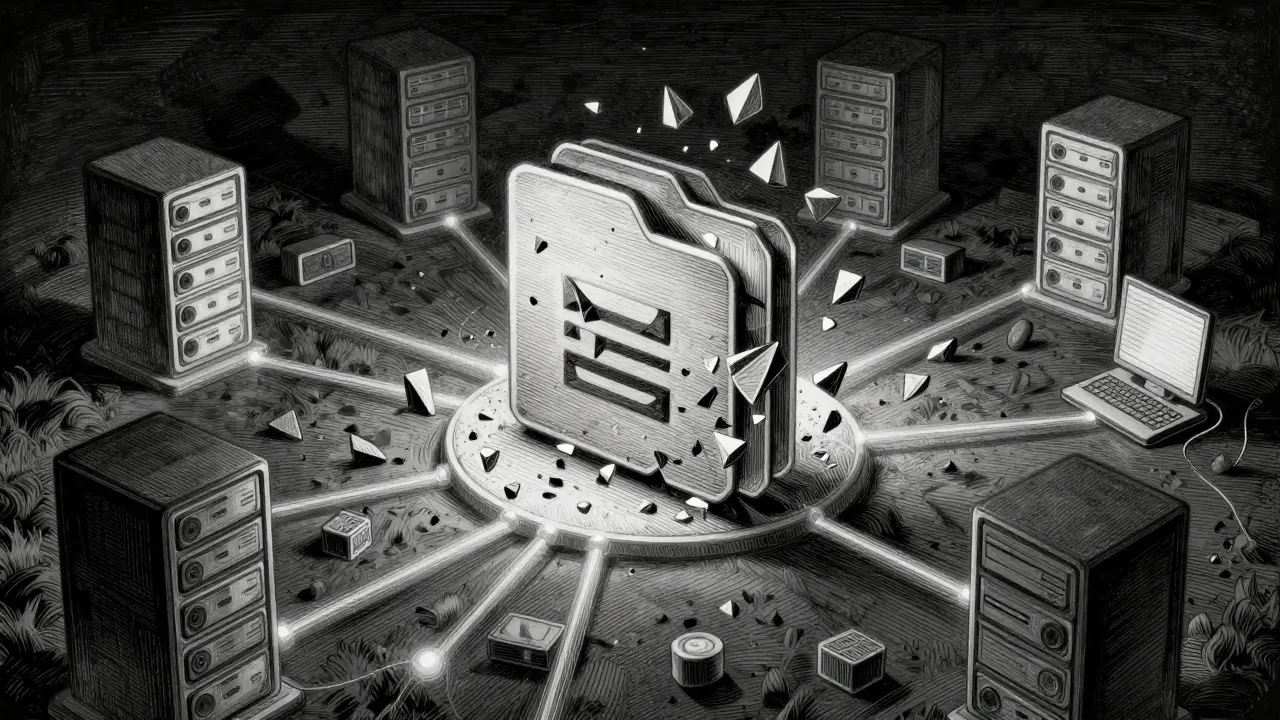
You’ve probably heard of Filecoin or Arweave if you follow crypto trends. But have you heard of STORAGENT? It’s a newer player in the crowded field of decentralized storage, claiming to mix blockchain with artificial intelligence to keep your data safe and accessible. If you’re wondering what this coin actually does, how it works, and whether it’s worth your attention, you’re not alone. The crypto space is full of projects promising "AI-driven" solutions, but few explain clearly what that means for your files.
STORAGENT positions itself as a bridge between traditional cloud storage limitations and the robustness of Web3 technology. Instead of relying on a single company like Amazon or Google to host your data, it uses a distributed network. But here’s the twist: it claims an "AI Agent" manages this network. This article breaks down exactly what STORAGENT is, how its technology stacks up against established competitors, and what you need to know before considering it for your portfolio or data needs.
Understanding the Core Concept: Decentralized Storage Meets AI
To understand STORAGENT, you first need to grasp the problem it tries to solve. Centralized cloud providers are convenient, but they are single points of failure. If their servers go down, get hacked, or decide to censor content, your data is at risk. Decentralized storage networks (DSNs) fix this by splitting files into pieces and storing them across thousands of independent computers worldwide.
STORAGENT is a cryptocurrency project designed to provide secure, censorship-resistant file storage using a decentralized architecture guided by an artificial intelligence agent. It operates within the broader Web3 ecosystem, aiming to offer a robust alternative to centralized cloud services.
The unique selling point here is the "AI Agent." In most decentralized networks, finding reliable nodes (computers storing your data) relies on static reputation scores or cryptographic proofs. STORAGENT claims its AI layer actively monitors node performance, latency, and uptime. Think of it like a smart traffic controller for data. Instead of just sending your file to any available computer, the AI decides which nodes are currently the fastest and most reliable, optimizing for speed and security in real-time.
How the Technology Works: IPFS and the AI Layer
Let’s look under the hood. STORAGENT doesn’t reinvent the wheel for file storage; it builds on existing standards. The foundation of its system is the InterPlanetary File System (IPFS), which is a peer-to-peer hypermedia protocol designed to make the web faster, safer, and more open by replacing HTTP with a distributed file system.
Here is how the process likely flows:
- Data Ingestion: You upload a file. STORAGENT’s client software encrypts it and splits it into chunks.
- Distribution via IPFS: These chunks are distributed across the IPFS network. IPFS uses content addressing, meaning files are identified by their hash (unique fingerprint) rather than their location. This ensures integrity-if someone tampers with the file, the hash changes, and you’ll know.
- AI Optimization: This is where STORAGENT differentiates itself. The AI Agent oversees the placement of these chunks. It analyzes node health and network conditions to ensure high availability. If a node goes offline, the AI can theoretically trigger redundancy protocols faster than manual checks.
- Incentivization: Node operators who store this data earn STORAGENT tokens. Users pay in STORAGENT tokens to store and retrieve data.
This combination aims to solve two major pain points in decentralized storage: retrieval speed and reliability. By using AI to manage the complexity of a distributed network, STORAGENT hopes to deliver a user experience closer to traditional cloud services while maintaining decentralization.

Tokenomics: Supply and Circulation
When evaluating any crypto asset, the numbers matter. STORAGENT has a specific supply structure that investors should note.
| Metric | Value | Note |
|---|---|---|
| Total Supply | 999.98 Million | Fixed total amount of tokens created |
| Circulating Supply | 999.98 Million | Self-reported as fully circulating |
| Max Supply | Not Specified | No hard cap beyond total supply documented |
The fact that the circulating supply matches the total supply suggests that all tokens have been issued. However, the absence of a defined "maximum supply" field in some listings can be confusing. It usually implies there is no mechanism to mint additional tokens beyond the initial 999.98 million, but it lacks the explicit hard-cap verification seen in more mature projects. Always check the latest contract details on a block explorer to verify inflationary risks.
STORAGENT vs. Established Competitors
STORAGENT isn’t operating in a vacuum. It competes with giants like Filecoin, Arweave, and Storj. How does it stack up?
| Feature | STORAGENT | Filecoin (FIL) | Storj (STORJ) | Arweave (AR) |
|---|---|---|---|---|
| Primary Tech | IPFS + AI Agent | Proof-of-Spacetime | Audit-based Sharding | Spacetime Proof / Endowment |
| Storage Type | Dynamic/Rental | Rental | Rental | Permanent (One-time fee) |
| AI Integration | Yes (Node optimization) | No | No | No |
| Maturity | Early Stage | Mature | Mature | Mature |
Filecoin is the market leader in terms of volume and recognition, using complex cryptographic proofs to ensure data is stored. Storj focuses heavily on privacy and ease of use, using sharding to split files so no single node has the whole picture. Arweave offers permanent storage for a one-time fee, ideal for archiving.
STORAGENT’s niche is the AI component. While Filecoin and Storj rely on economic incentives and reputation systems, STORAGENT argues that AI can make the network smarter and more efficient. However, this comes with a trade-off: maturity. Filecoin and Storj have years of track records. STORAGENT is still proving its concept.

Risks and Considerations for Investors
Before buying or using STORAGENT, you need to weigh the risks. The decentralized storage sector has a total market capitalization of around $1.11 billion, dominated by a few large players. STORAGENT is a small fish in this pond.
- Liquidity Risk: As a smaller asset, STORAGENT may have lower trading volume. This means you might face slippage (getting a worse price) when buying or selling large amounts.
- Adoption Uncertainty: Technology is only valuable if people use it. STORAGENT needs developers to build apps on top of it and users to store data. Currently, its adoption is limited compared to incumbents.
- AI Hype vs. Reality: Many projects slap "AI" on their branding without substantive implementation. Verify if the AI Agent provides measurable improvements in speed or cost over standard IPFS implementations.
- Regulatory Gray Area: Data storage laws vary by country. While decentralized networks are resilient, the legal status of hosting certain types of data remains complex.
Who Is STORAGENT For?
STORAGENT appeals to three main groups:
- Privacy Advocates: Individuals who want to avoid Big Tech surveillance and control their own data destiny.
- Developers Building Web3 Apps: Creators of dApps (decentralized applications) who need cheap, scalable, and censorship-resistant storage for user-generated content.
- Speculative Investors: Those looking for early-stage exposure to the intersection of AI and Blockchain, accepting higher risk for potential higher rewards.
If you are a casual user looking for a simple Dropbox replacement, STORAGENT is probably not ready for you yet. The interface and setup require more technical know-how than mainstream cloud services. But if you are building a decentralized application or want to support the growth of AI-driven infrastructure, it’s a project worth watching.
Is STORAGENT a good investment?
Like all cryptocurrencies, STORAGENT carries significant risk. It is an early-stage project in a competitive niche. Its value depends on successful adoption of its AI-driven storage technology. Do your own research and never invest more than you can afford to lose.
How does STORAGENT differ from Filecoin?
Filecoin uses proof-of-spacetime mechanisms and has a larger market share and maturity. STORAGENT differentiates itself by integrating an AI Agent to optimize node selection and performance, aiming for better efficiency and fault tolerance in its IPFS-based architecture.
What is the role of the AI Agent in STORAGENT?
The AI Agent acts as an orchestration layer. It monitors network conditions, node health, and latency to dynamically place data on the most reliable and fast nodes, enhancing the overall performance and security of the decentralized storage network.
Can I use STORAGENT to store personal files securely?
Technically, yes. Files are encrypted and distributed via IPFS. However, the user experience is currently geared towards developers and tech-savvy users. For average consumers, the setup may be more complex than traditional cloud services.
Where can I buy STORAGENT tokens?
STORAGENT is listed on various cryptocurrency exchanges. Check platforms like CoinMarketCap or CoinGecko for the most current list of supported exchanges and trading pairs.
Oh look, another project slapping 'AI' on a blockchain wrapper to sell you the same old IPFS sharding.
I've been in this space since 2017 and let me tell you, every time someone says 'AI-driven storage', my wallet gets nervous. It's usually just a marketing buzzword for a basic load balancer that doesn't actually learn anything. But hey, if you want to gamble your savings on a token with no real adoption yet, go ahead. I'll be over here using AWS S3 because it actually works without me needing to configure a node.
hey guys i think u might be missing the point about the ai agent part. its not just hype if u read the whitepaper they claim it optimizes node selection based on latency which is actually pretty cool for ipfs networks that are notoriously slow at retrieval times right now. i tested storj and filecoin before and sometimes getting data back takes forever so if an ai can predict which nodes are gonna drop offline and move data faster that could solve the biggest pain point of decentralized storage. also the tokenomics seem simple enough with fixed supply so no inflation risk there unlike some other coins
you really believe this garbage? lol. the author clearly doesnt understand how ipfs works because content addressing already handles integrity checks via hashes so what exactly does the 'ai' do that cryptographic proofs dont do better? its probably just a centralized oracle pretending to be decentralized while taking a cut of your transactions. i checked their github and its basically empty repos copied from open source projects. typical scam play where they use buzzwords like ai and web3 to attract retail investors who cant code. stay away unless you want to hold the bag when the rug pull happens next month.
it feels like we are all just chasing shadows in the digital void trying to find meaning in tokens that have no intrinsic value beyond collective belief. why do we trust machines to store our memories when the machines themselves are built on sand? maybe the ai knows something we dont about the fragility of human existence and thats why it needs to keep our files safe from the inevitable collapse of society. but honestly i just want my photos back when i lose my phone and this stuff seems way too complicated for that simple need.
I am so tired of people saying everything is a scam! Just because you don't understand the tech doesn't mean it's bad! STORAGENT is trying to innovate and you guys are just haters! If you don't like it don't buy it! Stop dragging down everyone else's excitement! We need more support for new projects instead of constant negativity! Let them grow and see what happens!
im curious bout the actual implementation details though cause most ai integrations in crypto are just superficial wrappers around existing apis. has anyone seen benchmarks comparing storgent retrieval speeds vs standard ipfs gateways? i know ipfs can be spotty depending on pinning services so if this ai layer genuinely improves uptime that would be a game changer for dapps needing reliable backend storage. also wondering if the ai model itself is open source or proprietary black box cause that matters for security audits
The audacity of these developers to call it 'AI' when it's clearly just a heuristic algorithm with a fancy name is insulting to intelligent people everywhere. They are exploiting the current AI gold rush to pump a worthless token while hiding behind technical jargon that confuses the average user. It is morally bankrupt to market such a primitive system as revolutionary when established protocols like Filecoin have years of proven stability. You are all being manipulated by greed and ignorance.
Oh wow this discussion is getting so heated! I can feel the tension through the screen! Some people are really passionate about decentralization while others are skeptical which is totally understandable given all the scams out there! But imagine if this actually worked seamlessly for everyday users! No more worrying about big tech deleting your posts! That would be amazing for freedom of speech! Let's hope for the best outcome!
Listen up folks! If you're going to invest in early-stage crypto you NEED to do your own research! Don't just follow the hype! Look at the team! Look at the code! If you can't verify the technology then you're gambling not investing! I've seen too many people lose life savings on projects like this that promise the moon and deliver dust! Educate yourself or get left behind! The market will crush you if you're not prepared!
I appreciate the detailed breakdown in the post regarding the comparison with Filecoin and Arweave. It highlights a critical gap in the market for optimized retrieval speeds which is often overlooked. While skepticism is healthy especially with the 'AI' label, the underlying problem of IPFS latency is real and solving it would benefit the entire Web3 ecosystem. Perhaps we should wait for independent third-party audits before forming strong opinions either way.