
You know that sinking feeling when you wire money internationally and it takes three days to arrive? Or the frustration of waiting weeks for a loan approval because banks are still using fax machines and siloed databases? That friction is exactly what Blockchain Banking Services aim to eliminate. It’s not just about Bitcoin or speculative crypto trading; it’s about rewriting the plumbing of global finance. By using distributed ledger technology (DLT), banks can process transactions in real-time, cut out expensive middlemen, and create an immutable record that everyone trusts.
If you’ve been hearing buzzwords like "DeFi" or "tokenization" but aren’t sure how they fit into your actual bank account, this guide breaks it down. We’ll look at why traditional systems are struggling, how blockchain fixes specific pain points like cross-border delays, and where the technology actually delivers value today versus where it’s still hype.
What Exactly Is Blockchain in a Bank?
At its core, blockchain is a digital ledger. But unlike the spreadsheet your accountant keeps on their local hard drive, this ledger is shared across a network of computers. Every transaction is grouped into a "block," linked to the previous one, and secured by cryptography. Once data is written, it cannot be changed or deleted. This immutability is the killer feature for banks.
Traditional banking relies on centralized databases. If Bank A sends money to Bank B, both institutions have to reconcile their separate records later. Errors happen. Delays happen. With blockchain, there is a single source of truth. Both parties see the same updated balance instantly. As Adam Retkes from BankFrick noted, this isn't about replacing all infrastructure overnight; it's about enhancing security and streamlining operations without throwing away legacy systems entirely.
The Six Core Applications Changing Banking
It’s easy to get lost in the tech stack, so let’s focus on jobs-to-be-done. Here are the six primary areas where blockchain banking services are already making waves:
- Smart Contracts: These are self-executing codes stored on the blockchain. Think of them as automated agreements. If Goods X arrive at Warehouse Y, the contract automatically releases payment to Supplier Z. No manual checks, no delays.
- Cross-Border Payments: Traditional wires involve correspondent banks, each taking a fee and adding time. Blockchain cuts these intermediaries out, reducing settlement times from days to seconds.
- Account-to-Account Transfers: Whether it’s B2B or P2P, recording transfers on a shared ledger ensures both sender and receiver banks update simultaneously, eliminating reconciliation headaches.
- Securities Holdings: Stocks and bonds often sit in opaque custody chains. Blockchain creates a transparent, accessible record of ownership, which is particularly useful for complex instruments like syndicated loans.
- Trade Finance: Letters of credit and bills of lading are notorious paperwork nightmares. Digitalizing these on a tamper-proof ledger reduces fraud and speeds up shipping logistics.
- Asset Tokenization: This turns physical assets-like real estate or fine art-into digital tokens. It allows fractional ownership, meaning you could buy 1% of a commercial building instead of needing millions upfront.
Why Banks Are Actually Adopting It (Not Just Hype)
Let’s be honest: banks move slowly. They don’t adopt new tech because it’s cool; they adopt it because it saves money or mitigates risk. Blockchain hits both buttons.
First, cost reduction. The Society for Worldwide Interbank Financial Telecommunication (SWIFT) network is reliable but expensive. Each intermediary adds a layer of fees. By removing these layers, banks can offer cheaper international transfers while keeping higher margins themselves. Second, efficiency. Reconciliation-the process of matching internal records with external statements-consumes massive amounts of staff hours. A shared ledger makes this automatic.
Third, trust. In an era of cyber threats, a decentralized system is harder to hack than a central server. You can’t just breach one database to steal everything; you’d need to compromise the majority of the network nodes simultaneously. For compliance teams, this transparency is gold. Auditors can trace every transaction back to its origin without digging through emails and PDFs.
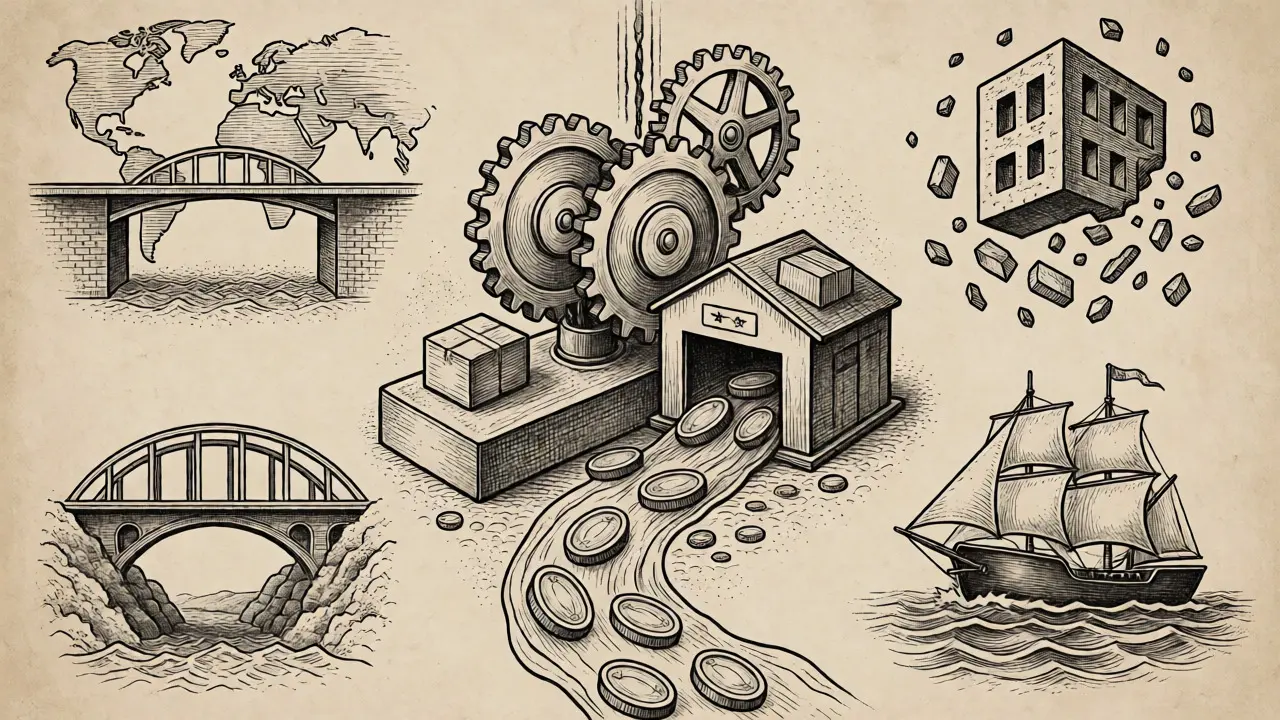
Real-World Implementation: What Works and What Doesn’t
Implementation isn’t plug-and-play. Major financial institutions are experimenting with hybrid models. They aren’t ripping out mainframes; they’re building blockchain layers on top of existing systems.
For example, JPMorgan Chase uses its own private blockchain, JPM Coin, to settle transactions between institutional clients instantly. It’s not public like Ethereum; it’s permissioned, meaning only approved participants can join. This addresses the regulatory concern that public blockchains lack privacy. Similarly, HSBC has used blockchain for trade finance documents, cutting processing time by up to 50%.
However, challenges remain. Integration complexity is high. Legacy banking systems were built in the 1970s and 80s; talking to them requires custom APIs and significant IT overhead. Staff training is another hurdle. Tellers and back-office workers need to understand distributed ledgers, not just code. And then there’s regulation. While the EU’s MiCA framework provides clarity, the US landscape remains fragmented, with the Federal Reserve still navigating how to handle digital assets under current laws.
Blockchain vs. Traditional Banking: A Quick Comparison
To help you decide if this matters for your finances, here’s how the two stacks compare on key metrics:
| Metric | Traditional Banking | Blockchain Banking |
|---|---|---|
| Settlement Time | Days (T+2 or longer) | Seconds to Minutes |
| Intermediaries | High (Correspondent banks, clearinghouses) | Low (Peer-to-peer validation) |
| Transparency | Siloed; limited visibility | Shared ledger; full audit trail |
| Security Model | Centralized (Single point of failure) | Decentralized (Consensus-based) |
| Cost Structure | Fixed + Variable intermediary fees | Lower operational costs per transaction |
The Role of Cloud Providers and DeFi
You don’t need to build a blockchain from scratch anymore. Cloud giants like Amazon Web Services (AWS) and IBM offer "Blockchain as a Service." AWS QLDB, for instance, provides a fully managed ledger database that mimics blockchain properties without the heavy consensus overhead of public networks. This lowers the barrier to entry for mid-sized banks.
Then there’s Decentralized Finance (DeFi). While still niche compared to traditional banking, DeFi platforms allow users to lend, borrow, and trade directly via smart contracts. Some forward-thinking banks are starting to integrate DeFi protocols into their offerings, allowing customers to earn yield on stablecoins or access liquidity pools. It’s early days, but the convergence of TradFi (Traditional Finance) and DeFi is inevitable.
Is Blockchain Banking Right for You?
If you’re an individual investor, you might care about faster transfers and lower fees. If you’re a business owner, the benefits lie in streamlined supply chain finance and instant settlements. The technology is maturing, moving from experimental pilots to production-grade tools.
Keep an eye on regulatory developments. The passage of clear frameworks will accelerate adoption. Also, watch for interoperability standards. Currently, different blockchains struggle to talk to each other. Solutions like Polkadot or Cosmos aim to fix this, creating a unified web of financial ledgers.
Blockchain isn’t going to replace your local branch tomorrow. But it is quietly becoming the backbone of high-value, high-speed financial transactions. Understanding how it works puts you ahead of the curve in a rapidly shifting economic landscape.
Is blockchain banking safer than traditional banking?
Generally, yes, regarding data integrity. Because the ledger is decentralized and immutable, it is much harder to alter transaction history fraudulently compared to a centralized database. However, user error (like losing private keys) remains a risk in non-custodial setups.
Do I need cryptocurrency to use blockchain banking services?
No. Many blockchain banking applications use stablecoins (digital currencies pegged to fiat money like the USD) or operate entirely behind the scenes using private ledgers. You interact with standard currency, but the underlying settlement uses blockchain technology.
How does blockchain reduce cross-border payment costs?
It eliminates the need for multiple correspondent banks. Traditional SWIFT transfers pass through several institutions, each charging a fee and holding funds during reconciliation. Blockchain enables direct peer-to-peer settlement, removing these intermediary fees and speeding up the process.
What is asset tokenization in banking?
Tokenization converts rights to an asset into a digital token on a blockchain. This allows for fractional ownership, meaning investors can buy small portions of expensive assets like real estate or private equity, increasing liquidity and accessibility.
Are smart contracts legally binding?
This depends on jurisdiction. In many places, smart contracts are recognized as valid if they meet standard contract law requirements (offer, acceptance, consideration). However, legal frameworks are still evolving, so complex agreements often include traditional legal wrappers alongside the code.