
Imagine trying to solve a puzzle where the solution changes every time you look at it. That is essentially what Bitcoin miners do millions of times per second. At the heart of this process lies SHA-256, a cryptographic algorithm that secures the entire Bitcoin network. Without it, digital money would be easy to counterfeit and transactions would lack trust. But how does a math formula actually mine coins?
Let's break down exactly how SHA-256 works, why Bitcoin relies on it, and what it means for the future of mining. You don't need a degree in computer science to understand the basics. We will walk through the mechanics, the hardware involved, and the real-world impact of this technology.
What Is SHA-256 and Why Does Bitcoin Use It?
SHA-256 stands for Secure Hash Algorithm 256-bit. It was developed by the National Security Agency (NSA) and published by NIST in 2001. In simple terms, it takes any amount of data-whether it's a single word or an entire book-and converts it into a fixed-length string of characters called a "hash." This hash is always 256 bits long, usually displayed as a 64-character hexadecimal string.
Bitcoin doesn't just use SHA-256 once; it uses it twice. This double-hashing method, known as HASH256, adds an extra layer of security. When Satoshi Nakamoto designed Bitcoin in 2008, he chose SHA-256 because it has three critical properties:
- Determinism: The same input will always produce the same output. If you hash "Hello" with SHA-256, you get the exact same result every time.
- Avalanche Effect: A tiny change in the input creates a completely different output. Change one letter in "Hello," and the resulting hash looks nothing like the first one.
- Preimage Resistance: It is practically impossible to reverse-engineer the original data from the hash. You can see the lock, but you cannot recreate the key.
These features make SHA-256 perfect for securing a decentralized ledger. They ensure that once a transaction is recorded, it cannot be altered without redoing all the work that went into validating it.
The Mechanics of Bitcoin Mining
Mining isn't about digging up physical resources. It is a computational race. Miners compete to find a specific number, called a nonce, that satisfies a difficult mathematical condition. Here is how the process unfolds step-by-step:
- Block Header Creation: Miners gather pending transactions and create a block header. This header includes the previous block's hash, a Merkle root (a summary of all transactions), a timestamp, and the difficulty target.
- Nonce Initialization: The miner sets the nonce value to zero. The nonce is a 32-bit field that acts as the variable in the equation.
- Hashing: The miner runs the block header through the SHA-256 algorithm twice.
- Comparison: The resulting hash is compared against the current difficulty target. The target is a very small number, meaning the hash must start with a certain number of zeros.
- Iteration: If the hash is too high (doesn't have enough leading zeros), the miner increments the nonce by one and tries again. This happens billions of times per second.
When a miner finally finds a nonce that produces a hash below the target, they broadcast the solution to the network. Other nodes verify the solution, and if valid, the block is added to the blockchain. The winning miner receives the block reward plus transaction fees. This mechanism is called Proof-of-Work.
| Component | Size | Function |
|---|---|---|
| Version Number | 4 bytes | Indicates the ruleset used for the block |
| Previous Block Hash | 32 bytes | Links the block to the previous one, ensuring chain integrity |
| Merkle Root | 32 bytes | Cryptographic summary of all transactions in the block |
| Timestamp | 4 bytes | Approximate time when the block was created |
| Bits (Difficulty Target) | 4 bytes | Defines how hard the puzzle is to solve |
| Nonce | 4 bytes | The variable number miners change to find a valid hash |
Hardware Evolution: From CPUs to ASICs
In the early days of Bitcoin, anyone could mine using their laptop's CPU. As more people joined, the competition increased, and the difficulty adjusted upward. General-purpose processors couldn't keep up. Miners moved to Graphics Processing Units (GPUs), which are better at parallel processing.
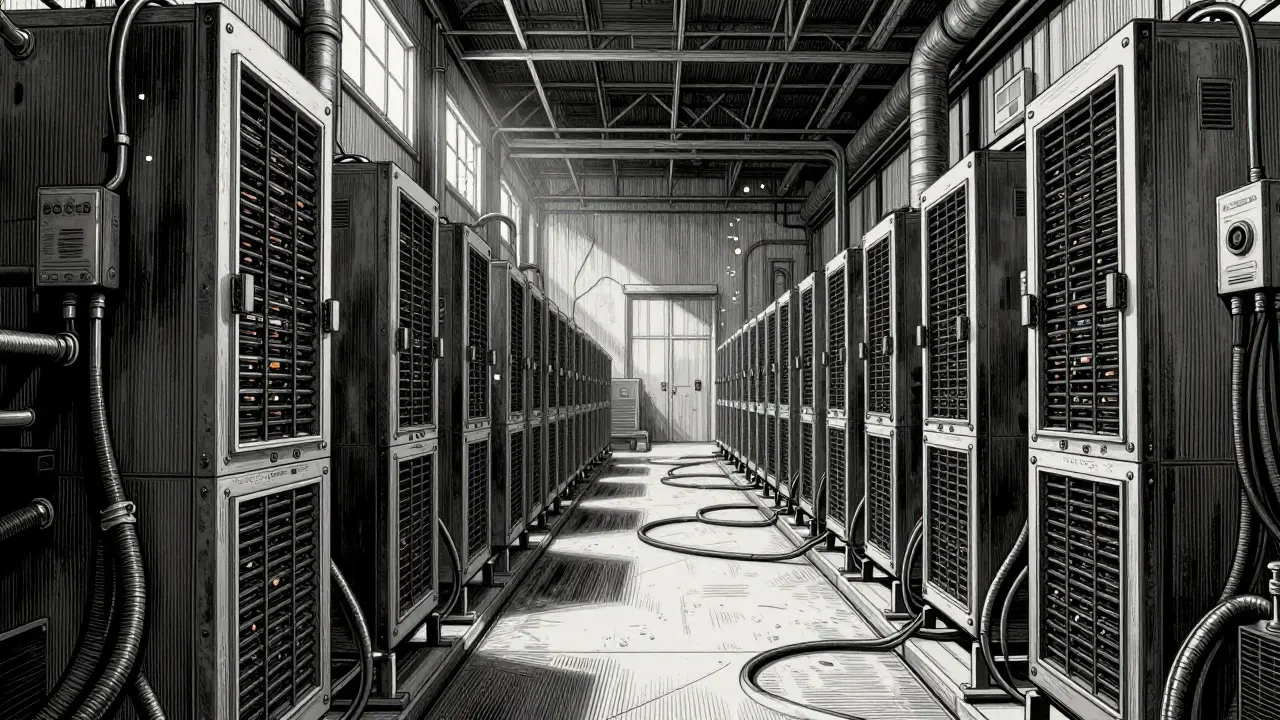
Then came Application-Specific Integrated Circuits (ASICs). These are chips designed solely to calculate SHA-256 hashes. They are incredibly efficient at this one task but useless for anything else. Today, mining with a CPU or GPU is economically unviable. You need industrial-grade ASIC miners like the Bitmain Antminer S21 or Whatsminer M30S++.
This shift has led to significant centralization concerns. Three major mining pools-Antpool, F2Pool, and Viabtc-controlled nearly 60% of the network hash rate in late 2023. While no single entity controls the network, the concentration of power raises questions about decentralization. However, the geographic distribution of miners has improved, with the United States now hosting over 46% of the global hash rate, largely due to favorable energy policies in states like Texas.
Energy Consumption and Environmental Impact
You cannot talk about SHA-256 mining without addressing energy. The proof-of-work model requires massive computational power, which translates to electricity consumption. According to the Cambridge Bitcoin Electricity Consumption Index, the network consumes approximately 121 terawatt-hours annually, comparable to countries like Argentina.
Critics argue this is wasteful. Alex de Vries, founder of Digiconomist, has described it as an unsustainable environmental cost. On the other hand, proponents like Michael Saylor view energy expenditure as a security budget. The energy spent makes attacking the network prohibitively expensive. Furthermore, many mining operations utilize stranded energy sources, such as flared natural gas or excess hydroelectric power, that would otherwise go unused.
The industry is responding to pressure. Newer ASIC models are becoming more energy-efficient. The Antminer S21 Hyd, for example, targets 24 joules per terahash, down from 33.5 J/TH in previous generations. Additionally, regulations like the EU's MiCA framework require proof of sustainable energy usage, pushing miners toward greener solutions.
Future Outlook: Halvings and Long-Term Viability
Bitcoin's protocol is designed to reduce miner rewards over time through events called halvings. The next halving, scheduled for April 2024, will cut the block reward from 6.25 to 3.125 BTC. This reduces revenue by 50% overnight, forcing less efficient miners out of the market.
Will SHA-256 remain viable? Most experts believe so. Galaxy Digital predicts mining will stay profitable through 2030, driven by increasing transaction fees. By 2040, fees may account for 90% of miner revenue. While some advocate for a switch to Proof-of-Stake (like Ethereum), changing Bitcoin's consensus mechanism would require near-unanimous agreement from miners and developers, making it highly improbable in the foreseeable future.
Practical Challenges for Miners
If you are considering entering the mining space, be aware of the hurdles. Profitability depends heavily on electricity costs. With average US rates around $0.055/kWh in Texas versus $0.13/kWh globally, location matters immensely. Hardware obsolescence is another risk; ASICs typically last 18-24 months before becoming uncompetitive. Maintenance is also intensive, requiring regular cleaning, cooling management, and firmware updates.
For beginners, the learning curve spans 3-6 months. You need knowledge of electrical engineering, networking, and cryptocurrency wallet management. Community resources like r/BitcoinMining and Bitcoin Stack Exchange offer valuable support, but success requires careful planning and capital investment.
Can I mine Bitcoin with my home computer?
No, not profitably. Modern Bitcoin mining requires specialized ASIC hardware. Home computers lack the processing power and efficiency needed to compete with industrial farms. Attempting to mine with a CPU or GPU will likely cost more in electricity than you earn in Bitcoin.
Why does Bitcoin use SHA-256 instead of other algorithms?
SHA-256 was chosen for its strong security properties, including collision resistance and preimage resistance. It has been extensively analyzed by cryptographers for decades with no practical vulnerabilities found. Its simplicity and robustness make it ideal for securing a decentralized financial network.
How often does Bitcoin mining difficulty adjust?
The difficulty adjusts every 2,016 blocks, which takes approximately two weeks. The adjustment aims to maintain an average block time of 10 minutes, regardless of changes in the total network hash rate. If more miners join, difficulty increases; if miners leave, it decreases.
Is Bitcoin mining environmentally friendly?
This is debated. Critics point to high energy consumption, while supporters highlight the use of renewable and stranded energy sources. The industry is moving toward greater sustainability, with newer hardware being more efficient and regulations encouraging green energy usage. Many mines now operate in regions with abundant hydroelectric or solar power.
What happens to miners after the next halving?
After the halving, block rewards are cut in half, reducing immediate revenue. Less efficient miners may become unprofitable and shut down, temporarily lowering the network hash rate. Over time, the difficulty adjusts downward, allowing remaining miners to stabilize profits. Long-term viability will depend on transaction fee growth and continued adoption.

It's fascinating how we've moved from guys mining on their laptops in basements to industrial farms burning more power than small nations. The tech evolution is wild, but the centralization aspect keeps me up at night. 🤔
The article misses the mark on why SHA-256 was chosen. It wasn't just about security; it was about simplicity and accessibility at the time. Satoshi wanted something anyone could verify with basic hardware initially. Now that ASICs dominate, the 'democratization' argument falls apart, but the underlying math remains bulletproof. We need to look at the long-term viability of PoW vs PoS debates without getting too emotional about energy usage.
You see the neon glow of the hash rate climbing higher, a digital ouroboros eating its own tail in an endless loop of futility. We are not mining coins; we are mining entropy, casting our computational souls into the void hoping for a mathematical blessing. The avalanche effect is not just a property of the algorithm; it is a metaphor for the fragility of our perceived order. One bit flips, and the entire world changes. Beautiful, terrifying, utterly pointless. 🌪️
This whole narrative is designed to make you feel smart for understanding a hashing function while you ignore the elephant in the room. You think knowing what a nonce is makes you part of the revolution? No. It makes you a consumer of technical jargon. The real story isn't the math; it's the control. And pretending otherwise is naive.
About damn time someone wrote this clearly. While Europe whines about carbon footprints, American miners are securing the financial backbone of the future using stranded energy in Texas. This is economic patriotism. We build, they complain. Simple as that.
Your conflation of 'stranded energy' with sustainability is intellectually lazy. The lifecycle analysis of ASIC manufacturing alone negates any marginal gains from flared gas utilization. Furthermore, the assertion that preimage resistance guarantees network security ignores the quantum threat horizon entirely. If you are not discussing post-quantum cryptography in the context of SHA-256 longevity, you are merely repeating marketing copy. The industry is built on sand, regardless of your ideological attachment to Proof-of-Work.
There is a profound silence in the hum of those servers, a meditation on value itself. We have created a machine that measures trust through suffering-computational suffering, yes, but suffering nonetheless. Is it ethical? Perhaps. Is it beautiful? Undoubtedly. I find myself drawn to the idea that truth can be forged through sheer brute force. It resonates with something primal in us. 🌌
I must interject regarding the halving section. Your explanation of the difficulty adjustment mechanism is slightly oversimplified. It does not happen instantaneously upon the halving event; rather, it adjusts based on the actual hash rate observed over the preceding two-week period. This nuance is critical for understanding short-term market volatility versus long-term protocol stability. Please ensure your sources reflect this temporal lag accurately. 😊