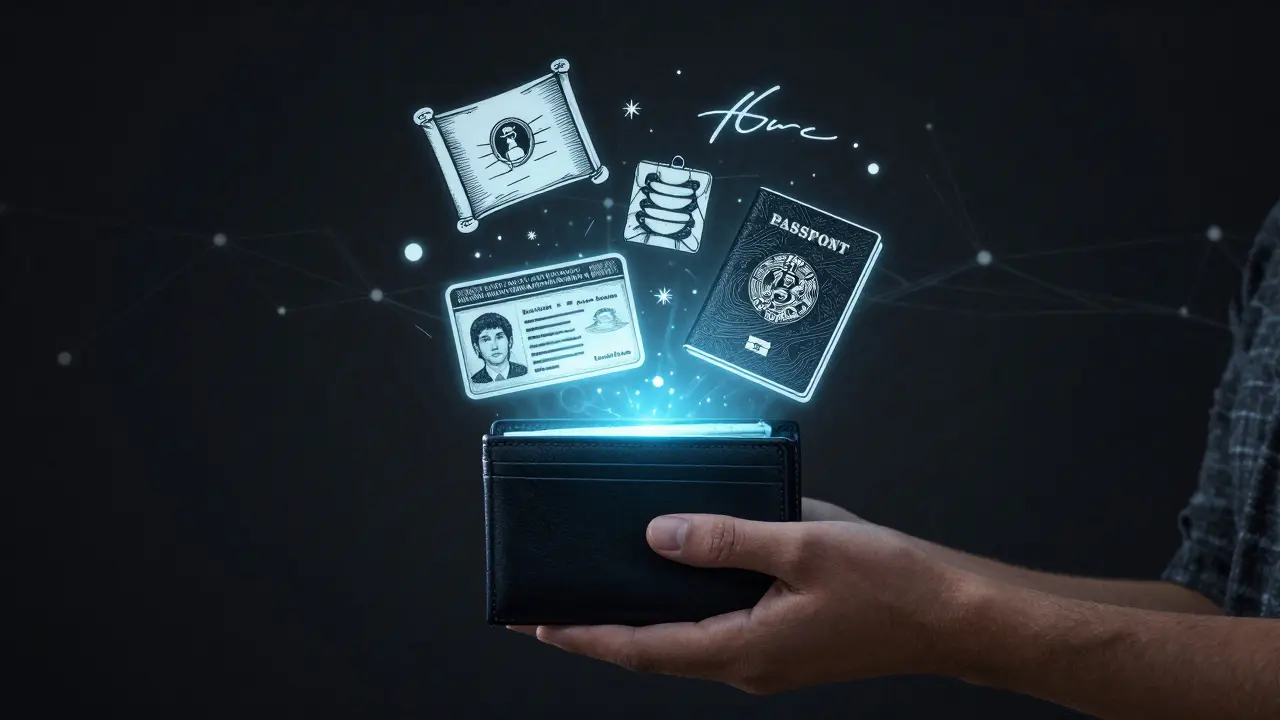
Imagine you could prove you’re over 21 without showing your driver’s license. Or verify your college degree without sending your transcript to a third party. No passwords. No central databases. Just a digital proof you control - and anyone can check, instantly, without asking you for more than what’s necessary. That’s what verifiable credentials with DID make possible.
What Exactly Are Verifiable Credentials and DIDs?
A verifiable credential (VC) is a digital version of a physical credential - like a diploma, passport, or license - but it’s cryptographically signed and impossible to fake. It’s not just a PDF you download. It’s a tamper-proof digital statement issued by a trusted source, like a university, government, or employer. And it’s linked to a decentralized identifier (DID), which is your unique digital address that doesn’t depend on any company or government to exist. Think of it this way: Your DID is like your digital fingerprint. It’s a string of characters generated using public-key cryptography, stored on a decentralized network (not a single server), and tied to your identity. The credential itself - say, your nursing license - is stored in your personal digital wallet. When you need to prove you’re licensed, you don’t send the whole document. You send a cryptographically signed proof that says, "I am a licensed nurse," without revealing your name, birthdate, or Social Security number. This isn’t theory. The W3C Verifiable Credentials Data Model v2.0 is the global standard that defines how these credentials are structured, issued, and verified. It’s backed by governments, universities, and tech giants because it solves a real problem: we’re still using 20th-century identity systems in a 21st-century digital world.How the System Works: Three Players, One Flow
There are only three roles in this system:- Issuer: The organization that creates the credential. Could be a university, a city hall, or a company.
- Holder: The person or entity that owns the credential. That’s you.
- Verifier: The party that needs to check the credential - like an employer, airline, or online service.
- You get a verifiable credential from your university. It’s issued to your DID, stored in your digital wallet.
- You apply for a job. The employer asks for proof of your degree.
- You open your wallet, select the credential, and send a presentation. This isn’t the full credential - it’s a proof that says, "This person holds a Bachelor’s in Computer Science from XYZ University, issued on January 15, 2024."
- The employer’s system checks the digital signature, confirms the DID is valid, and verifies the credential hasn’t been revoked. Done. No email to the registrar. No waiting.
Why DIDs Are the Secret Ingredient
Traditional digital IDs rely on usernames, emails, or social logins. That means companies like Google, Facebook, or LinkedIn control your identity. If they change their rules, delete your account, or get hacked, you lose access. DIDs fix that. A DID is:- Decentralized: Not owned by any company. Generated on your device.
- Portable: Works across apps, services, and platforms.
- Verifiable: Anyone can check its authenticity using public cryptography.
- Resumable: Even if the issuer goes out of business, your DID and credential still work.
did:key, did:web, did:ion - each using different networks. Some use blockchain (like Ethereum or Polygon), others use peer-to-peer networks or HTTP-based systems. The key point? You choose which method to use, and you can switch later. No lock-in.
A DID Document - linked to your DID - contains public keys, service endpoints, and verification methods. It’s like your digital business card. Anyone can look it up to confirm who you are, without needing to contact a central authority.

How Privacy Is Built In - Selective Disclosure and Zero-Knowledge Proofs
One of the biggest wins with VCs isn’t just security - it’s privacy. You don’t have to share everything to prove something. Let’s say you want to rent a car. The company needs to confirm you’re over 25. With traditional systems, you’d hand over your ID - which shows your full name, address, birthdate, photo, license number. With VCs, you can use a zero-knowledge proof (ZKP) to say: "I am over 25," without revealing your birthdate, name, or anything else. Even without ZKPs, the system supports selective disclosure. You can choose which claims to reveal. Your credential might contain:- Name
- Birthday
- License number
- Issuing authority
- Expiry date
Where This Is Already Being Used
You might think this is still experimental. But it’s live.- Academic credentials: Universities like MIT and the University of Nicosia issue diplomas as VCs. Employers verify them in seconds.
- Travel and border control: The EU is testing digital passenger passports using VCs. No more paper boarding passes or ID scans.
- Healthcare: Patients can prove vaccination status or immunization history without exposing their full medical record.
- Employment: Companies like Microsoft and IBM use VCs for employee onboarding. New hires verify degrees, certifications, and work history without paperwork.
- Online communities: Discord servers and DAOs use VCs to grant access based on verified membership - say, "You’ve attended 3 community events" - without asking for your real name.
VCs vs. NFTs: What’s the Difference?
People often confuse verifiable credentials with NFTs. They’re not the same. NFTs are unique tokens on a blockchain. They’re often used for art, collectibles, or access passes. But they’re not designed for identity. An NFT can’t be revoked. It can’t be selectively disclosed. And it doesn’t follow the W3C standard. VCs are designed for identity. They’re cryptographically signed, revocable, and portable. They follow strict data models. They’re meant to be checked, not traded. That said, some projects are combining them - for example, an NFT that contains a VC inside it. But the VC part still follows W3C rules. The NFT part just acts as a container. Think of it like a physical certificate inside a framed display. The frame isn’t the certificate.
Challenges - Why This Isn’t Everywhere Yet
The tech works. But adoption is slow.- Wallets are clunky: Most digital wallets for VCs are still in beta. They’re hard to use for non-tech people.
- Issuers are hesitant: Governments, schools, and companies are used to controlling data. Letting users own their credentials means giving up power.
- Interoperability gaps: Not all systems speak the same language. A credential issued on one DID method might not work on another.
- Revocation is tricky: How do you cancel a credential if someone loses their private key? Solutions like status lists and blockchain anchoring exist, but they’re not yet universal.
The Future: More Control, Less Friction
In the next 5 years, we’ll see:- VCs built into operating systems - iOS, Android, Windows - like biometrics.
- Government-issued digital IDs replacing physical passports and driver’s licenses.
- Healthcare systems using VCs to share medical records securely between providers.
- Zero-knowledge proofs becoming standard for age verification, credit checks, and background screenings.
What You Can Do Today
You don’t need to wait for a government to issue you a VC. Start experimenting:- Try TrustBloc or Animo to create a test DID and credential.
- Look for universities or employers offering digital diplomas or certifications as VCs.
- Use a wallet like uPort or Sovrin to store your first credential.
Are verifiable credentials stored on blockchain?
No, not necessarily. Verifiable credentials are stored in your personal digital wallet - not on a blockchain. What’s stored on blockchain (if anything) is the DID and its public key, or a reference to the credential’s revocation status. The credential itself - your diploma, license, or ID - stays off-chain. This keeps it private and efficient. Blockchain is only used for anchoring trust, not storing data.
Can I lose my verifiable credentials?
You can lose access if you lose your private key and don’t have a backup. That’s why wallet providers now offer recovery options like social recovery, multi-sig backups, or encrypted cloud backups. Unlike physical documents, you can’t just replace a lost VC - you need to reissue it. That’s why backup and recovery are critical parts of using VCs.
Who issues verifiable credentials?
Anyone can issue them - universities, employers, governments, even individuals. The key is trust. The verifier must recognize the issuer’s DID and public key. For example, a university’s DID might be registered in a public registry. Once trusted, its credentials can be verified globally. This is different from traditional systems where only approved agencies can issue credentials.
Do I need a blockchain wallet to use verifiable credentials?
Not always. While some wallets use blockchain to store DIDs, others work over HTTP or peer-to-peer networks. You can use a VC with a simple app that doesn’t involve crypto at all. What matters is the cryptographic signature and DID verification - not whether the underlying network is blockchain-based.
Are verifiable credentials legal?
Yes, in many jurisdictions. The EU’s eIDAS regulation already recognizes digital identities based on W3C standards. The U.S. National Institute of Standards and Technology (NIST) endorses decentralized identity for federal systems. Countries like Japan, Canada, and Australia are piloting government-issued VCs. Legality depends on how they’re used - but the technology itself is compliant with global digital identity frameworks.
Let’s be real - this whole ‘decentralized identity’ thing is just capitalism repackaging surveillance as liberation. You think you’re in control? You’re just trading your data to a new set of gatekeepers - the ones who run the DID registries and verify the cryptographic signatures. Who audits them? Who’s to stop a ‘trusted issuer’ from blacklisting you? It’s not freedom. It’s just a more elegant version of being locked out of your own life because some algorithm decided you’re ‘risky’.
Okay but imagine this: you’re 23, you got your degree, you apply for a job, and the employer’s system says ‘credential revoked.’ Why? Because your university’s DID got hacked. Or because they changed their mind. Or because someone in IT deleted the wrong file. Now you have to beg for a reissue. No one’s talking about the emotional toll of this. What if you’re homeless? What if you lost your phone? What if you’re just bad with tech? This isn’t progress - it’s a luxury for people who already have access to five backup systems and a therapist who helps them recover their private keys.
I love how this is being framed as ‘privacy’ - but in India, we’ve seen digital IDs used to deny people food, healthcare, and housing because their biometrics didn’t match. So when you say ‘no central database,’ I hear ‘no accountability.’ If the issuer goes out of business, sure, your credential still works - but who do you call when you’re denied a loan because the verifier’s system says ‘DID invalid’? No one. And that’s terrifying. I’m all for innovation, but let’s not pretend this doesn’t replicate the same power imbalances - just with more blockchain.
Oh wow, so now we’re supposed to trust a string of random characters more than a physical ID? Cool. And when your DID gets compromised because you clicked a phishing link disguised as ‘Verify Your Credential,’ who fixes it? The blockchain? The wallet app? Your ex? This isn’t empowerment - it’s just giving everyone a new way to accidentally delete their entire digital life. Also, zero-knowledge proofs? That’s like saying ‘I’m 25’ without showing your birthday… while blindfolded. How do I know you’re not lying? You don’t. And that’s the whole point - trust is dead. Welcome to the future.
They’re calling this ‘privacy’? Funny. The moment you use a VC, you’re creating a permanent, immutable, cryptographically signed trail of every single thing you’ve ever proven. That’s not privacy. That’s a blockchain-backed dossier. And guess who controls the verification logs? The same corporations that built the wallets. You think you’re free? You’re just a node in a new surveillance grid. They’re not removing centralization - they’re just making it harder to see. And the people who benefit? Not you. Not me. The ones who sell the infrastructure.
Let’s not pretend this isn’t a crypto bros’ fantasy dressed up as public policy. The W3C standard? It’s just a fancy stamp on a scam. You want to know why governments are adopting this? Because it lets them track you without being accountable. ‘Oh, the credential is yours!’ Sure. But the DID registry? Owned by a consortium of tech giants. The revocation list? Centralized. The service endpoints? Monitored. You’re not owning your identity. You’re leasing it from a corporation that just renamed itself ‘Web3.’
It is of paramount importance to recognize that the ontological underpinnings of decentralized identity systems are predicated upon a fundamental epistemological shift in the relationship between the sovereign individual and institutional authority. While proponents assert autonomy, the structural reliance upon cryptographic verifiability inevitably reifies a new class of technocratic gatekeepers - whose authority, though distributed, remains unchallenged by democratic mechanisms. The notion of ‘user control’ is, therefore, a semantic illusion, wherein agency is algorithmically constrained within pre-approved ontological frameworks. One must ask: is liberation truly liberation if it is only permissible within the boundaries of the system’s own design?
Why is this even a thing? Just use a password. Or a fingerprint. Or your face. It works fine. People are overcomplicating everything. I don’t want to manage a DID. I don’t want to back up keys. I just want to log in. This is tech for tech’s sake. And the people pushing it? They don’t even use it. They’re just talking about it on Twitter.
From an interoperability standpoint, the adoption of verifiable credentials aligned with the W3C Data Model v2.0 enables unprecedented composability across identity ecosystems - particularly when leveraging DID methods such as did:web and did:ion, which facilitate HTTP-based resolution without blockchain dependency. This architecture permits seamless credential presentation via portable wallets that abstract cryptographic complexity, thereby reducing friction in verifiable attestation flows for enterprise, academic, and public sector use cases. The key differentiator lies in the separation of issuance, storage, and verification layers - a paradigm shift from monolithic identity silos toward user-centric, cryptographically verifiable assertion chains.